In this article, you will read about:
Date and Timing of Adhika Jyeshtha Amavasya 2026
Spiritual Significance of Adhik Maas Jyeshtha Amavasya
Rituals and Practices on Adhik Jyeshtha Amavasya
Guru Transit, Ma Tara’s Grace, and Jyeshtha Adhika Amavasya
Worship Ma Tara on the Tantra Sadhana App
Adhik Jyeshtha Amavasya is when 2 spiritually powerful windows meet: Jyeshtha Amavasya, the night of dissolution and return to the Source, and Adhik Maas, the extra lunar month that stands outside the ordinary flow of time.
To help Shakti Upasaks make the most of this precious alignment, the Secret Shrine will appear in the Tantra Sadhana app, allowing them to worship Ma Tara.
Date and Timing of Adhik Jyeshtha Amavasya 2026
Date: 14-15 June (Sun-Mon)
Timing: 12:19 PM (Sun, 14 June) to 8:23 AM (Mon, 15 June)
Spiritual Significance of Adhik Maas Jyeshtha Amavasya
The combination of Adhik Maas, the month of Jyeshtha, and Amavasya creates a very potent period for spiritual growth. Unlike festivals that celebrate manifestation and abundance, Jyeshtha Adhik Amavasya invites the seeker inward, into the womb-like darkness from which all creation emerges.
Importance of Adhik Maas in Sanatan Dharma
The scriptures describe Adhik Maas as a sacred interval inserted into the lunar calendar to harmonise solar and lunar cycles. Over time, it came to be regarded as a period especially suited for spiritual disciplines.
The glory of Adhik Maas is praised in the Purushottam Mahatmya:
māsānāṁ puruṣottamo'smi |
"Among months, I am Purushottam."
Adhik Maas is often described as a period when worldly pursuits are temporarily set aside, and spiritual efforts receive multiplied results.
Why Amavasya Is Important in Tantra
In Tantra, Amavasya isn’t viewed negatively as darkness. Darkness is considered the primordial womb of creation.
On Amavasya, that hidden power withdraws from outer expression and becomes more accessible through inward contemplation.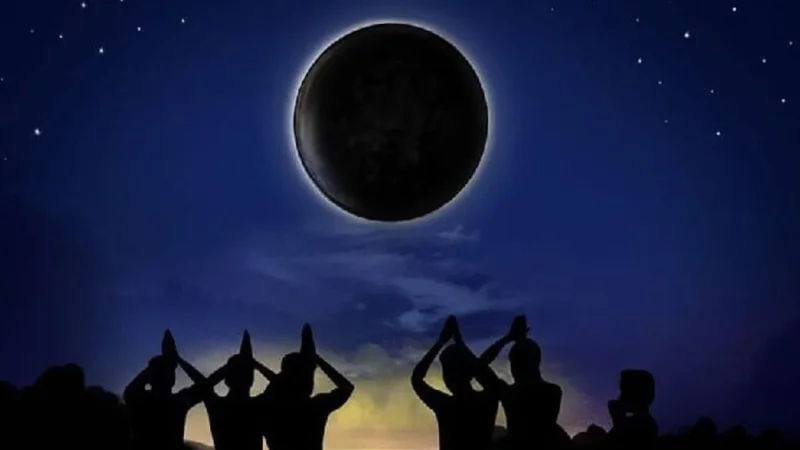
About Jyestha: The Hindu Month of Spiritual Fire
Jyestha falls during the peak summer when the earth is scorched by heat. Tantric symbolism sees this heat as Tapas, the fire of spiritual transformation.
The Kularnava Tantra repeatedly emphasises the necessity of inner purification through spiritual effort:
na tapasā samaṁ tīrthaṁ na tapasā samaṁ balam |
"There is no pilgrimage equal to Tapas and no strength equal to Tapas."
The burning heat of Jyestha becomes an external reflection of the inner fire required for spiritual growth.
What Makes Adhik Jyeshtha Amavasya Special in Tantra
In Tantra, creation begins in silence and ends in silence.
Jyestha Adhika Amavasya represents a rare meeting of 2 sacred voids in Jyeshtha:
Adhik Maas: a gap in the cycle of months
Amavasya: a gap in the cycle of lunar light
Together, they create a powerful symbol of returning to the Source, the Mother Goddess.
The seeker is invited to withdraw by turning:
Speech into silence
Mind into awareness
Awareness into the Heart
The Heart into the Divine Mother
Rituals and Practices on Adhik Jyeshtha Amavasya
The Five Voids and Jyestha Amavasya
The Vijñana Bhairava Tantra teaches meditation upon the inner voids:
śikhipakṣaiścitrarūpairmaṇḍalaiḥ śūnyapañcakam |
dhyāyato'nuttare śūnye praveśo hṛdaye bhavet ||"Meditating upon the five voids appearing as radiant circles of many colours, one enters the Supreme Void within the Heart."
— Vijñana Bhairava Tantra, Verse 32
This teaching is especially relevant to Amavasya.
The outer moon disappears. The mind becomes quieter. The seeker turns toward the inner sky of consciousness. The goal is not darkness but entry into the Supreme Void, the Mahashunya that is full of awareness.
Ancestors and Karmic Debts
Traditional Hindu observances associate Amavasya with ancestors.
The Garud Puran states:
tilairdarbhairjalaiḥ śrāddhaṁ pitṝṇāṁ tṛptikārakam |
"Offerings made with sesame, sacred grass, and water satisfy the ancestors."
On Amavasya nights, Tantric practitioners therefore combine:
Pitru Tarpan
Pind Daan
Ancestor remembrance
Mantra Jap
Worship of the Divine Mother
Through these spiritual practices, they not only express gratitude toward their ancestors but also strive to purify hereditary impressions (samskaras), karmic bonds, and subtle debts.
Vat Savitri Vrat and Nirjala Vrat
The Vat Savitri Vrat is a fast observed by married women for their husband’s longevity on Jyeshtha Amavasya.
The Vrat is named after Savitri—the legendary woman known for her courage, wisdom, and dedication—and the Vat Vriksh (banyan tree), which symbolises longevity and stability
Married women worship the banyan tree, tie sacred threads around it, and recite the Savitri-Satyavan story for their husband’s long life.
Jyeshtha Amavasya is also known as Nirjala Amavasya. The Nirjala Vrat is observed by fasting without water at the peak of summer. Tapas (austerity) is one of the foundational disciplines for spiritual progress in Sanatan Dharma.
Nirjala Vrat (meaning waterless fast) in the hottest time of the year is an act of intense Tapas. It is considered an offering of one’s bodily comfort to the Divine, earning spiritual merit in proportion to the sacrifice.
Guru Transit, Ma Tara’s Grace, and Jyeshtha Adhik Amavasya
Ma Tara’s Connection to Amavasya
Though Amavasya is dark externally, Ma Tara teaches that the inner light never disappears.
A well-known verse about Her declares:
tāriṇī durgatisaṁsārasāgarasya |
"She who carries beings across the difficult ocean of worldly existence."
— Tara Tantra traditions
For this reason, many practitioners combine Ma Tara’s Mantra Jap with Amavasya observances, seeking guidance through periods of uncertainty and transformation.
In Tantra, Ma Tara is not merely a Goddess of Protection. She is the Guru-Shakti Herself—the power that transforms sound into wisdom and wisdom into liberation.
Why Ma Tara Should Be Worshipped During This Rare Alignment
From a traditional Tantric perspective, the convergence of Jyeshtha Adhik Amavasya with the recent transit of Guru (Brihaspati or Jupiter) into Cancer (Kark) creates a suitable landscape for the worship of Ma Tara, the 2nd Mahavidya.
Jupiter entered Cancer, its sign of exaltation, on 2 June 2026—a position considered especially strong and auspicious in Vedic astrology.
Each Mahavidya is associated with a planet from the Navgrahas, and Ma Tara is naturally connected with Guru.
In many Tantric traditions, Ma Tara is regarded as:
The Mother of Mantras
The Revealer of Divine Speech
The Wisdom Power behind Guru
The Deliverer across the Ocean of Samsara
Guru represents:
Knowledge
Wisdom
Spiritual guidance
Revelation of higher truth
Thus, Guru and Ma Tara operate through the same principle:
That which guides the soul from darkness to illumination.
Ma Tara is not merely intellectual wisdom.
She is:
Compassionate wisdom
Rescuing wisdom
Motherly wisdom
Thus, Guru entering Cancer symbolically resembles “Wisdom entering the heart.”
And Goddess Tara is precisely the Mahavidya who transforms knowledge into living realisation.
In Sri Vidya, the lunar digits gradually withdraw into the Bindu during Amavasya. The fifteen kalas return to their source. Guru signifies divine knowledge. Tara signifies divine sound.
When knowledge (Guru) and sound (Ma Tara) unite during the dark moon, the practitioner is invited toward:
Inner Mantra
Silent Jap
Meditation on the void
Listening to the unstruck sound (Anahat Naad)
Thus, Adhik Jyeshtha Amavasya becomes not merely a night of ritual but a night of listening to the Guru within.
Worship Ma Tara on the Tantra Sadhana App
The Tantra Sadhana app offers all devotees of the Divine Mother a structured and accessible way to attain the grace of the Das Mahavidyas (10 Wisdom Goddesses of Tantra).
Created by the Himalayan monk, Om Swami, the app is entirely based on the Tantric path of Divyachar, where no physical ingredients or apparatus are used. All offerings are made mentally, or in this case, visualised in the form of 3D graphics on an interactive screen to make the process immersive.
Each Mahavidya is invoked in a separate virtual world over a specified number of days through Her Tantric Mantra Jap, Yagna, and Sadhana, all of which were mastered by Om Swami before creating the app.
Users hear all the awakened chants in His voice and perform rituals coded into the app from start to end, so the guidance of a personal Guru is not required. Being free of cost and ad-free, the app is accessible to everyone who has a smartphone or tablet and is interested in exploring Tantra.
Sadhaks can offer Dakshina voluntarily at any time.
Ma Tara’s Secret Shrine
The Secret Shrine is a special world in the Mahavidya realm of the app. Unlike the 10 worlds of the Das Mahavidyas, it appears only on special occasions that are relevant to any of the Mahavidyas, such as the Navratris and their Jayantis.
The purpose of this Shrine is to give all Sadhaks a chance to invoke the nurturing and purifying presence of the Mahavidya of the day through simple rituals like the recitation of their awakened Dhyan Shlok (also in Swamiji’s voice).
It is accessible to all users, including those who haven’t even begun their main journey on the app.
This Adhik Maas Jyeshtha Amavasya, Ma Tara’s Secret Shrine will appear in the app, offering Shakti Upasaks a guided way to chant Her Dhyan Shlok and perform Her Tantric Yagna.
Users get to decide the number of repetitions as per their availability and can return to the Shrine to perform the rituals again as many times as they want.
Date & Time of Secret Shrine:
7 AM (Sun, 14 June) to 11 AM (Mon, 15 June)
May Ma Tara’s blessings awaken the voice of your inner Guru for intuitive guidance on the spiritual path ahead.