In this article, you will read about:
Dates, Timings, and Darshan System of Ambubachi Mela 2026
History and Story of Ambubachi Mela
Spiritual Significance of Ambubachi Mela: Why It Is Celebrated
Geological Reason: Why the Water Turns Red During Ambubachi Mela
Rituals and Practices at Ambubachi Mela and Planning Your Trip
Special Worship on Tantra Sadhana App
Ambubachi Mela is the biggest 4-day festival celebrated every year at the Kamakhya Temple in Guwahati, Assam. Devotees of Goddess Kamakhya gather at the temple to celebrate Her annual menstrual cycle, which symbolises fertility and creation.
Goddess Kamakhya is closely associated with the Das Mahavidyas of Tantra and is identified with Ma Tripura Sundari. Therefore, Ma Tripura Sundari's Secret Shrine offers all users of the Tantra Sadhana app an opportunity to worship Her directly during the period of Ambubachi Mela.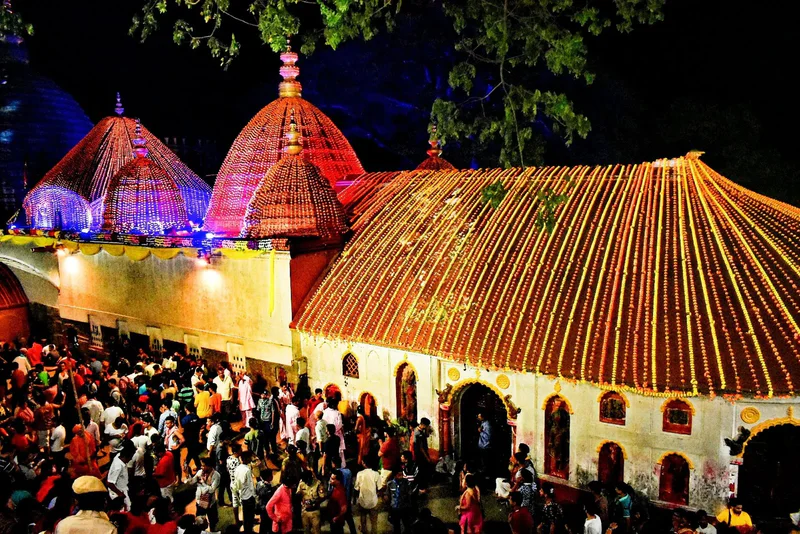
Dates and Timings of Ambubachi Mela 2026
As per the Assamese/Bengali calendar, Ambubachi Mela is celebrated in the month of Ashara (June).
Ambubachi Mela 2026: 22 June (Mon) to 26 June (Fri)
Festival Schedule
June 22 (Mon): The temple priests perform Pravritti (commencement) rituals in the morning. The festival begins as the main temple doors are closed for 3 days and 3 nights.
June 23, 24, 25 (Tue, Wed, Thu): The temple doors remain closed as Ma Kamakhya is believed to be menstruating during this period.
June 26 (Fri): The temple priests perform Nivritti (conclusion) rituals in the morning. The main temple doors reopen to devotees for Darshan.
Darshan System During the Ambubachi Festival
While the temple normally sells Special Darshan (VIP) passes for ₹501 to cut down waiting times, all VIP Darshan passes and special privileges are suspended during the Ambubachi Mela.
Everyone must stand in the same general public queue on reopening day, which is quite long because of the millions of people arriving. Wait times in the queue, therefore, can last anywhere from 6 to 12 hours.
Can’t make it to the Ambubachi Mela this year? You can still make the most of this auspicious period by invoking the creative energy of Ma Tripura Sundari at home.
Also known as Kameshwari (the Tantric Goddess of Desire), She is none other than Goddess Kamakhya Herself!
History and Story of Ambubachi Mela
The ancient, annual festival of Ambubachi Mela is celebrated only at the Kamakhya Temple, situated on the sacred Nilachal Parvat (Nilachal Hill) in Guwahati, Assam. Locally, it is known as “Amoti” or “Ameti”.
The geography of the Nilachal Hill itself is steeped in esoteric significance. It is poetically described across classical Tantric literature and local oral traditions as possessing a distinct reddish or vermilion-like hue.
This visual attribute is profoundly linked to Rajas (the cosmic principle of activity and passion), fertility, and the creative life-force of the Divine Mother.
The Descent of the Peeth
According to scriptural lore, Kamakhya Devi Temple is revered as one of the most prominent Shaktipeeths in India. Its scriptural origin traces back to the destruction of King Daksh’s Yagna, where Devi Sati's Yoni Pind (cosmic womb/genital organ) fell to Earth following Lord Shiva's grief-driven dance of destruction.
The falling of this specific limb established the site as the primary nucleus of cosmic manifestation and fertility.
The Kalika Puran explicitly defines this sacred geography:
yoni stambhaṃ jagat sarvaṃ yasyāṃ utpattihetavaḥ।
tasyāṃ pūjyatame deśe kāmarūpe nivāsinī॥"The Yoni upholds the whole universe; it is the source of all birth. In that most sacred land resides Kamakhya."
Etymology and Philosophical Roots
The etymological structure of the word "Kamakhya" breaks down into 3 foundational root words, which delineate its primordial nature:
Ka: Represents the feminine gender, indicating the Absolute Source of Nature (Prakriti).
Mai: Signifies the Universal Mother.
Kha: Denotes the act of Srijan—creation, manifestation, or birthing.
Thus, Kamakhya stands as the physical space where the Goddess is present explicitly as the Divine Mother of the Universe. The inner sanctum (Garbhagriha) lacks any anthropomorphic idol or conventional stone statue.
Instead, worship centres entirely around the Yonipeeth—a natural Svayambu Shila (a self-manifested stone cleft) nestled within a dark, cave-like subterranean structure.
This sacred stone cleft is nourished by a continuous underground spring water stream, maintaining a perpetual moisture that symbolises the eternal creative pulse of the Goddess.
Spiritual Significance of Ambubachi Mela: Why It Is Celebrated
The festival's name is derived from the words “Ambu,” meaning water, and “Bachi,” meaning flowing.
Its underlying philosophy shatters ordinary social assumptions and standard mundane practices. While many global cultures historically treat menstruation with taboo, isolation, or notions of impurity, the Shakta Tantra tradition completely inverts this paradigm.
At Kamakhya Devi Temple, the menstrual cycle is celebrated as the absolute pinnacle of cosmic purity, transformation, and Divine creative energy.
Scriptural Validation of the Creation Principles
The foundational concept of Nature as the cosmic womb, while Consciousness is the seed-giver, is heavily reinforced in the Bhagavad Gita:
sarvayoniṣu kaunteya mūrtayaḥ sambhavanti yāḥ।
tāsāṃ brahma mahadyonirahaṃ bījapradaḥ pitā ।।"O son of Kunti, whatever physical forms are brought forth within any womb, the Great Brahma (Mahat Brahma / Prakriti) is the birthing Mother, and I am the seed-giving Father."
— Bhagavad Gita (Chapter 14, Verse 4)
This scriptural decree aligns directly with the core philosophy of the Ambubachi Mela: Prakriti is the Universal Mother who births the physical Universe, while Purush, or Ishwar, infuses the seed of Consciousness into that sacred womb.
Why the Temple Remains Closed for 3 Days
The core of the observance revolves around the Rajaswala Avastha—the annual menstruation period of Goddess Kamakhya. Every year during this specific monsoon window, the Goddess is believed to undergo Her yearly menstrual cycle.
Suspension of Rituals: For 3 full days, the heavy doors of the sanctum sanctorum are completely sealed.
Absence of Public Activity: All regular public worship (Pooja), visual Darshan, and external offerings are suspended.
Period of Rest: The Goddess enters a period of sacred withdrawal and rest. Outside the closed doors, the standard outer rituals dissolve into an overarching environment of deep inner stillness and pure devotion.
The Significance of the Sacred Red Cloth
When the temple reopens amid immense spiritual fervour on the 4th day, the transition from restfulness to active manifestation is complete. Devotees gather to receive 2 distinct, highly sought-after forms of Prasad:
Angodak: The sanctified spring water that flows from the Yonipeeth, charged by the specific energy of these days and turned red in colour, like the water of the River Brahmaputra near the Nilachal Hill.
Angavastra (or Rakta Vastra): A sacred piece of white cloth that turns red due to its contact with the water, after being placed over the natural stone cleft during the 3 days the doors remain closed.

In Tantric symbolism, the redness of this cloth, too, is directly associated with the cosmic Rajas—the fiery, active, dynamic, and transformative Feminine principle. It represents the life force, the cosmic egg or womb (Brahmand), the capacity for absolute manifestation, and the deep mystery of biological and cosmic birth itself.
Agricultural and Seasonal Significance
The timing of the Ambubachi Mela is inextricably linked to the natural cycles of the macrocosm.
Monsoon Alignment: The festival starts precisely when the heavy monsoon clouds gather over Assam, and the Brahmaputra River swells with rainwater.
Fertilisation of the Earth: In Assamese agricultural traditions, the Earth itself is viewed as a living, breathing entity that undergoes a parallel period of menstruation and heightened fertility during these rains.
Renewal of Capacity: The 3-day rest period is seen as the vital pause before the earth's generative and agricultural capacity is completely renewed. Nature enters its most creative phase, ensuring that the soil is fertile enough to sustain upcoming crop cycles.
Geological Reason: Why the Water Turns Red During Ambubachi Mela
A fascinating phenomenon during this period is that the waters of the mighty Brahmaputra River visibly turn deep red.
While esoteric lineages view this as a literal reflection of the living body of the Goddess, there is an established geological reason behind it:
Mineral Composition: The Nilachal mountain range contains highly dense underground deposits of Kamiya Sindoor (natural cinnabar) and ferric oxide.
Chemical Blueprint: Cinnabar is a brilliant vermilion-coloured mineral ore composed of Mercuric Sulfide (HgS).
Monsoonal Churning: When the first powerful flushes of the monsoon arrive, the torrential rainwater penetrates the subterranean layers. This process vigorously churns up the sedimented minerals, mixing them with the local soil and water streams.
Visual Result: The resulting runoff discharges directly into the Brahmaputra River, turning the water into a dark, blood-red hue that mimics the blood of menstruation.
Ambubachi Mela 2026: A Video Overview
Planning Your Visit: How to Reach Ambubachi Mela
The Kamakhya Temple is located on the Nilachal Parvat (hill) in Guwahati, Assam. Here is how you can get there:
Air: Fly to Guwahati Airport (GAU), which is 20 km away from the Nilachal Hill, and then take a taxi.
Rail: Board the train to Kamakhya Station (6 km away) or Guwahati Station (8 km away), and then take an autorickshaw or cab.
Road: Take a bus or drive via NH 27/17 to Guwahati’s Inter-State Bus Terminus (16 km away).
Note: During the Ambubachi Mela, private vehicles are banned on the temple hill, so you will have to walk up the hill steps or use official government shuttle vans from the base of the hill.
Accommodation, Weather and Food
Accomodation
Because the festival attracts lakhs of pilgrims, including Sadhus, householders, and tourists, the local hospitality infrastructure stretches to its absolute limit.
On-Site Pilgrim Camps: The government and local authorities set up massive temporary tented colonies and Bhakt Niwas (pilgrim shelters) around Nilachal Hill. They primarily cater to the incoming Sadhus and budget ascetics.
Guesthouses & Mathas: Local religious Ashrams (like the Bharat Sevashram Sangha or Sri Chaitanya Gaudiya Math) offer budget-friendly rooms but book out months in advance.
Hotels: For standard comfort, visitors need to book hotels or homestays down in the main city of Guwahati (areas near Paltan Bazaar, GS Road, or the Guwahati Railway Station). Highly rated options include the Radisson Blu Guwahati or Sachika Hotels (Pure Veg) for premium stays, alongside dozens of budget homestays, located between 1 km and 7 km away from the main temple complex.
Weather
The Ambubachi Mela takes place in the middle of June, which directly coincides with the arrival of the heavy monsoon season in Assam, which is the period when nature rejuvenates itself and enters a phase of creation.
So, visitors should expect humid weather and a wet environment with frequent, heavy rain showers and thunderstorms. Temperatures can sit at 27°C (feeling like 32°C due to a 94% humidity level) with consistent daytime highs reaching around 31°C.
High-quality rain gear, umbrellas, and waterproof footwear with a good grip should be carried, as Nilachal Hill walkways and temple stairs become wet and slippery.
Food
Food during the festival revolves around community kitchens (Bhandaras) and highly specific ritual practices.
During the initial 3 days when the temple doors are sealed, local households and strict devotees observe a traditional fast.
Once the temple reopens on the 4th day, mass kitchens serve free Kamakhya Devi Bhog, a sacred and comforting dish of cooked Khichdi made of rice and lentils, distributed via the Anna Seva Kendra.
Rituals and Practices at Ambubachi Mela
The Ambubachi Mela is historically acknowledged as India's largest and most potent gathering of Tantric practitioners. The entire hill of Nilachal transforms into a massive spiritual centre.
It attracts an incredibly diverse cross-section of ascetics who normally spend the rest of the year in total seclusion within distant forests, caves, or high Himalayan zones.
The Spiritual Atmosphere
During these 4 days, the hill is characterised by a dense, highly charged, energetic field. The environment is visually and aurally defined by specific occurrences:
Continuous sacred fires (Dhuni), burning through the night across the temple complex.
The thunderous, overlapping echoes of advanced Devi Mantras, conches, and heavy brass bells.
Wandering Bauls, household seekers, Naga ascetics, Aghoris, and Kaula practitioners packed across every square foot of mud and stone.
Core Tantric Practices and Alchemical Symbolism
The Kamakhya Peeth holds a foundational status because it is the Supreme Seat of the Das Mahavidyas (the Ten Great Cosmic Wisdom Goddesses). Within this system, Ma Kamakhya herself is identified as Tripura Sundari (also known as Shodashi).
Srividya Upasakas and Tantric initiates regard a pilgrimage to this site—either before or after their core phase of arduous practice—as completely mandatory to seal their spiritual attainments.
Tantric alchemy, or Rasashastra, provides a highly complex layer of interpretation for the rituals performed here. In this system, materials are not treated merely as chemical elements, but as metaphysical principles:
As the Rasarnava Tantra states:
pāradaḥ śivavīryaṃ tu |
"Mercury is the Virya of Shiva."
In isolation, mercury is considered completely unstable, and sulphur remains an ungrounded force. Their absolute chemical and symbolic union mirrors the cosmic interplay of Shiv and Shakti, which is essential to trigger spiritual awakening inside the human body.
Practices Undertaken by Sadhaks
Because the spiritual energy of the region is believed to scale to its maximum intensity during the Rajaswala phase, practitioners engage in specific, highly concentrated disciplines:
Internal Meditations: Meditating deeply on the downward-pointing triangle of the Sri Chakra, which is structurally called the cosmic Yoni of creation.
Mantra Sadhana: Conducting rapid Jap or full-scale Purashcharan of the highly guarded Panchadashi and Shodashi Mantras.
Esoteric Puja: Execution of the intricate Sri Chakra Navavaran Puja to systematically trace existence back to its singular source at the central point (Bindu).
Confronting the Ego: Aghori and Kaula lineages utilise the intense energetic field near adjacent cremation grounds, isolated caves, and forests to perform midnight rituals aimed at completely crushing fear, bodily attachment, and cosmic illusion (Maya).
Ultimately, authentic teachers emphasise that despite the raw, intense external scenery of the Ambubachi Mela, the ultimate goal of Tantra is not sensationalism or fascination with physical elements.
The true pilgrimage for a serious seeker occurs entirely within the internal subtle body.
The physical Yonipeeth acts as a macrocosmic mirror to remind the practitioner that creation, the physical form, and the dual play of consciousness and energy are fundamentally divine.
Special Worship on Tantra Sadhana App
The Tantra Sadhana App by the Himalayan monk Om Swami offers devotees of the Divine Mother worldwide a free, ad-free and immersive way to worship the DasMahavidyas (10 Wisdom Goddesses of Tantra) through the scripturally acclaimed path of Divyachar, wherein all rituals are performed mentally.
Sadhaks embark on a journey of awakening each of the Mahavidyas sequentially, starting at Ma Kali’s world and ending at Ma Kamalatmika’s world. The awakening is carried out over a specified number of days through Tantric Mantra Jap, Yagna, and Sadhana for each Mahavidya.
All the rituals and chants in the app have been mastered and awakened by Om Swami Himself, making them incredibly potent for spiritual transformation.
As all the rituals are coded into the app along with Swamiji’s guided instructions, even beginners of Tantra can complete the whole app journey without the guidance of a personal Guru.
Ambubachi Shaktotsav Challenge
Can't make it to the Ambubachi Mela this time? Here's how you can still attain the blessings of Ma Kamakhya on the Tantra Sadhana app...
The Secret Shrine in the Tantra Sadhana app is a special 3D world that appears in the realm of the Das Mahavidyas on days that are significant to them, such as the Navratris and their respective Jayantis.
It offers all users a chance to invoke the Mahavidya of the day through Her Dhyan Shlok and Tantric Mantra Jap, irrespective of their progress in the main app journey.
Goddess Kamakhya is primarily worshipped as Ma Tripura Sundari — the 3rd Mahavidya, with Tantric Mantras like the potent Panchadashi Mantra.
Therefore, during the 4 days of Ambubachi Mela 2026, Ma Tripura Sundari’s Secret Shrine will be accessible in the app for all users, even if they haven’t yet unlocked Her virtual world.
In the Shrine, devotees will be able to worship Her by chanting Her awakened Dhyan Shlok andPanchadashi Mantra while listening to it in Om Swami’s voice. The number of counts is for the devotees to choose.
Take this up as a personal challenge (Sankalpa) — the Ambubachi Shaktotsav Challenge — to chant the Panchadashi Mantra as many times as you can, along with Her Dhyan Shlok.
Secret Shrine Dates & Timings:
Opens: 4 PM on 22 June (Monday)
Closes: 9 AM on 26 June (Friday)
Make the sacred festival of Ambubachi Mela 2026 a spiritually transformative one by attaining the blessings of the Divine Mother Who Birthed the Universe.