In this article, you will read about:
Dates, Timings, and Calendar of Ashadha Gupt Navratri 2026 July
Meaning and Spiritual Significance of Ashadh Gupt Navratri
Benefits of Das Mahavidya Worship During Gupt Navratri
History, Story, Vrat Kathas, and Why It's Called Varahi Gupt Navratri
Rituals, Rules, and Special Worship on Tantra Sadhana App
Among the 4 main Navratris in a year, Ashadha Gupt Navratri is the one that falls in the Hindu month of Ashadha.
As it is highly potent for Tantric Shakti Upasana, the Secret Shrine in the Tantra Sadhana app will remain open to all users throughout this auspicious period.
Dates and Timings of Ashadha Gupt Navratri 2026 (July)
Ashadha Gupt Navratri 2026 Start and End Date: 15 July (Wed) to 23 July (Thu)
Ghatasthapan Muhurat — 5:33 AM to 10:09 AM on 15 July
Ghatasthapan Muhurat falls on Pratipada Tithi.
Pratipada Tithi — 3:12 PM on 14 July to 11:50 AM on 15 July
Navami Tithi — 5:16 AM on 22 July to 7:03 AM on 23 July
Ashadha Gupt Navratri July 2026 Calendar
What Is Ashadha Navratri?
The Sanskrit word ‘Navratri’ is derived from ‘Nav’, which means 9, and ‘Ratri’, which means Night.
Navratri is a festival of Sanatan Dharma that lasts for 9 nights, during which the Mother Goddess, Adishakti, is worshipped and celebrated.
Other than the Masik Navratri (Monthly Navratri) that occurs from Shukla Pratipad to Shukla Navami, there are 4 prominent Navratris in a year of the Hindu Calendar, aligning with lunar and seasonal changes:
Magh Navratri in the month of Magh (Jan/Feb)
Chaitra Navratri in the month of Chaitra (Mar/Apr)
Ashadh Navratri in the month of Ashadh (Jun/Jul)
Sharad Navratri in the month of Ashwin (Sep/Oct)
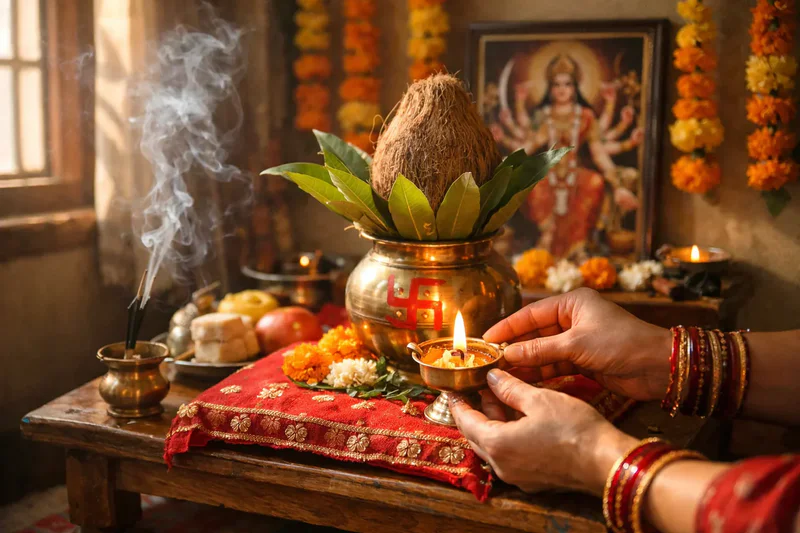
What Is Ashadha Gupt Navratri?
Like Magh Navratri, Ashadh Navratri is a Gupt Navratri (Secret/Hidden Navratri) and therefore called Ashadh Gupt Navratri.
Gupt Navratri is not a pompous celebration with social gatherings, music, and dance, like the Chaitra and Sharad Navratris.
It is Gupt because it is solely meant for transformative spiritual practices, especially of the Tantric or esoteric kind.
Tantric and lesser-known forms of the Divine Mother, such as the Das Mahavidyas, Ma Pratyangira, and Ma Varahi, are worshipped during this period through elaborate rituals from secretive Tantric texts and traditions.
These rituals usually require initiation from an experienced and qualified Guru from an established lineage.
Esoteric Meaning of Gupt Navratri
The popular Navratris celebrate the Divine Mother's victory over external demons.
The Gupt Navratris are about the conquest of the hidden demons within, such as fear, attachment, ignorance, pride, desire, anger, and the illusion of separateness.
The ‘secret’ in the Gupt Navratris is not only about hidden rituals but the hidden dimensions of the seeker's own consciousness that the Divine Mother gradually reveals.
Spiritual Significance of Ashadha Gupt Navratri: Why It Is Observed
Astrological Importance
Ashadha Gupt Navratri occurs at the onset of the monsoon season in Ashadh, which naturally symbolises rejuvenation, cleansing, and new beginnings.
Astrologically, this period is governed by a potent combination of 3 highly revered Nakshatras: Punarvasu (representing rebirth and transformation), Pushya (signifying protection and spiritual nourishment), and Ashlesha (associated with cosmic energy and overcoming adversity).
Together, they form a unique cosmic alignment that creates a potent environment for spiritual growth, healing, and Self-realisation.
Tantric Importance
From a Tantric perspective, Ashadh marks a transition in the annual spiritual cycle. As the monsoon clouds gather and nature turns inward, Sadhaks are encouraged to withdraw from external distractions and enter deeper states of contemplation.
Esoterically, the 9 nights symbolise the progressive purification of the physical, subtle, and causal bodies.
The 9 nights may also be viewed as 9 stages through which the individual consciousness journeys from bondage to union with Adishakti.
While the Prakat Navratris focus on invoking Divine Power, the Gupt Navratris focus on becoming receptive to Divine Wisdom. Ashadha Gupt Navratri is therefore considered especially favourable for:
Jap Anushthan and Mantra Siddhi
Kundalini practices
Guru worship
Meditation (Dhyan)
Mahavidya Upasana
Benefits of Das Mahavidya Worship During Gupt Navratri
Unlike the 4 main Navratris, where the 9 forms of Ma Durga (Navdurgas) are worshipped, Gupta Navratri focuses on the Das Mahavidyas (10 Wisdom Goddesses of Tantra), who collectively represent the complete spectrum of Divine Consciousness.
Each Mahavidya causes a particular spiritual transformation:
Maa Kali: Transcendence of time and fear
Maa Tara: Divine knowledge and protection
Maa Tripura Sundari: Harmony and spiritual fulfilment
Maa Bhuvaneshwari: Expansion of consciousness
Maa Bhairavi: Tapas and inner power
Maa Chinnamasta: Transcendence of ego
Maa Dhumavati: Wisdom through detachment
Maa Bagalamukhi: Control of harmful influences
Maa Matangi: Mastery of speech and knowledge
Maa Kamalatmika: Prosperity and spiritual abundance
Ashadha Gupt Navratri is believed to amplify the fruits of Mahavidya worship because its subtle energies naturally support such inner transformation.
History and Story of Ashadha Gupt Navratri
According to sacred texts, the origin of this period of Sadhana is tied to the great sages, Rishi Vishwamitra and Rishi Vashisht.
When their initial spiritual endeavours failed to yield the desired cosmic perfections (Siddhis), they discovered the hidden window of Gupt Navratri in the cosmic cycle.
By secretly performing Shakti Sadhana during these 9 days, they successfully attained their spiritual goals.
Since then, this period has been reserved for private, quiet worship away from community festivities.
Because the Divine Consciousness (Daivi Chetna) is believed to be at its peak during this time, it has historically held immense significance for traditional Tantric lineages in regions such as Kamakhya, Bengal, Odisha, Nepal, and Kashmir.
Rather than performing outward rituals, Sadhaks perform Manasik Sadhana (mental worship).
Undertaking austerities, Purascharanas, and receiving Mantra Diksha (initiation) in complete secrecy during these 9 days is believed to exponentially amplify spiritual results, paving the way for liberation (Moksh).
Vrat Kathas (Legends) of Ashadha Gupt Navratri
Sage Shringi
According to Puranic scriptures, the legend of Gupt Navratri is closely associated with Sage Shringi.
Once, when Sage Shringi was addressing a gathering of his disciples and devotees, a distressed woman emerged from the crowd and fell at his feet in deep sorrow, explaining that her husband was trapped in bad company and indulged in sinful habits.
Because of this, their household was ruined, and she was unable to perform any religious rituals, Pujas, or fasts to seek Divine help.
Sage Shringi consoled her and introduced her to the concept of Gupt Navratri. He explained that while the Prakat Navratris (Chaitra and Sharad) are meant for mainstream Devi worship, the Gupt Navratris are highly potent for secret, intense rituals.
He advised her to fast and pray secretly to the Goddess during the upcoming Ashadh Gupt Navratri. Following the sage's guidance, the woman observed the fast with strict discipline and absolute devotion, keeping her rituals private.
As a result, the negativity in her home vanished, her husband’s intellect reformed, and his lifestyle changed for the better. Since then, observing this fast has been considered highly rewarding for overcoming deep personal crises.
Prince Sudarshan
Another account comes from the Devi Bhagavat Puran, specifically the narrative of Prince Sudarshan in the 3rd Skandh. Sudarshan was the young son of King Dhruvasandhi of Kosala.
After the king’s death, a conflict regarding succession arose between rival queens and royal factions. The young prince’s mother, Manorama, fled with him to the forest, seeking refuge in Sage Bharadwaj’s Ashram.
There, the child repeatedly heard the syllable ‘Kleeng’ - the celebrated Kama Bij, symbolising the energy of Ma Durga, Ma Tripura Sundari, and the power of manifestation in Shakta Tantra.
Though he uttered it innocently without formal initiation, the mantra began working through Ajnata Jap (unconscious repetition).
Sudarshan’s spontaneous chant matured into Siddhi through Devi’s Grace.Later, She appeared to Sudarshan in a radiant, multi-armed, weapon-wielding form.
As it was Gupt Navratri, She granted him protection against hostile forces and blessed him to win his deceased father’s throne and rule his kingdom.
Sudarshan eventually married Princess Shashikala, all under the Goddess’s protection.
Why Ashadha Gupt Navratri Is Also Called Varahi Gupt Navratri
In Sri Vidya and Tantric traditions, Ashadha Gupt Navratri is closely associated with Varahi Devi, the boar-faced commander of Ma Tripura Sundari’s celestial armies and the Shakti (power) of Lord Varaha, one of the 10 main Avatars of Lord Vishnu.
Just as Lord Varaha lifted the Earth from the cosmic ocean, Ma Varahi lifts the soul out of ignorance, fear, and Karmic bondage.
Her tusks symbolise the power to dig deep and uproot hidden problems and deeply embedded karmic tendencies that ordinary effort can’t remove.
Ashadha Gupt Navratri is often called Varahi Navratri or Varahi Gupt Navratri because Ma Varahi governs:
Hidden processes and operations in subtle realms
Inner transformation
Protection of Sadhaks and Sadhana
Removal of unseen obstacles
Destruction of negative occult influences
Granting of victory
So, the subtle energies of this period make Her blessings particularly accessible.
Because Gupt Navratri itself concerns hidden spiritual work, many lineages dedicate special worshipto Ma Varahi during these 9 nights.
Rules to Follow, Rituals, and Foods Permitted During Ashadha Gupt Navratri
While customs vary by lineage, the following spiritual disciplines are commonly observed:
Daily worship of the Divine Mother
Recitation of Durga Saptashati, Lalitha Sahasranam, and Lalita Trishati
Mahavidya Mantra Jap
Sri Vidya Mool Mantra Jap
Navavaran Puja of the Sri Yantra
Brahmacharya (celibacy)
Truthfulness and self-restraint
Restraint of anger and gossip
Core Rituals and Rules
Secrecy: This is the most critical rule. The prayers, Mantras, and fast must not be flaunted or discussed openly with others to preserve their spiritual energy.
Ghatasthapan (Kalash Installation): A sacred pot (Kalash) is established on the first day. Devotees use copper, brass, or clay pots, strictly avoiding steel or iron.
Mantra Chanting: Devotees chant specific Mahavidya Mantras using a Rudraksha or red sandalwood Jap Mala.
Dietary Rules: A Sattvic diet (without onion and garlic) is followed.
Special Opportunity to Worship on the Tantra Sadhana App
Tantra Sadhana App
The free and ad-free Tantra Sadhana App has been created by the Himalayan monk, Om Swami, with the sole purpose of making the Tantric worship of the Das Mahavidyas accessible.
To anyone who feels a calling towards the Divine Mother or Tantra, Tantra Sadhana App provides a guided, awakened path, even if they aren’t initiated or have a personal Guru.
As it follows the sacred path of Divyachar, no physical offerings are required in any of the rituals.
All the rituals have been awakened by Om Swami and coded into the app to ensure they are error-proof. Moreover, all awakened chants are heard in His recorded voice.
Users begin the app journey by unlocking Ma Kali’s immersive world and awakening Her through Tantric mantra chanting, fire offerings, and the immersive Shav Sadhana over 33 days.
Then, they proceed to unlock the next world, belonging to Ma Tara, the second Mahavidya.
The journey eventually ends with Ma Kamalatmika, the Tantric form of Goddess Lakshmi and the tenth Mahavidya.
Secret Shrine for Ashadha Gupt Navratri 2026
The Secret Shrine is a small, special world set apart from the 10 Mahavidya worlds. It appears only on days that are especially powerful and effective for Mahavidya worship.
Unlike the 10 Mahavidya worlds, it is accessible to all users, irrespective of their progress in the app’s main journey.
This Shrine will appear and remain open throughout the 9 nights of the upcoming Ashadh Gupt Navratri, allowing all users to worship the 10 Mahavidyas across 10 days, starting with Ma Kali on the Amavasya of 14 July and ending with Ma Kamalatmika on 24 July.
The worship of each Mahavidya will be through chants of Her Dhyan Shlok and Mool Mantra with seed syllables, the counts of which are for the users to decide.
Period When the Secret Shrine Will Remain Open:
12 AM on 14 July (Tuesday) to 12 AM on 24 July (Friday)
If you’ve been consuming a lot of content on Tantra and wondering how, when, and where to begin your practice, this is the end of your search and the beginning of a new chapter in your life.