A Tantric Perspective on Navratri and the Das Mahavidyas
In this article, you will read about:
What Is Chaitra Navratri?
Chaitra Navratri in the Tantric Tradition
How the Das Mahavidyas Connect to Chaitra Navratri
Day 1 of Chaitra Navratri — Ma Kali
Recommended Practices for Navratri
Worship Ma Kali This Chaitra Navratri
What Is Chaitra Navratri?
Navratri comes from two Sanskrit words:
Nava – Nine
Ratri – Night
Thus, Navratri literally means Nine Nights.
However, in traditional Shakta understanding, Navratri is not simply 9 calendar days of worship. It refers to 9 specific lunar Ratris (nights) calculated according to the Tithis (dates) of the lunar calendar.
A Tithi is defined by the angular relationship between the Sun and Moon (12° increments) in the Vedic astronomical system.
A Tantric verse from the book, Devi Puja and Shatchandi Vidhan, explains this clearly:
tithyā vinirṇayaṃ kuryāt na vāraṃ na ca saurakam |
devyā pūjāvidhānaṃ tu tithimātraṃ prakīrtitam ||
Meaning:
The worship of the Goddess must be determined by Tithi, not by weekday or solar calculation.
What Chaitra Navratri represents spiritually
Chaitra Navratri is the Navratri observed in the lunar month of Chaitra (March–April), marking the beginning of the Hindu lunar year as per the Hindu Panchang.
It is dedicated to the worship of Divine Mother as the source of creation, symbolising the renewal of cosmic energy and the awakening of Shakti at the start of the annual spiritual cycle.
Thus, ChaitraNavratri is a sacred period for Shakti worship.
During this period, devotees worship the Divine Mother in different forms — most commonly the Navadurga.
What Is Tantra?
Tantra is a spiritual system focused on the direct experience of divine energy (Shakti).
The word Tantra comes from:
Tan – Expansion
Tra – Liberation or Tool
Thus, Tantra means ‘a system for expanding consciousness.’
Unlike purely devotional paths, Tantra emphasises:
Mantra (sacred sound)
Yantra (sacred geometry)
Dhyan (meditation)
Kundalini awakening
Direct realisation of Shakti within the body
In Tantra, the Divine Mother is not merely worshipped externally.
She is understood as Kundalini Shakti — the cosmic energy present within every human being.
The aim of Tantra is to awaken this energy and unite it with pure consciousness (Shiva).
How Navratri and the Tantric Path are Connected
Navratri is considered one of the most powerful periods of the year for Shakti Sadhana.
From a Tantric perspective, the nine nights symbolise nine stages of inner transformation.
During these stages:
layers of ego dissolve
internal energies awaken
consciousness expands
The tenth day (Dashami) represents spiritual emergence or victory.
Tantric interpretation of Navratri
Each night represents:
purification of inner tendencies
awakening of latent Shakti
progressive expansion of awareness
In the Sri Vidya tradition, Navratri is also linked to:
the nine Avaranas (enclosures) of the Sri Chakra
the progressive journey toward union with the Divine Mother
Chaitra Navratri in the Tantric Tradition
In Tantra, Navratri is not limited to the Navadurga alone.
Tantric practitioners often worship the Das Mahavidyas — the Ten Wisdom Goddesses that have emerged from the Divine Mother.
The 10 forms are:
Ma Chhinnamasta
Ma Bhairavi
Ma Dhumavati
Ma Bagalamukhi
Ma Matangi
Ma Kamalatmika
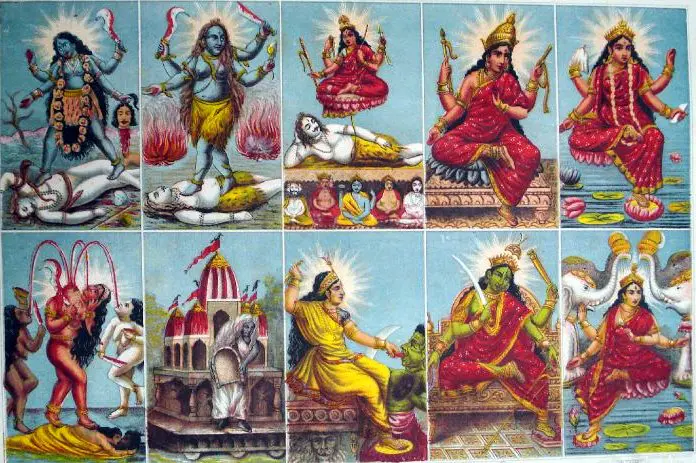
These forms represent the different cosmic powers of Shakti and different stages of spiritual transformation.
Why Navratri is powerful for Tantra practitioners
During Navratri:
Shakti is believed to be more accessible
meditation becomes deeper
mantra practice becomes more effective
For this reason, Tantric Sadhaks perform:
Mantra Jap
Yantra worship
Midnight rituals
Internal meditation practices
How the Das Mahavidyas Connect to Chaitra Navratri
The Das Mahavidyas originate from a famous Tantric narrative.
According to Tantric tradition:
When Lord Shiv attempted to prevent Devi Sati from attending King Daksha’s Yagna, the Divine Mother manifested as 10 fierce forms, blocking every direction.
These ten forms became the Das Mahavidyas.
They represent:
the complete spectrum of Shakti
the forces governing Creation, Preservation, Dissolution, Knowledge and Liberation
The Navratri journey can be viewed as a gradual awakening of these powers within the seeker.
In Tantric interpretation, the journey begins with Ma Kali, the force that breaks spiritual inertia.
Day 1 of Chaitra Navratri — Ma Kali
The Tantric cycle of Mahavidya worship often begins a day earlier on Amavasya with Ma Kali.
Ma Kali represents:
Time (Kala)
Dissolution
Destruction of the ego
Awakening of spiritual power

She is the first Mahavidya.
Without Ma Kali’s Grace, transformation cannot begin.
What Ma Kali represents spiritually
She symbolises:
The destruction of false identity
Confrontation with inner darkness
The beginning of spiritual awakening
Just as Navadurga worship begins with Devi Shailaputri, the Tantric journey begins with Ma Kali — the awakening of primal Shakti.
Ma Kali’s Bij Mantra
क्रीं (Kreeng)
This is considered the primary seed mantra of Ma Kali.
A Puja Paddhati manual of Ma Kali states:
krīṃkāraṃ bījam ity uktaṃ kālikāyāḥ paraṃ smṛtam |
Meaning:
The syllable Krīṁ is declared to be the supreme seed mantra of Kali.
Meaning of Krīṁ
Each sound component represents a cosmic principle:
Thus, the mantra represents the awakening of transformative energy that burns ignorance and leads to liberation.
Recommended Practices For Navratri
DOs:
Purity of Food: Consume only fruits, dairy, and simple Sattvik food.
Cleanliness and Personal Hygiene: Bathe before your daily practice.
Akhand Jyoti: If possible, light a lamp mentally or physically that burns continuously for 10 days to represent the unwavering presence of the Goddess.
Chant and Meditate: Focus on meditating on the form of the Goddess for that day, and chanting Her mantra.
Donate: Charity is highly encouraged during these days to help purify karmic debts.
Direction: If possible, face East or North East during your worship.
Clothing: If possible, wear red-coloured clothing and sit on a red Aasan during your worship. If this is not possible, wear fresh clothes of any colour.
DON’Ts:
Indulge in False Speech: Refrain from unnecessary talking and lies.
Eat Tamasic Foods: If possible, avoid non-vegetarian food, alcohol, tobacco, onion, garlic, and gluten.
Show Arrogance: Pay attention to emotions of anger, jealousy, and lust. When they arise, mindfully turn your attention away from them and towards the Mother Goddess.
Worship Ma Kali This Chaitra Navratri
Navratri is far more than a festival.
It is a structured spiritual period dedicated to Shakti worship.
From a Tantric perspective, these nine nights represent the progressive awakening of divine energy within the seeker.
The journey begins with Ma Kali, the force that destroys inertia and initiates transformation.
Through mantra, meditation and discipline, Navratri becomes not merely a ritual period — but a process of inner alchemy and spiritual evolution.
This Chaitra Navratri, the Tantra Sadhana App by Himalayan monk, Om Swami, offers Shakti Sadhaks access to its Secret Shrine.
Each day of Navratri, the Shrine allows seekers to recite the Dhyan Shlok and Mool Bij Mantra of a Mahavidya. The Shloks and mantras, awakened and consecrated by Om Swami, make the worship potent, safe and in accordance with the scriptures.
Once your Chaitra Navratri Sadhana is done on 15 April 2027, you can also begin your worship of the Das Mahavidyas, awakening each Mahavidya with their Tantric Bij mantra and esoteric Sadhana, one at a time - starting from Ma Kali to Ma Kamalatmika.
The app is free and ad-free, with an entirely optional Dakshina.
The Chaitra Navratri of the Das Mahavidyas begins on Amavasya, 6 April 2027.
Enter the Secret Shrine to worship Ma Kali with Her Dhyan Shlok and Dakshin Kali Bij Mantra, which includes Her powerful seed syllable ‘Kreeng’ along with others.
May the blessings of the Das Mahavidyas make this Chaitra Navratri a transformative period in your life.