In a Nutshell:
When is Guru Purnima 2026?
28-29 July (Tue-Wed); Ashadh Purnima in the Hindu calendar.What is Guru Purnima?
Guru Purnima is a sacred Hindu, Jain, and Buddhist festival to honour, thank, celebrate, and worship one's spiritual, academic, and career Gurus.How is it important for Tantra Sadhaks?
Progress in Tantra Sadhana greatly depends on the grace of Gurus. Guru Purnima is one of the best days to get initiated into a Tantric practice by them and take their blessings.How can the Tantra Sadhana app be of help?
Created by the Himalayan Siddha, Om Swami, the app offers even those without a personal Guru a safe, convenient, and effective way to worship the Das Mahavidyas (10 Wisdom Goddesses of Tantra).What's special in the app on Guru Purnima 2026?
The Secret Shrine of Ma Tripura Sundari, the First Goddess who rules the Universe, opens on this full moon day in the Tantra Sadhana App.
Here, all users can chant Her Dhyan Shlok, perform Her Yagna and pay homage to the Guru Tattva.
On Guru Purnima, millions of seekers across Bharat and the world pause to bow before the Holy Feet of their teachers and mentors and celebrate all the beings who carry knowledge forward.
Om Swami's Live Discourse on Guru Poornima 2026
On the auspicious occasion of Guru Poornima 2026, Om Swami is scheduled to deliver a live discourse on YouTube for the first time.
Watch the YouTube Live on 29 July (Wed) at 7:30 AM IST.
Date and Time of Guru Purnima 2026
Guru Purnima, also called Ashadh Purnima, occurs on the full moon day of the Hindu month of Ashadh.
Significance of Guru Purnima: Honouring the Light That Dispels Darkness
To understand Guru Purnima is to grasp that the light of knowledge is passed like a flame from one lamp to another, and gratitude to the giver is a sacred duty.
Here, the Guru is not merely a teacher of facts but the living bridge between bondage and liberation.
Because the seeking mind is the most intense obstacle, spiritual evolution without guidance is difficult. The Guru provides vital direction, initiation, and above all, Grace.
Thus Guru Purnima is not just a festival of celebration, but a recognition of this Divine transmission.
Skand Puran glorifies the Guru principle:
guruḥ pitā gururmātā gurudevo na saṁśayaḥ |
śive ruṣṭe gurustrātā gurau ruṣṭe na kaścana ||"The Guru is Father, Mother, and Divine Guide.
If Shiv is displeased, the Guru can protect you; but if the Guru is displeased, none can protect you."
Meaning of the Word ‘Guru’
Tradition holds that Gu signifies Darkness and Ru signifies its Remover — so a Guru is, by definition, one who dispels darkness or ignorance.
Guru Purnima honours that dispeller, recognising that every human achievement, however brilliant, rests on the shoulders of someone who taught, guided, or showed the way.
In the Hindu understanding, Avidya (ignorance) is considered the root cause of all suffering, and the Guru is the one force capable of uprooting it.
The Brihadaranyaka Upanishad captures the yearning at the heart of this night in a prayer recited by seekers for millennia:
asato mā sadgamaya |
tamaso mā jyotirgamaya |
mṛtyormā amṛtaṁ gamaya ||“Lead me from the unreal to the real, from darkness to light, from death to immortality.”
Guru Purnima is the day this prayer is directed, in gratitude, toward the living or departed teacher who has already begun answering it.
Relevance of the Full Moon
The Full Moon (Purnima) represents Completeness and Radiance. It is considered the ideal day to begin or reaffirm spiritual study, since the mind is thought to be most calm and receptive during this lunar phase.
The full moon itself is significant: just as the moon reflects the sun’s light into the night, the Guru reflects Divine Consciousness into the disciple’s heart.
Origin of Guru Purnima in Sanatan Dharma: Vyas Purnima
Guru Purnima is also known throughout India as Vyas Purnima, for it is the birthday of the sage Krishna Dvaipayan Vyas or Ved Vyas, one of the most revered figures in the entire tradition of Sanatan Dharma.
He is credited with compiling the Vedas from their scattered oral forms into the 4 organised collections — Rig, Yajur, Sam, and Atharv.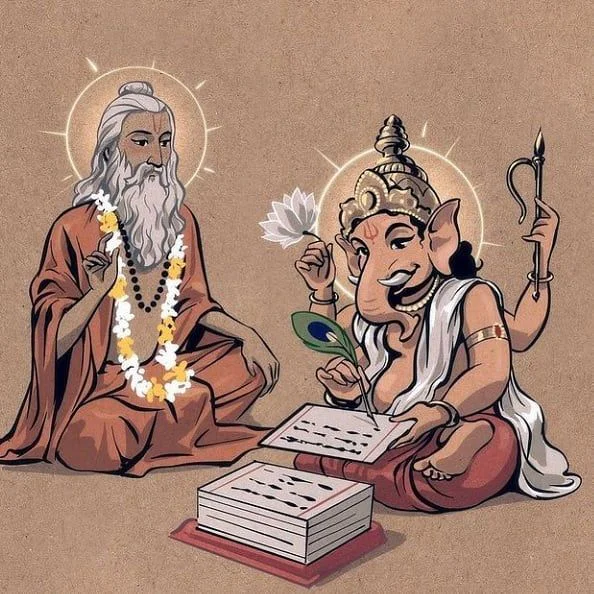
He is also traditionally credited as the author of the 18 Maha Puranas, the Brahma Sutras, and above all, the Mahabharat, the vast epic that contains the Bhagavad Gita — arguably the single most influential spiritual text in Sanatan Dharma history.
A Deeper Connection
Tradition holds that on this full moon day, Sage Vyas first divided the single Ved into 4 for the benefit of humanity, and it was on this day too that He began teaching the Brahma Sutras to His disciples.
Because of this, Vyas Purnima came to mark not just His birth but the moment His teaching mission truly began — the moment knowledge that had existed in seed form was released to the world in an organised and accessible way.
The Skand Puran and other texts describe how sages and scholars would gather on this day to pay respects to Sage Vyas before beginning their own study of the scriptures for the coming months. This practice continues in traditional Vedic schools (Gurukuls) even now.
It is worth noting that in the Bhagavad Gita, Lord Krishna Himself, when listing the manifestations through which His glory is known, declares:
munīnām apyahaṁ vyāsaḥ |
"Among the sages, I am Vyasa."
— Bhagavad Gita, Ch. 11, Vibhuti Yoga
The Mahabharat says:
vyāsāya viṣṇurūpāya vyāsarūpāya viṣṇave |
namo vai brahmanidhaye vāsiṣṭhāya namo namaḥ ||"Salutations to Vyasa, who is the very form of Vishnu, the treasure-house of Brahman."
Thus, when a Shishya or disciple bows to their Guru on this day, they are participating in a chain that reaches back to Sage Ved Vyas Himself — the first link in an unbroken lineage of teaching that is the lifeblood of Dharma's survival across ages.
Astrological Connection with Planet Guru (Jupiter)
In Vedic astrology (Jyotish), the planet Jupiter is known as Guru (or Brihaspati), and this naming is far from incidental.
Jupiter is regarded as the most benevolent and auspicious of all the Navagrahas, associated with wisdom, higher learning, ethics, prosperity, and spiritual growth.
It is fitting, then, that Guru Purnima falls during a period astrologically aligned with this planet's energies, reinforcing the day's themes of knowledge, guidance, and the expansion of consciousness.
A traditional verse says:
devānāṁ ca ṛṣīṇāṁ ca guruṁ kāñcanasannibham |
buddhibhūtaṁ trilokeśaṁ taṁ namāmi bṛhaspatim ||"I bow to Brihaspati, the Guru of Gods and sages, radiant like gold, embodiment of intelligence."
Brihaspati, in Vedic astrology, is not merely a planetary influence but a Divine sage in his own right — the Guru of the Devas, the celestial teacher who advises the Gods themselves in matters of Dharma, strategy, and righteous conduct.
The Rigved, the 1st Hindu scripture, contains hymns praising Brihaspati as the one whose voice brings forth new light, and who leads the singers of hymns toward truth with resounding brilliance.
It describes him as the one born from great light in the highest heaven, tumultuous-voiced and resplendent, the slayer of darkness through his radiance.
Guru Purnima, falling on the full moon, is symbolically potent because the moon represents the mind, while Guru represents wisdom. When the mind is full and receptive, wisdom can be fully reflected.
Spiritually, this teaches us that a purified mind becomes capable of receiving the Guru’s grace.
Rituals and Traditions of Guru Purnima
The rituals of Guru Purnima, though they vary by region, lineage, and tradition, share a common thread of gratitude made visible through action.
The day typically begins with disciples rising early, bathing, and dressing simply, preparing themselves inwardly before approaching their teacher.
Guru Worship or Guru Paduka Puja
At the heart of the day's observance is Guru Puja or Guru Paduka Puja — the ritual worship of the Guru’s Holy Feet or Padukas (sacred sandals).
Disciples traditionally wash the Guru’s feet and offer a garland of flowers, apply sacred sandalwood paste and Kumkum (vermilion) to the Guru’s Feet or Padukas. They present fruits, sweets, Vastra (cloth), or other simple offerings as tokens of respect.
In many traditions, this worship culminates in Guru Vandan, prostrating at the Guru's feet. Where the living Guru is not physically present, disciples often worship their picture, Padukas, or a symbolic seat (Aasan) reserved for the teacher.
Mantra Chants and Stotra Recitations
The Guru Gita, a dialogue between Lord Shiv and Goddess Parvati on the Nature and Glory of the Guru, is recited in many households and Ashrams from beginning to end. Alongside it, verses from the Guru Stotram are commonly chanted.
Among the many verses recited during Guru Puja, one from the Guru Gita is especially central to the ritual moment when the disciple's gaze meets the teacher's:
dhyānamūlaṁ gurormūrtiḥ
pūjāmūlaṁ guroḥ padam |
mantramūlaṁ gurorvākyaṁ
mokṣamūlaṁ guroḥ kṛpā ||“The root of meditation is the Guru's form,
the root of worship is the Guru's feet,
the root of Mantra is the Guru's word,
and the root of liberation is the Guru's grace.”
Disciples recite this verse silently as they perform the very acts of garlanding and prostration in the worship described above, so that the ritual and the words being chanted reinforce one another simultaneously.
Satsangs
In many spiritual and monastic communities, the day includes formal discourses (Pravachans) in Satsangs (spiritual gatherings), given by the head of the lineage or a senior teacher, addressing the assembled disciples on scripture, philosophy, and discipleship.
This tradition traces back to the belief that Sage Vyas Himself used this day to teach the Brahma Sutras.
Ashrams often hold large communal gatherings, drawing disciples from far away, specifically to be in the physical presence of their teacher. This reflects the enduring belief that proximity to a realised Guru carries a transformative power that cannot be replicated at a distance.
Vrat, Daan, and Seva
Fasts are observed on this day. They are often partial fasts, involving fruits and milk rather than grains, undertaken as a form of austerity offered in the Guru's honour.
Charitable giving is equally emphasised. Alms, food, clothing, and educational materials are frequently donated to the poor, students, or religious institutions — because honouring one's Guru is incomplete without extending that same generosity outward into the world.
Formal Initiations
For those who follow a particular lineage or monastic order, Guru Purnima is also the occasion to formally renew vows of discipleship, to receive a new Mantra Diksha or teaching, or in some cases to be formally initiated as a disciple for the first time.
Rituals Connected to Planet Guru
Hindus choose Guru Purnima to perform remedies or worship aimed at strengthening their connection to Jupiter's positive qualities.
Devotees especially chant the Brihaspati Mantra or Guru Mantra to invoke clarity and insight.
Yellow, the colour associated with Jupiter, is also commonly worn or offered in worship on this day. Foods and charitable gifts associated with Jupiter, such as chickpeas, turmeric, and yellow sweets, are donated to Brahmins, teachers, or the needy as an astrological remedy.
Role and Importance of a Guru in Life
Sanatan Dharma distinguishes between 3 types of Gurus:
Shiksha Guru: Imparts skills and formal knowledge.
Diksha Guru: Initiates the disciple into spiritual practices or mantras.
Sadguru: A true Guru who has realised the Ultimate Truth and guides the seeker to liberation.
Even Divine incarnations on Earth accepted Gurus: Lord Ram followed Sage Vasishth, Lord Krishna studied under Sage Sandipani, and Arjun learned from Dronacharya.
Guru Gita, one of the most authoritative texts on the Guru Tattva, reflects the exalted position given to a Guru:
gururbrahmā gururviṣṇuḥ
gururdevo maheśvaraḥ |
guruḥ sākṣāt paraṁ brahma
tasmai śrīgurave namaḥ ||"Guru is Brahma, Vishnu, and Maheshwar. Guru is the Supreme Brahman itself. Salutations to that Guru."
The Necessity of Spiritual Guidance
The Katha Upanishad underscores the necessity of a guide, describing the spiritual path as a razor's edge:
uttiṣṭhata jāgrata prāpya varān nibodhata,
kṣurasya dhārā niśitā duratyayā,
durgam pathas tat kavayo vadanti |"Arise, awake, approach the great teachers and learn; the path is sharp as a razor's edge, difficult to cross, so the wise declare."
The Mundaka Upanishad adds that reading texts is insufficient; a seeker must approach a teacher who is scripturally learned and established in Brahman (tadvijñānārthaṁ sa gurumevābhigacchet
samitpāṇiḥ śrotriyaṁ brahmaniṣṭham |)
This is illustrated through the householder Shaunaka, who approached the sage Angiras asking:
kasmin nu bhagavo vijñāte sarvam idaṁ vijñātaṁ bhavati?
"O Revered One, by knowing what does everything else become known?"
Angiras initiated him into Para Vidya (higher knowledge), shifting Shaunaka from accumulating information to realising the Self.
The Bhagavad Gita outlines the practical formula for the student-teacher relationship:
tad viddhi praṇipātena paripraśnena sevayā,
upadekṣyanti te jñānaṁ jñāninas tattva darśinaḥ |"Know this through humble reverence, sincere inquiry, and service; the wise who have realised the truth will instruct you."
How to Find a Guru and Follow Them Faithfully
The question of how to find a true Guru is one the scriptures approach with considerable seriousness, for they are equally clear that not everyone who claims the title deserves it.
The Mundaka Upanishad's counsel — that a seeker should approach a teacher who is both learned in scripture (Shrotriya) and established in Brahman (Brahmanishtha) — sets a high bar, because it suggests that scholarship alone is insufficient.
A true Guru must also have lived and realised what they teach, so that their words carry the weight of direct experience rather than secondhand information.
The Bhagavad Gita's guidance on this front is equally practical. Lord Krishna's counsel to approach the wise "through humble reverence, sincere inquiry, and service" implies that finding a Guru is not a passive event but an active discipline.
The seeker must first cultivate humility, then genuine curiosity, and demonstrate willingness to serve — qualities that, the tradition suggests, naturally draw a worthy teacher's attention and cause the right connection to form, often at a time the seeker least expects it.
A common saying in spiritual circles is that when the disciple is truly ready, the Guru appears. It suggests that inner readiness, more than external searching, is what ultimately determines when this meeting occurs.
The Hindu tradition, through numerous cautionary stories and the teachings of later saints and reformers, also warns against blind faith placed in unworthy or self-styled teachers.
Seekers are traditionally advised to observe a prospective Guru's conduct, the consistency between their teaching and behaviour, and the fruits visible in the lives of their disciples.
Finding a Guru is not about chasing charisma or miracles. Fortune and fame could also be misleading.
Scriptures and traditions repeat that a Guru is genuine if:
They have overcome the Shadripus: lust, anger, greed, delusion, pride, and envy
They are deeply compassionate towards all living beings
Their presence reduces inner agitation
Their teachings align with Dharma
They possess an unusual steadiness of mind, vision, and breath
They encourage effort and make you self-reliant, not dependent
The Kularnav Tantra plainly states that a true Guru is without excessive personal ambition, is not swayed by wealth, and does not trade Mantra, Yantra, or spiritual instruction for money.
Given how often spiritual authority has been abused for material gain across history, this single criterion has remained one of the most frequently cited tests applied by discerning seekers evaluating a prospective teacher.
Guru Lakshanas: Marks of a True Guru in the Tantras
The Tantric texts also describe a more technical dimension of Guru Lakshanas (signs) specific to initiatory practice.
True competence to initiate a disciple, they say, requires:
Mastery of the subtle body's centres (the Chakras from Muladhar to Ajna)
The capacity to purify the threefold impurities said to bind the soul
Fluency in the different states of consciousness: Jagrit (waking), Swapna (dreaming), Sushupti (deep sleep), Turiya (awareness), and the state that lies even beyond Turiya — Turiyatit (supreme state).
What Faithful Discipleship Means
Following a Guru faithfully does not mean abandoning discernment. The greatest disciples in Hindu scripture—such as Arjun, Nachiket, and Svetaketu—are remembered precisely because they questioned deeply and pressed for clarity.
True discipleship balances reasoned understanding with integrity in Sadhana and trust in the instruction. It demands sustained effort, commitment to practice, humility in receiving correction, and patience through periods of slow progress.
Because the transformation of consciousness is a slow, careful labour akin to a sculptor removing stone to reveal the form already present within.
The Guru as well as the disciple must commit to it for the long haul.
Modern-Day Relevance of Guru Purnima
Today’s world, dominated by instant data access and AI, offers infinite information but little wisdom. One can access thousands of books, lectures, and teachings online, yet remain confused. This makes Guru Purnima more relevant than ever.
While search engines provide endless facts, they cannot substitute for the inner clarity, ethical guidance, and personal transformation derived from a living mentor.
The Upanishadic insistence that certain knowledge can only be transmitted through a living, trusted relationship — not through text alone — offers a quiet but firm counterpoint to an age that sometimes mistakes access to data for actual wisdom.
Today, this enduring need for personal guidance applies not just to spiritual masters, but to the practice of honouring academic teachers, career mentors, parents, and grandparents.
Educational and cultural institutions globally utilise this day to hold public felicitations for retired and senior educators.
Furthermore, modern technology has transformed how the festival is observed without displacing its essential spirit.
Live-streamed discourses allow disciples separated by continents to receive their Guru's teaching on this day in real time.
Online communities gather virtually to chant the Guru Gita together.
And younger generations, often introduced to these practices through social media rather than a family Gurukul, find their own paths into traditions.
While today’s technology successfully digitises the interaction, it ultimately preserves an ancient, unalterable truth: the spark of true wisdom can’t simply be downloaded — it must be passed from one living heart to another.
Special Worship on Om Swami’s Tantra Sadhana App
The Tantric worship of the Divine Mother, Adishakti, in the forms of the Das Mahavidyas (10 Wisdom Goddesses of Tantra) has historically been inaccessible and less well-known.
However, it is the most potent way to awaken Her protective, nurturing, and guiding Presence in one’s life.
The Himalayan monk, Om Swami, created the free and ad-free Tantra Sadhana App to bridge this gap for sincere spiritual seekers worldwide. It offers its users a journey through 10 immersive 3D worlds belonging to the 10 Mahavidyas, respectively from Ma Kali to Ma Kamalatmika.
The journey in each world involves discovering essential facts about the world’s Mahavidya and performing Her rituals in sequence over a few weeks to awaken Her.
The rituals include Tantric Mantra Jap, Yagna, and Mool Sadhana, all of which adhere to the principles of Divyachar — the highest Tantric path that requires no physical offerings or Puja materials. The worship is all mental.
All the rituals in the app have been mastered by Om Swami Himself and coded into it according to His instructions. Users hear the awakened chants in Swamiji’s recorded voice while they chant them.
This makes the worship of the Das Mahavidyas particularly potent and completely error-free, even in the absence of a personal Guru.
Ma Tripura Sundari’s Secret Shrine
The Secret Shrine appears in the app on days that are auspicious for Mahavidya worship, such as the Navratris.
It offers all users an opportunity to connect with one of the Mahavidyas, even if they haven’t begun their main journey in the app.
Ma Tripura Sundari’s energy is said to be the highest on Purnimas. This Guru Purnima, Her Secret Shrine will appear in the app, giving users a golden chance to not only chant Her awakened Dhyan Shlok but also perform Her Tantric Yagna.
In this special Yagna, the Sadhak makes offerings to each of the 300 divine names of Ma Tripura Sundari, which were revealed as the Sri Lalita Trishati by Lord Hayagriva to Sage Agastya in the Brahmand Puran.
Secret Shrine Dates & Timings:
Opens at 5 PM on 28 July (Tue) 2026
Closes at 1 AM on 30 July (Thu) 2026
This year, don’t just celebrate Guru Purnima. Invoke the Mother Goddess’s guiding light to lead you on a blissful journey to Her Divine abode.