In this article, you will read about:
How the text resists you
What a reader brings
Reading as Sadhana
The Reader’s Map and the Long Path
The Tantra Sadhana App
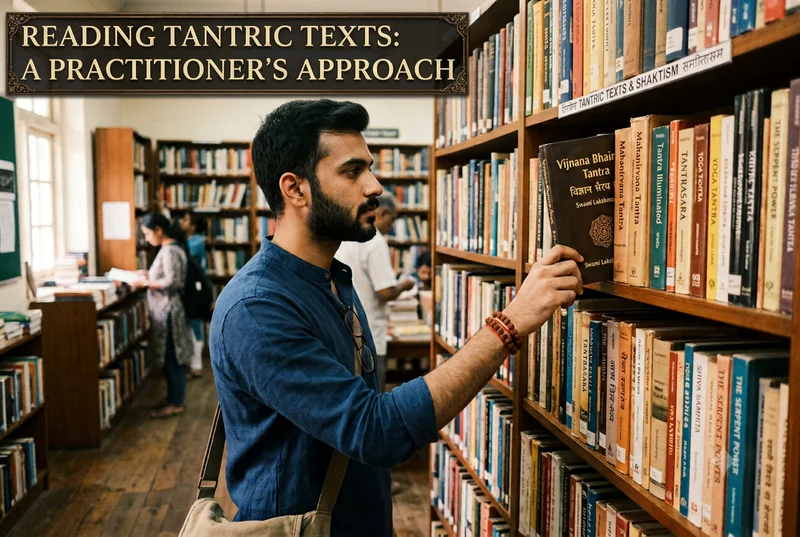
For centuries, Tantric texts were closely guarded within lineages. They passed from Guru to disciple and rarely left the fold. Its practitioners largely lived at the margins of society, outside caste and Vedic norms.
To the common eye, Tantric imagery of cremation grounds, skulls, fierce deities, and Bali (blood offerings) was reason enough to keep distance, with the belief that what happened in these circles was either dangerous or worse.
But beyond this curtain of fear, Tantric thought was finding new ways of being understood. In its earliest form, its thinking sat inside the ritual texts. For example, to understand consciousness or the Divine or liberation, one worked through procedure, mantra, deity description, and initiation instructions. Vedant, by contrast, already had standalone books on these matters.
By the ninth and tenth centuries, Tantra began producing sophisticated writing of its own. Utpaladeva’s Pratyabhijna argued that one need not begin with cremation-ground rituals to understand Tantra; one could begin with consciousness itself. This type of depth made Tantric thought accessible to the learned outside the lineages. Kings, whose advisors came from these circles, found Tantra politically useful: it offered the protection of fierce deities and powerful mantras for victory and prosperity. After all, the thought ran that a king who served the Divine was a king who had the Divine as his ally.
In Kashmir, the Karkota and Utpala kings supported the Shaiva traditions that gave rise to Kashmir Shaivism. The Cholas, in the south, patronised Tantric Shaivism. In Assam, the Koch and Ahom dynasties protected and rebuilt Kamakhya, one of the central pilgrimage sites of the Das Mahavidyas.
The commentaries that emerged from these courts travelled across regions, highlighting that any seeker, whatever their background, could realise the Truth. This gave Tantric thought wider acceptance, and today we find these texts on phones, in PDFs and in translations across many languages. The question now is no longer how to find them.
With greater accessibility, the reader today has the texts but rarely what makes them understandable. These texts were never written to be read alone. The Guru’s choice and the disciple’s stage of practice decided what the reader could understand. And yet the reading is happening, at scale. The question now is how to read them.
Most readers come looking for information about what Tantra is or what a particular mantra means; others come to perform the rituals and mantras the text describes, hoping to follow the instructions line by line.
Both kinds miss the point. These texts are meant to transform the one who reads them. The text does not give the same thing to every reader. The reader’s attention, inner state, and whatever practice they have done before, all compound with what the text gives back. Tantric scriptures are not a storehouse of information; they are tools that shape the reader.
This is made clear in the Tripura Rahasya. Sage Haritayana, while narrating to Narada, opens by saying that the teaching it contains is so concentrated and direct that one who cannot grasp the Truth even after hearing it must be set aside. Not even Shiv can give such a person wisdom. The teaching is not for everyone. Parashuram, however, came prepared. The text describes him as already pure-minded. As he listened to the revelation from the lips of Lord Dattatreya, he was absorbed in devotion. His mind grew stiller, then purer. His eyes glowed in rapture; his hair stood on end; he fell at his Master’s feet. The same words that would have slid off an unprepared reader transformed him.
Tantric texts can be classified in more than one way. The most familiar pairing is Agama and Nigama. The Lalita Trishati Bhashya, traditionally attributed to Adi Shankaracharya, describes Agama as the teaching that flows from Shiv’s mouth to Devi’s ear, sanctioned by Vishnu. Nigama is the reverse, flowing from Devi to Shiv, with the same sanction. This dialogue structure runs through many Tantric works, including the Mahanirvan Tantra and the Kularnava Tantra.
There are other classifications. The Sammohana Tantra names several classes: Tantras, Upatantras, Yamalas, Damaras, Samhitas, and related categories. The Yamalas are texts of union, where Shiv and Shakti speak as one. The Damaras deal with the invocation and control of unseen beings. The Nishvasa tradition speaks of five streams of revelation from Sadashiv’s five faces, a scheme Abhinavagupta later elaborated in the Tantraloka. Others classify by practice, with each path of worship anchored in its own scripture, as the Kularnava describes through the Acharas.
While the classifications may not converge on a single map, they share the same assumption: there must be Adhikar, the fitness to receive. Without that readiness, the text resists the reader and does not fully disclose itself.
How the text resists you
Language resists
The first resistance is in the language. The Tantras use vocabulary that often means more than what it appears to. Certain terms are direct and literal but carry a deeper sense that the reader recovers only with a key. This is known as Sandhya Bhasha, or twilight language.
Take the word Shmashan. At the surface, it is the cremation ground, the place where corpses burn. At a deeper level, it is the field within the practitioner where attachment is offered to fire and let go. The Kularnava Tantra incorporates both meanings. Which one a verse intends depends on how the reader has been prepared to read.
The point of the twilight is not concealment for its own sake. The deeper sense is meant to be available to the reader whose Sadhana has steadied the mind enough to hold it without distortion, who has come to the point in practice where this layer becomes relevant, and whose intent is to be changed rather than to extract information. And who has a teacher to hand them the key.
Structure resists
The second resistance is in how the text is built. The Tantras were written for readers already inside a lineage and practice. Take a practice like Nyasa, where mantras are placed on the body in a precise sequence. The text describes the placement, but presumes the practitioner already holds those mantras from a teacher. So too with rituals. They presume the practitioner knows how to perform them from a Guru.
The Tantras work the way a textbook on chemistry or law works. Anyone can open the pages and read. But what the text is actually pointing to opens only with a teacher who already knows the field. The principles, the methods, the practice are not in the words alone. Without that teacher, the reader has the book but not the subject.
Doctrine resists
The third resistance is in what the texts themselves say. In the Mahanirvan Tantra (4.36–37), Sadashiv tells Devi that the teaching given to one practitioner is not the teaching given to another. What suits each depends on place and time, on the practitioner’s capacity and custom, and on their disposition. Those who perform the worship they are qualified to perform, He says, “with safety cross the Ocean of Being”. It can be implied that those who attempt what is not theirs to attempt, do not.
The Kularnava goes further. The Kaula path, it says, is full of dangers. The practices that lead to liberation are the same practices that, given to the wrong recipient, lead to a fall. The unprepared reader is at real risk of going backwards, which is why the texts resist. They are not built to be inclusive or exclusive. They are built to do one thing for the prepared reader and another for the unprepared. With preparation, the words liberate. Without it, they bind further.
That’s why the texts act as gatekeepers.
What a reader brings
A steady mind
The first thing the reader brings is a mind steadied by Sadhana. An unsteady mind reads at the mercy of its state. Grief, for instance, can obscure what a calm mind would receive.
The Vijnana Bhairava (verse 101) holds that the practitioner who keeps the mind still even “under the sway of desire, anger, greed, infatuation, arrogance and envy” sees how these emotions, unchecked, stop the mind from receiving the truth. The Kularnava describes the true disciple as one who is “free from worry, disease, fickleness, grief, delusion and doubt”, “master of his senses”, “pure of mind, steady in observances”, “contented with himself”. Such is the mind the text was written for. Not a restless reader skimming sacred material like morning headlines.
Stage of practice
The second thing the reader brings is where they are on the path. The texts are written in layers. A verse that seems straightforward on first read can become essential five years later.
Take a passage on outer ritual, the offerings made to the deity. As Sadhana deepens, it can become a description of an inner offering: the practitioner’s Vrittis (tendencies) and ego placed before the Divine.
The Kularnava talks about three kinds of disciples, classified by where their devotion sits: at the beginning, in the middle, or at the end. Each is given a different kind of instruction, that of Karma (action), of Dharma (right conduct), or of Jnana (knowledge). The path moves through stages of inner growth, and the text unfolds with these stages, the way levels in a game open only after the earlier ones are cleared.
Intent to be changed
The third thing the reader brings is what they came for. The reader who comes only to extract information receives just that information. For the reader who comes to be changed, the deeper meanings of the text reveal themselves. The text turns into part of their Sadhana, working on them as they read.
The 'information reader' closes the book and makes notes. The practitioner takes the same verse and stays with it, returning to it over time as it works alongside their practice.
When the reader brings all three of these qualities—a steady mind, the right stage in practice, and the intent to be changed—they are no longer just reading. They are doing Svadhyay (sacred study), which the tradition treats as a Sadhana in itself.
Reading as Sadhana
Hearing the teaching
The first stage is Sravana, or hearing. The Tantric tradition treats reading the text as a form of hearing, even when there is no audible voice. The text speaks as a teacher would, and the reader’s task is to receive.
This shifts how the reader approaches the page. Reading is not for analysis or for collecting points to remember. It is for being there as the text speaks. The Tripura Rahasya (17.65) describes this first stage as the gaining of theoretical knowledge, where the teaching has reached the reader but is not yet their own. In practice, this means reading slowly, not reaching ahead for what the verse will mean or what its implication might be.
Holding it in mind
The second stage is Manana, or holding the teaching in mind. After it has been received, the reader still does not move on. They take what was read and turn it over, again and again, until it sits naturally with what they have already come to know through their own Sadhana.
The Tripura Rahasya (17.66) describes this reflection as having a specific endpoint. The work is to bring scripture, the master’s instruction, and the reader’s own practical understanding into agreement. This can take weeks or months until something in the reader’s practice gives them a way in. The verse then stops being only the text’s claim and becomes the reader’s insight.
Bringing it into experience
The third stage is Nididhyasana, where the teaching is brought into practice. The Tripura Rahasya (17.67) says that once knowledge has been ascertained, it must be practised, “even forcibly if necessary, until the truth is actually experienced”.
This is especially clear in a text like the Vijnana Bhairava, whose verses are not philosophical claims but Dharanas, meditation instructions. A verse on holding the mind steady in strong emotion is meant to be done the next time grief or anger arises. The reading completes itself in the practising.
Returning to the verse
The practitioner returns to the same verse many times. Each return begins another cycle of Sravana, Manana, Nididhyasana, with the verse opening different depths each time.
This is why these texts are not finished after a single reading. The question is not which Tantras to read, but which Tantras to live with.
The Reader’s Map
What follows is an orienting map of Tantric texts. It moves from what is accessible to all, to what opens only with lineage and practice.
Stotras and Devotional Hymns
These are widely recited as devotional foundations. From the Vedic tradition come the Devi Sukta (Rigveda 10.125), the Sri Sukta (Rigveda Khila), and the Durga Sukta (Taittiriya Aranyaka 10, also known as the Mahanarayan Upanishad) and the Sri Rudram (Yajurveda, Taittiriya Samhita 4.5 and 4.7), the foundational Vedic hymn to Rudra-Shiv. The major Shakta-Tantric stotras include the Devi Mahatmya, also called the Durga Saptashati (Markandeya Puran, chapters 81–93); the Saundaryalahari, attributed to Adi Shankaracharya; the Lalita Sahasranam with the Lalita Trishati; the Khadgamala Stotra; the Shyamala Dandakam, attributed to Kalidasa; and the Uma Sahasram by Kavyakantha Ganapati Muni (1907), a thousand-verse stotra to Uma.
Conceptual Texts
The next layer helps the reader understand the Tantric worldview, where the Devi is the ultimate reality, Shiv the supreme consciousness, the body a sacred field.
Several Upanishads are central. The Devi Upanishad (Devyatharvashirsha) presents the Devi as Brahman. The Bhavana Upanishad reads the human body as Sri Yantra. The Tripura Upanishad speaks of the Panchadashi mantra. The Saubhagya Lakshmi, Bahvricha, and Sarasvati Rahasya Upanishads all belong to the wider Shakta world, acknowledging Devi’s various forms. From the Shaiva tradition come the Atharvashira Upanishad on Rudra-Shiv as the Supreme, the Kshurika Upanishad on the yogic dissection of body and mind, and the Rudra Hriday on the heart of Rudra.
From the Puranas, the Devi Bhagavat is the major Shakta Purana, with the Devi Gita in its seventh book modelled on the Bhagavad Gita. The Kalika Puran, associated with Kamarupa, lays out Kali worship and identifies the various Shakti Pithas. On the Shaiva side, the Shiv Puran tells stories of Shiv and Parvati and presents devotion to Shiv as a path to freedom. The Linga Puran speaks of the symbolism and worship of the linga. The Skanda Puran focuses on Shiv’s family, especially his son Skanda, and on pilgrimage sites.
These are not Tantras in the strictest sense, but they prepare the inner world the Tantras assume.
A note on what these texts ask of the reader
Devotional reading and hymn-recitation are widely practised without formal initiation, as is the study of the Upanishads and Puranas, whether read as philosophy, doctrine, or story.
The Lalita Sahasranam’s Phalashruti (verses 81–83) forbids imparting the hymn to anyone not initiated into Sri Vidya. The tradition reads this prohibition as extending to its mantric and ritual use: the activation of the embedded mantras from the text. Anga-Nyasa and Kara-Nyasa, Avarana Puja, the installation of the Sri Chakra, and the use of stotras such as the Khadgamala as ritual invocation also require formal initiation (Diksha) and lineage protection.
A note on initiation
The texts that follow are open to read, but their deeper layers come alive only when the reader has done the Sadhana, received Diksha, and reads under the guidance of a Guru. The Kularnava (Ullasa 14) is explicit on this: “all japa, puja and like activities by those who are not initiated are fruitless like the seed sown on rock”.
Foundational Tantras
These are the core scriptures of the Tantric path. The Kularnava Tantra sets out Kaula doctrine: the guru-disciple relationship, the qualifications of the seeker, and the practice of initiation. The Mahanirvan Tantra presents Sadashiv’s instruction to Devi on the broader Tantric path. The Vijnana Bhairava Tantra, classed within Kashmir Shaivism but read across streams, gives 112 Dharanas as meditation techniques. The Tantraraj Tantra is a major Sri Vidya scripture on the origin of the Vidyas and the worship of the Sri Chakra. The Rudra Yamala is widely cited in later Tantric literature, though the surviving text is fragmentary and disputed.
Sri Vidya Literature
For practitioners of Sri Vidya. The Vamakeshwar Tantra (Nityashodashikarnav) is the foundational text on the Panchadashi mantra and the Nitya Devis. The Yogini Hriday is its companion, covering the inner meanings of the Sri Chakra and the mantras placed upon it. The Jnanarnav and Srividyarnav Tantras contain extensive material on the Sri Chakra and its symbolism. The Tripura Rahasya, in its Jnana Khand, presents Shakta Advait through the voice of the Goddess; we have cited it throughout this article. The Parashuram Kalpa Sutra is a manual of Sri Vidya practice attributed to Sage Parashuram. The Nityotsav by Umanandanath, a disciple of Bhaskararaya, is a key ritual manual for daily Sri Vidya worship.
Das Mahavidya Texts
Each of the Das Mahavidyas has Her own Tantric literature. For Kali: the Kali Tantra, Mahakal Samhita, Niruttar Tantra, and Karpuradi Stotra. The Tara Tantra for Tara; the Bhuvaneshwari Rahasya for Bhuvaneshwari; the Chinnamasta Tantra for Chinnamasta; the Dhumavati Tantra for Dhumavati; the Bagalamukhi Tantra for Bagalamukhi; the Matangi Tantra for Matangi. Tripura Sundari is largely covered through the Sri Vidya scripture world; material for Bhairavi and Kamalatmika is distributed across compilations rather than concentrated in single texts. Across the ten, the Todala Tantra treats the Mahavidyas and their interrelationships; the Shakta Sangam Tantra is organised into four sections (Kali, Tara, Sundari, Chinnamasta); and the later Shakta Pramod compiles Mahavidya practices.
Shaiva Tantric Literature
The Shaiva traditions produced central Tantric texts on Shiv as consciousness, and on the recognition that Self is not separate from Him. From Kashmir Shaivism: the Pratyabhijnahriday by Kshemaraj, a short text on recognition (Pratyabhijna) of the Self as Shiv; Abhinavagupta’s Tantralok, the encyclopedic Tantric reference in thirty-seven chapters, with his Tantrasar as a condensed companion; the Shiv Sutras and Spand Karikas, on the dynamic pulse of consciousness underlying all experience; and his Paratrishika Vivaran, on consciousness, bliss, and the supreme word. From the wider Shaiva world, the Malini Vijayottar Tantra is the foundational Trika scripture, the Svacchand and Netra Tantras are major Bhairava texts, and the Nishvasa Tattva Samhita is among the earliest Shaiva Tantras. The Kamika Agam belongs to the foundational Shaiva Siddhanta fold.
Classical Commentaries
Classical commentaries help unlock the texts for the reader. For Sri Vidya, Bhaskararaya is the standard: the Varivasya Rahasya on the Panchadashi mantra, the Saubhagya Bhaskara on the Lalita Sahasranam, the Setubandha on the Vamakeshwar Tantra, and the Guptavati on the Devi Mahatmya. Lakshmidhara’s Saubhagyavardhini is the standard commentary on the Saundaryalahari. Punyananda’s Kama-kala-vilasa explains the symbolism at the centre of the Sri Chakra; Amritananda’s Dipika is the standard commentary on the Yogini Hriday. From the Shaiva side, Jayaratha’s Viveka is the essential commentary on Abhinavagupta’s Tantralok.
Living Teachers and Contemporary Works

The lineage is still speaking. Three works by Om Swami are especially useful here. The Ancient Science of Mantras explains the practice of mantra and how it works on the practitioner who takes it up. The Legend of the Goddess opens the sixteen verses of the Sri Suktam, tracing their Vedic roots and the mantric layers each verse carries. Kundalini: An Untold Story addresses the energetic dimensions of Sadhana from the author’s years of direct meditation.
Pandit Rajmani Tigunait, of the Himalayan tradition, has written widely on Tantric Sadhana; Tantra Unveiled and Shakti Sadhana are popular. Kavitha Chinnaiyan, working from Sri Vidya, has written on the Mahavidyas in Shakti Rising and Glorious Alchemy. Sir John Woodroffe (as Arthur Avalon) remains essential for early English translations of the foundational Tantras; his introductions are his own commentary, not the body of the texts.
The Long Path
The Tantric texts are not finished after a single reading. They are companions for the long path. A verse received in the first year returns differently in the fifth. The same Sahasranam recited at the beginning is the Sahasranam whose names open at a different layer years later, when the Sadhana has done its work and the reader’s mind is steadier.
This is the relationship the tradition asks the reader to take up. Approach the text the way a disciple approaches a teacher: with attention, with devotion, with the readiness to be changed. Read what you can read, where you are. Stay with the verses that resist, because they are asking you to ripen. Return to the verses that have already opened, because they may say something new.
Many Tantras speak in the voice of Shiv to Devi, and Devi to Shiv. They are still speaking. It remains for the reader to listen, over the years of their Sadhana.
The Tantra Sadhana App
The Tantra Sadhana App, founded by Om Swami, exists to support that listening through initiation into specific Mahavidya Sadhanas, mantra guidance, and the shelter of a living lineage.
The door is open. Step in when you're ready.