In this article, you will read about:
The Role of Bhakti in Tantra
Tantric Saints Who Deepened Their Practice With Bhakti
Bhakti as Described in Tantric Texts
Conclusion and the Tantra Sadhana App
The Role of Bhakti in Tantra
Imagine that you have been training for years to become a chef. You are ready to give your final examination and earn your stripes by cooking a spectacular Asian meal. You have all your proteins and vegetables neatly sliced and diced on the main counter.
The slab on the left has different spices and aromatics, and the slab on the right includes fats and oils. The top shelf holds vinegars, wines, and sweeteners, and the drawers hold texture boosters and toppings.
The judge counts down, and it's time to start. Suddenly, your heart sinks, and you realise you are going to fail in this examination. You did not include any matchsticks or a lighter to fire up your stove.
All these fancy ingredients, the aromatics, the oils, the vinegars, and the fancy cooking techniques would matter without being able to light the fire, which is the most primal ingredient to make this gourmet dish.
Bhakti is that fire which propels rituals in Tantra. Sometimes, we get so caught up in the practices, the mechanics, and the minutiae of the rituals that we completely forget the purpose behind doing them.
Tantric Saints Who Deepened Their Practice With Bhakti
Sri Ramprasad Sen
This concept of Bhakti being the fuel of Tantric practices is best understood by looking at the lives of saints like Ramprasad Sen, whose intense Tantric practices were drenched in pure Bhakti.
Sadhak Ramprasad was initiated into Tantric Sadhana by his Guru, Krishnanand Agamavagish, and he practised intense Tantric rituals, including Kundalini Yoga and meditation on the Panch Mundi Asan, which consisted of 5 skulls.
However, the root cause of all this Sadhana was to glimpse his beloved Ma Kali. This fierce longing often erupted into tender, loving devotional poetry. ‘Dub De Re Mon Kali Bole’, one of his compositions, has the following lines:
Dub de mon Kali bole
Hridi-ratnakarer agadh jole.
Ratnakar noy shunyo kokhon,
Du-char dube dhon na pele;
Tumi dom-shamorthe ek dube jao
Kulakundalinir kule."Taking the name of Kali, dive deep down, O Mind, into the heart's fathomless depths, where many a precious gem lies hid. But never believe the bed of the ocean is bare of gems if in the first few dives you fail; with firm resolve and self-control, dive deep and make your way to Mother Kali's realm."
One of the core tenets of Bhakti is surrender, and you get a glimpse of his desire to extinguish his personality and surrender to Ma Kali in the following lines from the poem ‘Ebar Kali Tomay Khabo’:
Ebar Kali tomay khabo.
Ebar tumi khao ki ami khai ma, dutor ekta kore jabo.
Khabo khabo boli mago udorostho na koribo,
Ei hridi-podme boshaiye, mono-manoshe pujibo."This time I shall devour Thee utterly, Mother Kali!
Thou must devour me first, or I myself shall eat Thee up; one or the other it must be.
O Mother, I shall eat Thee up but not digest Thee; I shall install Thee in my heart and make Thee offerings with my mind."
Sri Bamakhepa
An even more potent example is the life of Bamakhepa, the greatest devotee of Ma Tara, who was called the Mad Saint of Tarapith. He was a powerful Vamachar (left-hand path) Tantric practitioner and temple priest who dwelt in the cremation grounds of Tarapith Temple.
However, he always referred to Ma Tara as “Bodo Maa” (elder mother) and called his biological mother “Choto Maa” (younger mother).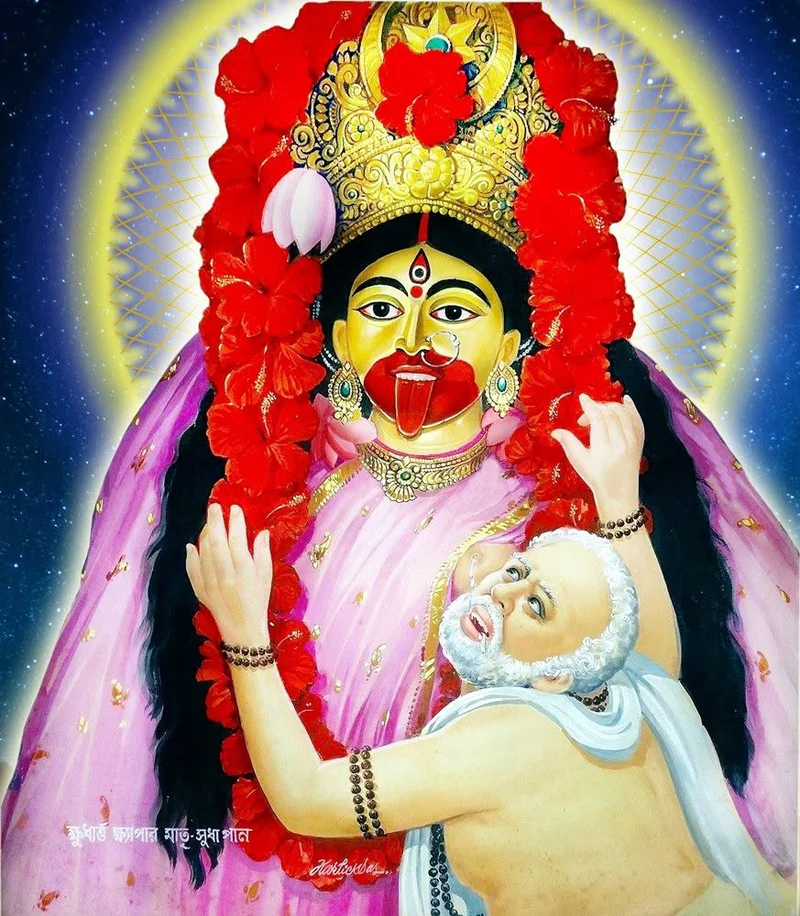
He would sit at Her altar, converse with Her, eat Her offerings, and even fight with Her with a passion that only a child could summon while angry at his mother. The other priests in the temple tried to intervene, but it's said that Ma Tara appeared in their dreams and told them that Bamakhepa was Her child.
When launching the powerful Tantra Sadhana App to enable seekers to worship the Das Mahavidyas, the Himalayan monk Om Swami, too, emphasised that the only way to approach the Divine Mother is to be Her child.
Sri Ramakrishna Paramahamsa
The pinnacle of using Bhakti in Tantric practices was demonstrated by the peerless Sri Ramakrishna Paramhamsa. He was completely immersed in the Bhakti Bhav of Ma Kali when he met his guru, Bhairavi Brahmani, around 1861.
Most people called him mad, but she explained to them that all his behaviours were markers of Para Bhakti, as described in Vaishnav texts and exhibited by seekers such as Chaitanya Mahaprabhu.
She then initiated him into Shakt Tantra, where he undertook 64 major Tantric Sadhanas. He began with traditional practices such as Mantra Jap to stabilise his mind.
When Ramakrishna moved into the Vamachar stages, which traditionally utilise Panchamakar (grain, fish, meat, wine, and sexual union), he practised the Divya (divine) or Pratinidhi (substitution) method.
Being a strict celibate with an intense aversion to alcohol, he did not literally consume wine or engage in sexual acts. Instead, he sublimated these elements: he would touch a drop of wine to his forehead as a mark of the Mother, and he would worship his female partner as the Divine Mother Herself (Shodashi Puja).
Bhairavi Brahmani confirmed that his mental absorption was so complete that he achieved the results of the Vamachar path without ever breaching his vows of renunciation.
Bhakti as Described in Tantric Texts
One of the most important texts in Tantric Sadhana is the Kularnav Tantra, which deals with the left-handed, or Kaulachar, tradition. These texts elevate Bhakti to be the beating heart of the tradition.
The Guru is not just viewed as a teacher but as a physical embodiment of Lord Shiv, who, through an act of supreme compassion, transmits the sacred knowledge of liberation. The text declares:
“To perdition he goes who regards the Guru as human, the Mantra as mere letters, and the Images as stone.”
The Kaul texts are often quoted for their references to the Panchamakar (the 5 Ms) used in their secret rituals. The Tantras explicitly state that the literal use of these methods is only for seekers who have entirely conquered lust, fear, and a dualistic perception of the world.
The text goes on to explain how these apply to most seekers.
The ‘Divyatattva’ of the 5 Ms can help you understand how rituals that feel radical are actually testing and helping you realise the depth of devotion and surrender.
Another fascinating text that completely merges the two seemingly contrasting paths of Tantra and Bhakti is the Lakshmi Tantra. While most Tantric texts focus on Lord Shiva or Ma Kali, the Lakshmi Tantra is an Agamic text sitting at the intersection of Vaishnavism and Tantra.
It elevates Ma Lakshmi as the creative Shakti who manifests the entire Universe from a fraction of Herself.
The text also includes esoteric Tantric practices but anchors them all in the principle of Prapati (absolute self-surrender).
Story of Gajendra Moksh
The confluence of Tantra and Bhakti in Lakshmi Tantra is evident in its position that "no protection would be given when it is not sought," reinforcing the need for complete surrender.
The story of Gajendra Moksh from the Bhagavatam beautifully illustrates this…
As Gajendra, the king of elephants, entered the sacred lake to refresh himself, he was suddenly seized by a mighty crocodile lurking beneath the waters. What began as a peaceful retreat instantly turned into a desperate battle for survival.
Gajendra struggled against the crocodile with all his strength for a long time, relying solely on his own effort. Only when he realised his complete helplessness did he abandon all pride and wholeheartedly surrender to Lord Vishnu, crying out for Divine refuge.
It was at that moment that Sri Hari immediately descended to rescue him and grant him liberation. The episode perfectly reflects Lakshmi Tantra's teaching that Divine Grace flows only when the seeker consciously seeks it through complete surrender.
Samkhya and Yoga
Samkhya and Yoga are closely related, ancient Hindu philosophical systems (Darshans) that analyse reality to achieve liberation from suffering.
Samkhya provides the theoretical, dualistic framework (counting elements like Purush and Prakriti), while Yoga provides the practical, meditative methodology to achieve that liberation.
"Samkhya" translates to "number" or "enumeration," indicating its analytical approach to breaking down existence into 25 fundamental Tattvas (principles).
It centres on the distinction between Purush (Pure Consciousness/soul) and Prakriti (Nature/matter) to understand that the Self is Pure Consciousness, separate from material nature, thus stopping suffering.
The confluence of Tantra and Bhakti also highlights its Tantric lineage by describing how seekers, having purified their internal organs and mastered Samkhya and Yoga, become imbued with pure devotion.
Ultimately, the Yogin shakes off all afflictions and "becomes one with the Supreme Brahman represented by Ma Laksmi and Lord Narayan".
Ultimately, Tantra is a form of Bhakti in which the Bhakta (devotee) holds that if they are part of the Supreme Divine, they must one day become one with the very Divine they worship.
Bhakti is the fuel that provides the Tantric practitioner with the emotional intensity, humility, and wisdom to navigate the spiritual path, which is often a razor's edge.
If you don’t spend enough time grounding yourself in devotion, the chances of your spiritual journey being hijacked by ego, desire for fame, or other desires are very high.
This raises the question: how can you practice ancient Tantric practices grounded in Bhakti in today’s world?
One way is the innovative Tantra Sadhana App created by Om Swami.
The Tantra Sadhana App
This revolutionary mobile application brings the esoteric practices of the Das Mahavidyas (10 Wisdom Goddesses of Tantra) into the palm of your hand, making ancient Tantric wisdom accessible to sincere seekers worldwide.
Om Swami, a renowned spiritual leader with decades of personal experience in Vedic and Tantric practices, created the Tantra Sadhana App to democratise access to authentic Tantric practices.
Following the path of Divyachar (mental worship), Swamiji Himself mastered all the rituals offered in the app before creating it to make them accessible to all Shakti Upasaks.
Swamiji also describes the Tantra Sadhana app as a "portal into Sri Vidya" for those interested in practising Sri Vidya. He elaborates on the pathway to Sri Vidya Sadhana through the app, which is designed as a comprehensive, authentic journey without shortcuts.
The Tantra Sadhana app represents a new frontier in spiritual technology, where ancient wisdom and modern innovation merge to create accessible pathways to transformation.
For those drawn to the esoteric path of Tantra, this digital tool offers an authentic entry point to practices traditionally shrouded in secrecy and available only to a select few.
Follow this esoteric path of Bhakti and Tantra to experience the Divine Mother’s blissful presence in your life.
References: