# The Kalighat Kali Temple in Kolkata
Published: 2025-10-14
Category: Ma Kali
Category URL: https://tantrasadhana.app/blog/category/ma-kali
Meta Title: The Kalighat Kali Temple in Kolkata
Meta Description: Explore the sacred origin of Kalighat Temple, the symbolism of Mahakali’s idol, daily rituals, tantric practices, and the saints who found divine grace here.
Tags: Tantra, Tantra Sadhana, Das Mahavidya, Ma Kali
Tag URLs: Tantra (https://tantrasadhana.app/blog/tag/tantra), Tantra Sadhana (https://tantrasadhana.app/blog/tag/tantra-sadhana), Das Mahavidya (https://tantrasadhana.app/blog/tag/das-mahavidya), Ma Kali (https://tantrasadhana.app/blog/tag/ma-kali)
URL: https://tantrasadhana.app/blog/the-kali-ghat-temple-where-time-bows-to-maha-kali
[_हिंदी में पढ़ें_](https://tantrasadhana.app/blog/the-kali-ghat-temple-where-time-bows-to-maha-kali-hindi)
### In this blog, you’ll read about:
- Kalighat Kali Temple Timings, Special Festivals, and Photos
- Kolkata Kalighat Kali Temple Tour and History
- Kalighat Kali Temple Statue and Artistic Contribution
- Kalighat Temple’s Architecture and the Saints Who Bowed There
- Praying to Maa Kali — A Modern Seeker’s Starting Point
There are temples that stand as monuments, and there are temples that breathe like living beings.
The **Kalighat Temple** in Kolkata, West Bengal, is one such place— **reverberating, mysterious, and eternal**.
Step inside the narrow lanes of its locality, and you will hear not just the clamour of bells and chants but the pulse of a city that has grown around the **feet of Mahakali** Herself.
As the name suggests, the temple is dedicated to **Kali Mata**, one of the Das Mahavidyas (Ten Great Wisdoms) in the Hindu Tantric tradition.
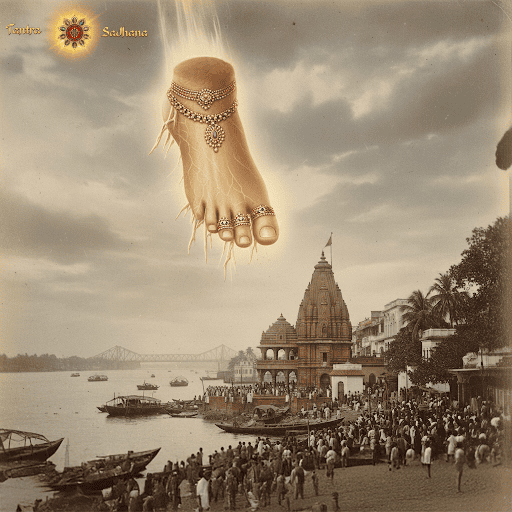
Recognised as one of the **51 Shakti Pithas** (Seats of Shakti / Abodes of Power), the Kalighat Temple is believed to mark the exact spot where the **toes of Devi Sati’s right foot** fell, imbuing the land with immense spiritual power.
## Kalighat Kali Temple Timings — Daily Worship Schedule
At Kalighat, [**Maa Kali**](https://tantrasadhana.app/blog/a-complete-guide-to-ma-kali-worship-rituals-offerings-dates) **is not a statue — she is a living deity**. Swami Ramakrishna Paramahamsa used to say in Bengali:
> "Ma Bhavatarini of Dakshineshwar, Ma Kali of Kalighat and Shyam Sundar Jiu of Khardaha are living. They walk, talk, and eat food offered by the devotees."
Every day, the temple follows a sacred rhythm that mirrors the tender care one would offer to a loved one.
### **The Morning Ritual**
- The day begins in **deep devotion** as priests wake the Goddess gently around **4:00 AM**.
- She is bathed, anointed, and adorned with **fresh garlands**—especially **red hibiscus**, her favourite flower.
- By **5:00 AM**, the **Mangal Aarti** is performed, and the doors open for **darshan**, allowing devotees to receive her gaze.
### **Afternoon Rest**
- Between **2:00 PM and 5:00 PM**, the temple closes. During this time:
- **Bhog (sacred food offering)** is presented to the Goddess.
- She is believed to **rest**, away from public view—a mark of deep respect and reverence.
### **Evening Worship**
- At **5:00 PM**, the temple reopens for the **Sandhya Aarti** (Evening Offering of Light).
- The temple remains open until **10:30 PM**, giving devotees ample time to worship, pray, and connect.
### Shehnai Service
Every evening, a middle-aged man named **Ranjit Majhi** plays his shehnai for Ma Kali at the Kalighat Temple, in the office room beside the sanctum—not as a job but as **Seva (service)**, out of pure devotion.
The entire temple complex is filled with its resonant melody, along with the ringing of bells, ritual sounds, and the evening Arati. To him, playing the shehnai elsewhere feels ordinary, but playing it for **Ma Kali at Kalighat** is a totally different experience.
## How to Reach Kalighat Temple
Reaching the Kalighat Kali Temple in Kolkata is straightforward as it is well-connected by all major modes of transport:
- **By Metro (Most Convenient):** Take the North-South Corridor ( **Blue Line**) of the Kolkata Metro.
Get down at either **Kalighat Station** (take the Southern exit) or **Jatin Das Park Station** (take the Northern exit).
The temple is a brief 5 to 10-minute walk (around 400–700 meters) from either station.
- **By Bus:** Board any bus heading towards South Kolkata via **Shyama Prasad Mukherjee Road**.
Get down at the **Kalighat Bus Stop**, **Hazra More**, or **Rashbehari More**.
From there, you can easily walk or take a short auto-rickshaw ride to the temple.
- **By Train:** If arriving at **Howrah Junction (HWH)** or **Sealdah (SDAH)** railway stations, the easiest route is to take a taxi/bus or hop onto the local metro line connecting to the Blue Line to reach Kalighat Metro Station.
- **By Air:** The nearest airport is **Netaji Subhash Chandra Bose International Airport (CCU)**, located about 23–25 km away.
From the airport, you can hire a prepaid taxi or an app-based cab (like Ola/Uber) to reach the temple directly via the E.M. Bypass or Maa Flyover, which takes roughly 50 to 60 minutes depending on traffic.
## Best Time to Visit Kalighat Temple: Special Festivals & Sacred Nights
### **Festivals**
During major festivals like:
- **Snan Yatra**
- **Kali Puja**
- **Diwali**
- **Navratri (Durga Puja)**
…the Kalighat Temple transforms into a **spiritual powerhouse**. Tantric rituals, night-long prayers, and special offerings take place. The **temple is decorated elaborately**, pulsating with the energy of thousands who gather to honour the Divine Mother.
Other prominent festivals include:
- **Nakuleshwar Mahadev Festival**
- **Holi of Shyam-Rai (Celebrated on Ram Navami)**
### **Amavasya (New Moon Nights)**
- Considered **extremely auspicious** for Maa Kali
- Special **midnight rituals** are often performed, aligning with Her fierce, transformative energy.
### The Ritual of Dondi
On festival days like **Kali Pujo** or **Chhath Puja**, some devotees perform **Dondi**—a physical act of penance and surrender:
- Devotees **lie prostrate on the ground** and slowly move forward towards the temple.
- Some **crawl or drag themselves**, inch by inch, as an offering of love, devotion, and humility.
This intense act is not forced—it is a **voluntary vow**, symbolic of one’s soul inching closer to the Divine through **effort and surrender**.
In Kalighat, worship isn’t just ritual—it is **relationship**. From the morning wake-up to the midnight chants, the temple breathes with the presence of the Mother, and her children come not just to worship—but to be seen, held, and transformed.
Download Tantra Sadhana App
## Kalighat Temple Photos
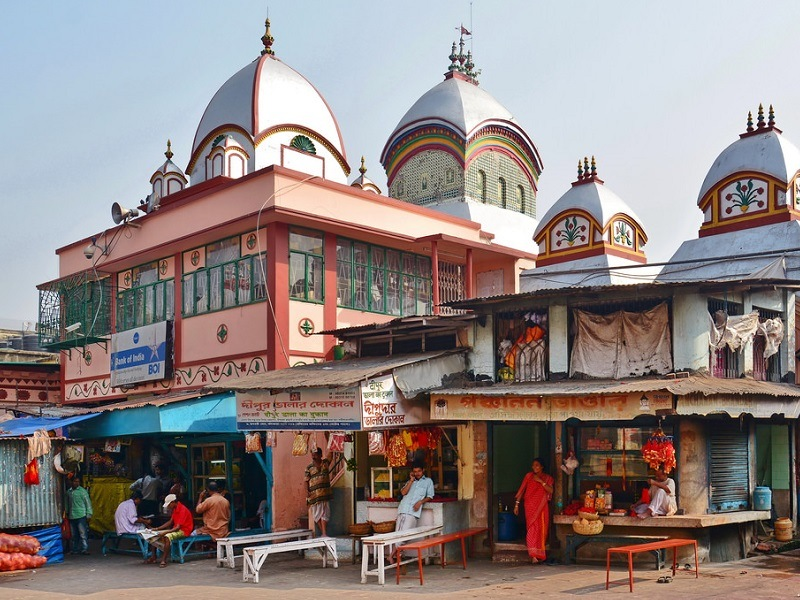Source: trawell.in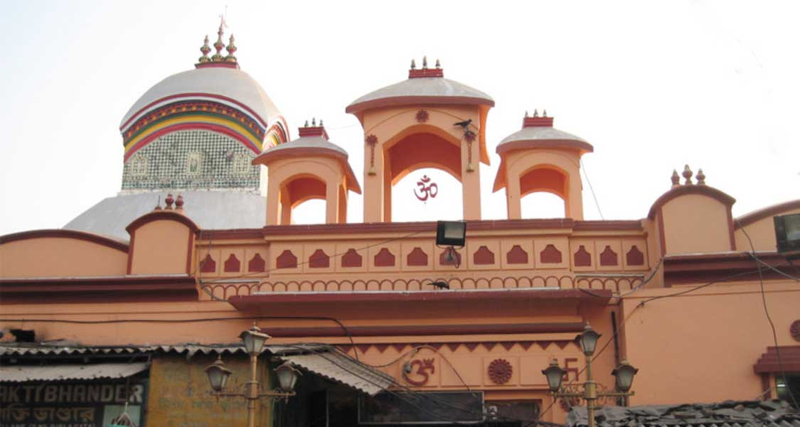Source: hoteldekho.com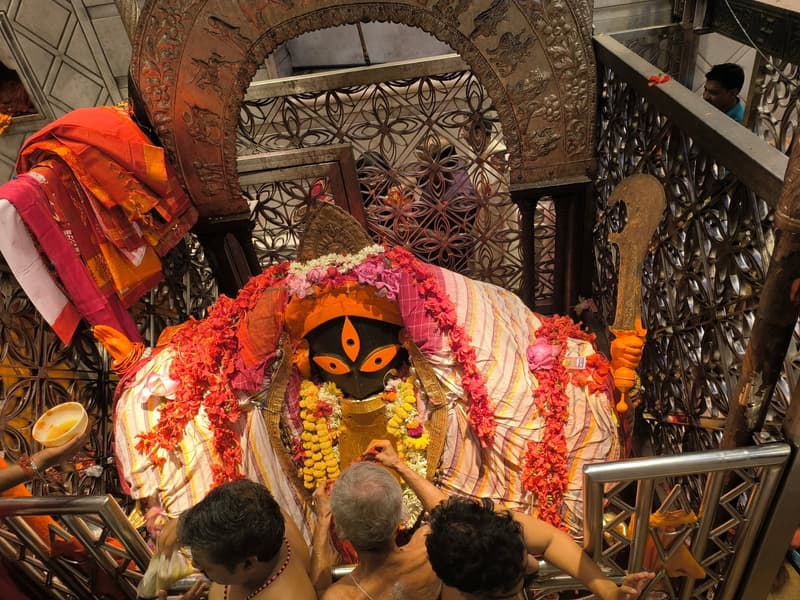Source: facebook.com/joymaakali80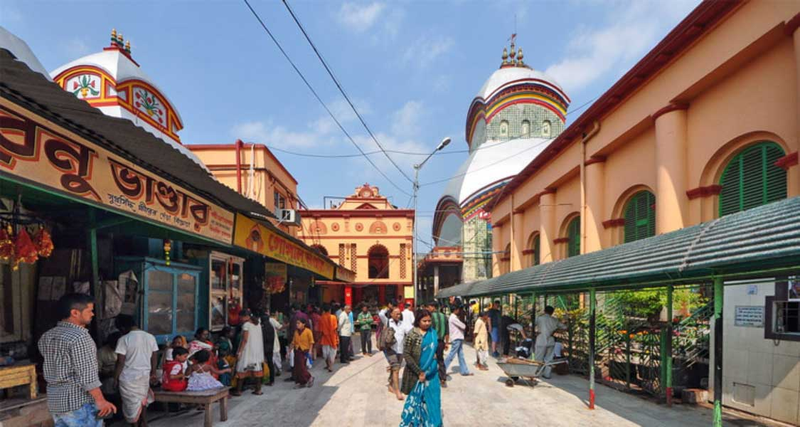Source: hoteldekho.com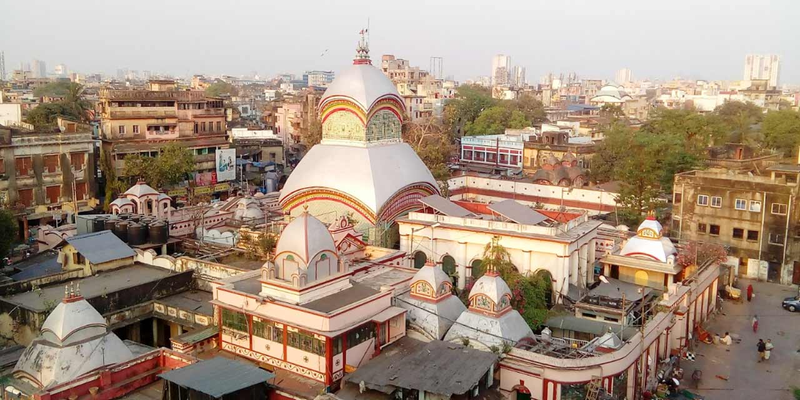Source: indiantempletour.com
## Kolkata Kalighat Kali Temple Tour – Structures Within the Complex
Beyond the sanctum, the **Kalighat complex** hosts several spiritually significant spaces:
### **1\. Natmandir**
A rectangular covered pavilion next to the main temple, where devotees can have **darshan (sight)** of Kali Maa’s face from afar.
### **2\. Jor Bangla**
The **verandah** of the temple faces the idol directly. From here, rituals in the **garbhagriha (inner sanctum)** can be viewed through the Natmandir.
### **3\. Harkath Tala**
A space for **animal sacrifice**:
- Two altars known as **Hari-Kath**:
- One for **buffaloes**
- One for **goats and sheep**
- Positioned adjacent to the Natmandir
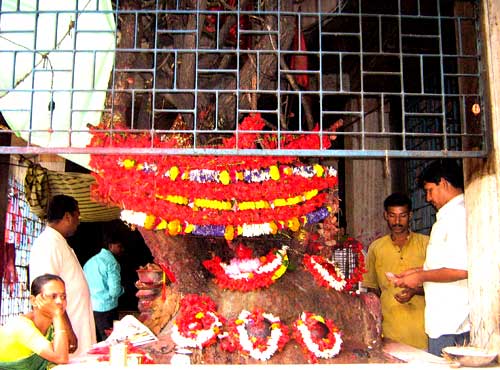
### **4\. Sosthi Tala (Monosha Tala)**
A small **sacred altar** under a cactus plant represents three goddesses: **Sosthi**, **Sitola**, and **Mongol Chandi**
- All the **priests here are women.**
- There is No daily Bhog or puja. It is considered a space of quiet, ancestral power.
- It is also believed to be the **Samadhi (final resting place)** of the saint **Brahmananda Giri.**
### **5\. Nakuleshwar Bhairav Temple**
A Lord Bhairav temple with a Svayambhu Lingam is situated in Haldar Para lane on the opposite side of the Kalighat Temple.
### **6\. Radha-Krishna Temple (Shyam-ray Mandir)**
A harmonious presence—this shrine reflects the **plurality of devotion** found within the complex.
### **7\. Kundupukur (The Sacred Tank)**
Situated to the southeast of the temple, outside its walls:
- Believed to be where **Devi Sati’s toe was discovered**
- Said to **bestow the boon of a child** to those who bathe or pray here with devotion
The architecture and spatial layout of **Kalighat Temple** do more than serve ritual function—they **embody the layers of Tantra, Shakti worship, and rural devotion**. Every pillar, tank, and altar is a reminder that Kali is **everywhere**—in the form, in the formless, in ritual, and in mystery.
## Kalighat Temple's Historical Story
### Etymology of the Name
It is believed that the temple originally stood on the banks of the **Hooghly River**, a prominent distributary of the Ganga. Over time, as the river shifted its course, the temple came to rest along the banks of what is now known as the **Adi Ganga**.
In Peetha Nirnaya Tantra, the temple is referred to as _“Kalipeetha”_. As it was located on a Ghat (a portion of a riverbank with steps for bathing, washing, etc.) of the Adi Ganga, it came to be known as **Kalighat**.
This sacred waterway holds immense religious importance. Even today, many devotees take a **holy dip in the Adi Ganga** before entering the Kalighat temple complex, considering it a **spiritual purification ritual** before their Darshan of **Ma Kali**.
### A Place of Divine Choosing & Popular Origin Stories
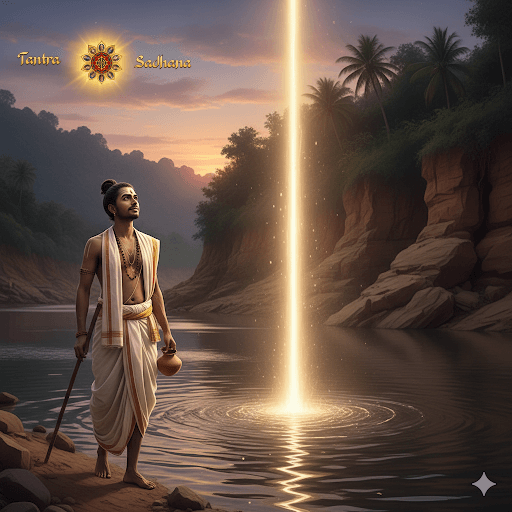
There are numerous stories about how the **Kalighat Temple** came into being. One of the most popular involves a Brahmin named **Atma Ram**, who noticed a toe-shaped structure floating in the **Bhagirathi River**.
People believe he was guided to it by a **beam of divine light** emerging from the water. Later, in a dream, he learned that the toe belonged to **Devi Sati**. He was asked to build a temple at the site and search for a **Svayambhu Lingam** (a self-manifested form of Shiva) of **Nakuleshwar Bhairav**.
Atma Ram eventually found the lingam and began worshipping it along with the toe-shaped relic.
Another version of the origin story says that the **idol of Kali Maa** was originally discovered as a **black stone**, worshipped under the open sky. A skilled craftsman, inspired by spiritual visions, is said to have carved the current form of the goddess from that single slab of stone.
There are **many such versions**, some overlapping and others differing completely. But this only adds to the temple’s mystique — revealing a **tapestry of faith**, rather than a single fixed narrative.
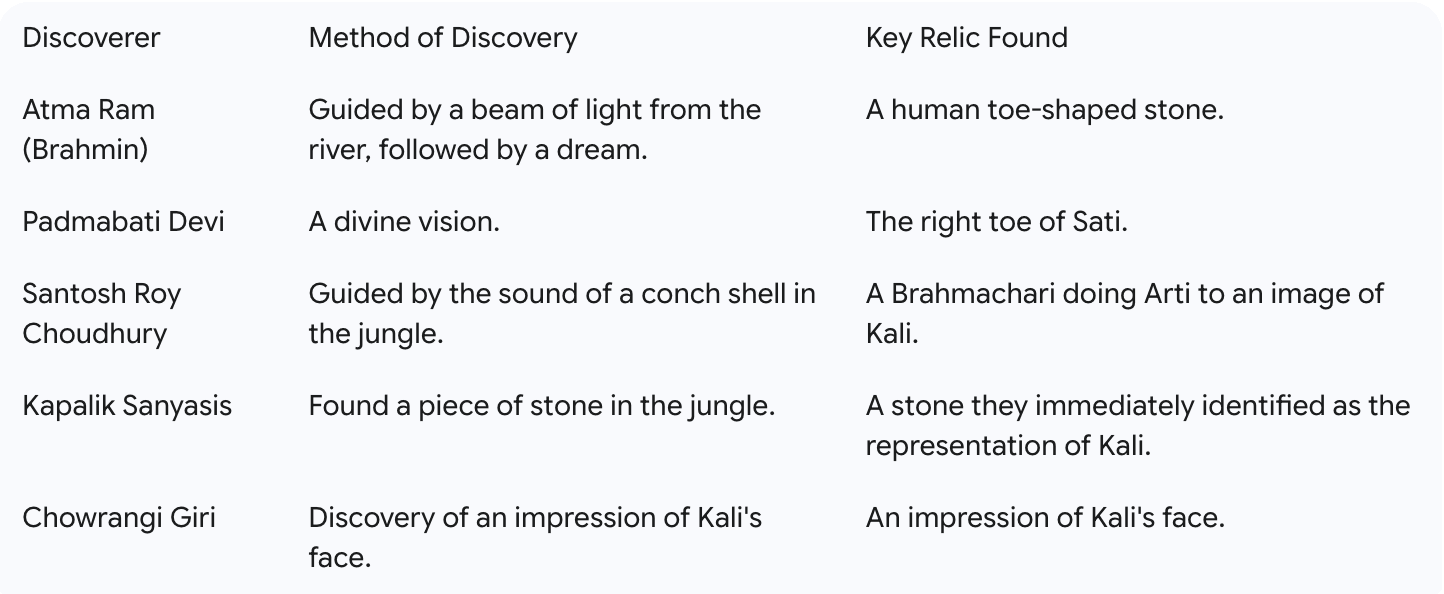
All these stories imply one truth: the site itself was always sacred. It was not man who chose the spot, but the **Divine that chose to reveal itself** there. The tales are simply accounts of those fortunate enough to witness and honour that revelation.
Initially, the temple was **not a grand structure**, but a **small, hut-like shrine** near the river. The present temple was constructed between **1809–1814** by the **Sabarna Roy Chowdhury family of Barisha**, a prominent zamindar family in Bengal.
Though the physical temple is only about 200 years old, literary references to it appear in much **older texts** — such as _Mansar Bhasan_ (15th century), _Chandimangal by Kavi Kankan Mukundaram_ (17th century) and _Peetha Nirnaya Tantra_ (11th century). These references serve as powerful evidence of the **ancient and enduring sacredness** of this mysterious shrine.
## The Uniqueness of the Kalighat Kali Temple Statue
The idol of **Maa Kali** at Kalighat is unlike Her typical depictions found in most temples and images.
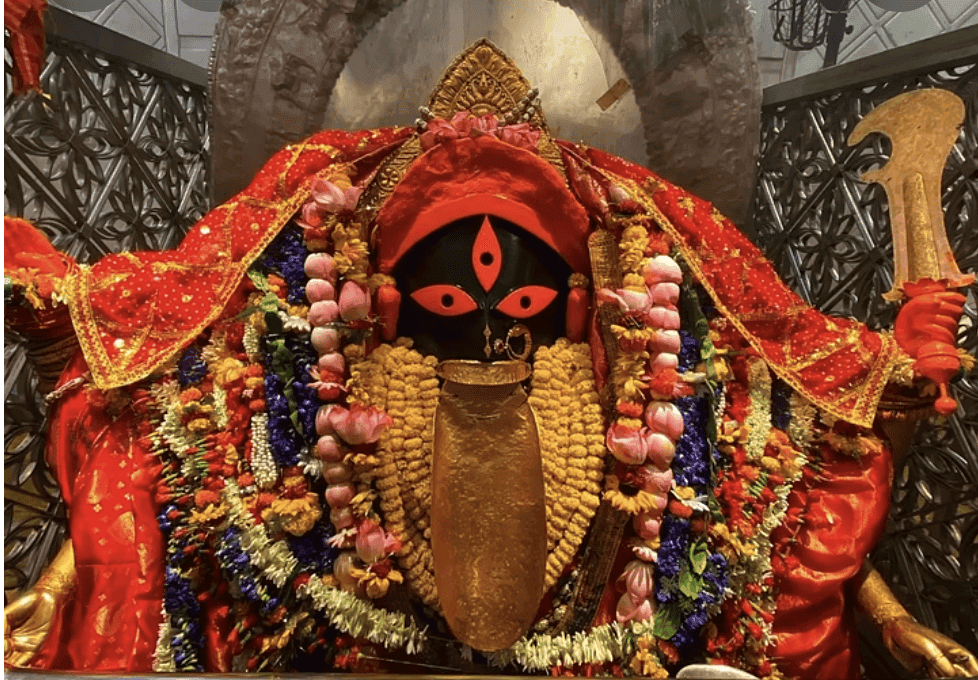
According to local lore, the idol was discovered as an **impression of Ma Kali’s terrifying face** on a black stone — with **three eyes** and a **long protruding tongue**, but **no full body**. Devotees continued to worship just **Ma’s face**, recognising Her powerful presence even in this form.
Today, the idol has:
- **Three large eyes without eyelids**, symbolising the Moon, Sun, and fire element.
- A **gold tongue** extended in her signature expression
- **Four hands**: one holding a sword, one a severed head, and two in **Abhaya and Varada Mudras** (bestowing blessings and protection)
The golden hands and tongue were later additions to the idol.
On the occasion of **Snan Yatra** (the ceremonial Bathing Festival on Jyeshtha Purnima), an extraordinary ritual takes place — **the priests blindfold themselves** before bathing the relic of Ma Sati, out of deep reverence for Her divine power.
Festivals like **Kali Puja**, **Durga Puja**, and **Poila Boishakh** (Bengali New Year) see thousands of devotees flocking to the temple to seek blessings from **Kali Mata**. Her fierce yet compassionate presence continues to draw seekers from all walks of life.
### Kali Maa’s Statue – Symbolism of Her Ayudhas (Weapons and Tools)
The iconography of **Kali Mata** is not just visually arresting—it is **rich with spiritual meaning** and **Tantric wisdom**.
### **The Four Golden Hands**
Of her four hands:
- Two are in **Abhaya Mudra** (granting fearlessness) and **Varada Mudra** (offering boons), symbolising **protection** and **compassion**.
- The other two hold a **sword** and a **severed head**, central to understanding Kali’s deeper message.
### **The Sword and the Severed Head**
These two elements convey a profound truth:
- The **sword** stands for **Divine Knowledge (Jnana)**—the clarity that cuts through illusion.
- The **severed head** represents the **human ego (Ahamkara)**—the false identity we cling to.
Together, they teach us this core lesson: **Liberation (Moksha)** can only be attained by **slaying the ego** through the power of divine insight.
Ma Kali is not a destroyer of life, but a **liberator of the soul**. Her image is not terrifying—it is **freeing**.
### **The Hidden Toe of Sati**
A lesser-known yet powerful secret lies beneath the idol.
Concealed within the pedestal of Kali Maa’s statue is a **Svayambhu (self-manifested)** relic—the **original toes of Devi Sati**—placed inside a silver box, with a carved image of Lord Shiva lying down. It resembles the standard iconography of Ma Kali standing on Lord Shiva.
**It is never revealed to the public**, nor even to the priests. In fact, in most of the Shakti Peethas, the sacred body parts of Ma Sati are hidden from public viewing. Many of them also do not display the actual relic.
This **invisible sacred core** reinforces the idea that the **true source of spiritual power is often unseen**—hidden, yet always present.
Just like Ma Kali herself, the temple invites us to **look beyond the visible**—to seek the **truth that lies beneath the form**.
Awaken Her Grace
## **Kalighat Temple’s Artistic Contribution: A Distinctive Painting Tradition**
Kalighat painting, also known as Kalighat Patachitra or Kalighat Pat, is a distinctive Indian painting tradition that emerged in the nineteenth century. It was developed and practised by specialised scroll painters known as _Patuas_ in the vicinity of the Kalighat Kali Temple.
These paintings are marked by vivid colours, bold and flowing outlines, and minimal backgrounds, giving them a striking visual immediacy. Their themes range from Hindu deities and Puranic narratives to scenes drawn from everyday social life.
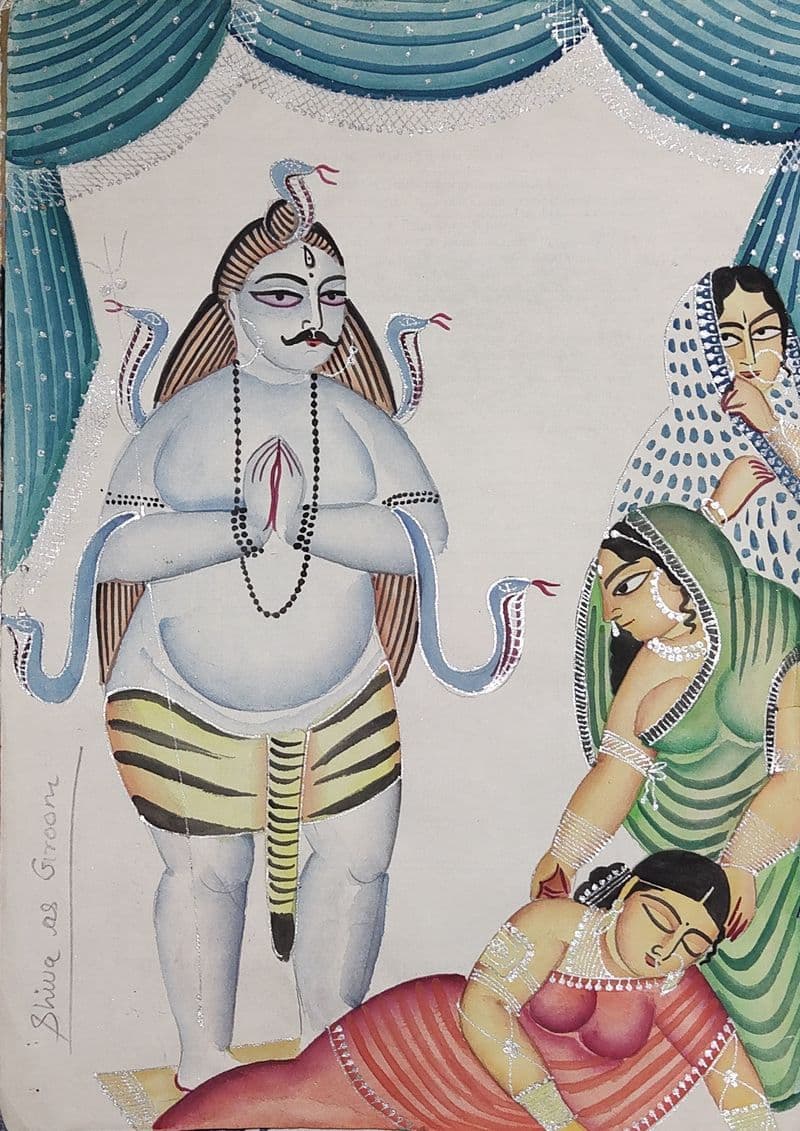
Today, the Victoria and Albert Museum in London houses the largest collection of Kalighat Pat paintings in the world, with approximately 645 works preserved in its archives.
## Kalighat Temple’s Architecture – A Sacred Blend of Earth and Spirit
The **Kalighat Temple**, dedicated to **Mahakali**, is not only spiritually potent—it is architecturally unique. Its form reflects the **Bengal countryside’s soul**, rooted in both rural simplicity and sacred complexity.
### Aat-Chala Style – Bengal’s Architectural Legacy
The main sanctum follows the **Aat-Chala** (eight-roofed) style, a hallmark of Bengal’s traditional temple architecture:
- Inspired by the **mud-and-thatch huts** found in villages
- The temple has **four sides and a truncated dome**
- **Three gold-topped spires** crown the roof, symbolising divinity
- **Metallic silver panels** and **vibrant colour bands** add a festive yet sacred aesthetic
- Recent restorations feature **terracotta motifs** inspired by nature—bridging tradition with artistry
## Saints Who Bowed at the Kalighat Kali Temple
Kalighat has never been just a structure of stone and rituals. It is a **living river of devotion**, pulling into its orbit saints, tantrics, monks, and mystics — seekers whose hearts burned with longing for the Divine.
Here are just a few of the **great souls who bowed before Maa Kali** in this sacred space:
### Sri Ramakrishna Paramahamsa
Kalighat was one of the places where [Sri Ramakrishna Paramahamsa](https://tantrasadhana.app/blog/swami-ramakrishna-paramahamsa-shakta-saint-kali-devotee)’s divine madness bloomed—where devotion overflowed beyond ritual and became ecstasy.
Sarat Chandra Chakravarti, in the 4th chapter of his book, 'Life of Nag Mahashaya', narrates the time when **Sri Ramakrishna visited Kalighat Temple** with his nephew, Hriday Mukherjee.
On the northern side of the pond near the temple, Sri Ramakrishna saw the Ma Kali in the form of a virgin wearing a **red-bordered cloth**. Seeing Her, he entered a higher state of consciousness while appearing to have lost consciousness externally.
After it passed, Sri Ramakrishna went inside the temple and found the **same red cloth** on the image of Ma Kali there. Hearing about this from Sri Ramakrishna, Hriday said, "Had you told me then and there, I would’ve run and caught hold of Her". With a smile, Sri Ramakrishna replied, "Ah, that cannot be; unless She wants it. None can see Her without **Her grace**, though She is present everywhere and before all".
### [Bamakhepa](https://en.wikipedia.org/wiki/Bamakhepa) — The Tantric Saint of Tarapith
According to texts such as _Kalitirtha Kalighat_ by Abadhut, _Kalighat Itibritta_ by Upendranath Mukhopadhyay, and _Bharater Sadhak_ by Shankarnath Ray, Maharaja Jatindramohan Thakur of Pathuriaghata once **visited Kalighat with the renowned saint Sri Bamakhepa** in the year 1898.
When Sri Bamakhepa entered the temple and found out that other visitors had been prohibited from entering it during his visit, he yelled in protest: “Equal rights! You have committed a great injustice. I shall have darshan of my Little Mother together with everyone.” The temple doors were immediately opened, and the huge crowd that had gathered outside to see Sri Bamakhepa was let inside. Only then did Sri Bamakhepa have a Darshan of **Ma Kali’s idol** at the temple, touching it with the affection of a child.
### Swami Vivekananda
Not many know that Swami Vivekananda once performed the ritual of Dondi at the Kalighat Temple to fulfill his mother’s vow.
After conquering the West with the message of Vedanta, he returned home—exhausted, but ablaze. In the silence of Kalighat, he bowed before Maa Kali. He asked for the **strength** to carry out the mission given by his Master, Ramakrishna.
And the Mother answered.
### The Living Flame
To visit Kalighat is to **stand in paradox**:
The chaos of crowds, the clang of bells, the scent of incense, the bleating of goats, the roll of drums,the sweetness of Kheer Mohan from Her chosen sweet shop… And yet, **at the heart of it all, silence**. In the sanctum, the Mother’s gaze meets your own — **piercing, forgiving, all-consuming**.
Kalighat is not just a temple. It is **Kolkata’s spiritual pulse**, a place where myth, memory, and modern life flow into one. In fact, Kolkata is said to derive its name from ‘Kali-Kshetra,' which is Kalighat.
Here, **Maa is not distant**. She is raw. She is real. She is present. And anyone who meets her gaze carries her fire **forever**.
**Know about the other** [**most powerful temples of Maa Kali here**](https://tantrasadhana.app/blog/most-powerful-kali-temples-across-india) **.**
## Praying to Maa Kali — A Modern Seeker’s Starting Point
For those who feel called to **Maa Kali’s fierce grace** but are unsure where to begin — you don’t need elaborate fire offerings, precise mantra chanting, or a formal initiation by a Guru.
All you need is **devotion and discipline**.
The [**Tantra Sadhana App**](https://tantrasadhana.app/) offers an easy, accessible, and **authentic path** for beginners to connect with the Divine Mother through guided daily practice.
- 🌑 It begins with **self-initiation** — a preparatory stage designed for sincere seekers.
- 🕉️ Then it leads you through the **main Sadhana of each Mahavidya**, starting with **Maa Kali**.
- 🌺 You are free to focus solely on Kali Maa’s practice if She is the one calling you.
Created by [**Om Swami**](https://omswami.com/), a Himalayan monk who has completed over **15,000 hours of deep meditation** and mastered various Vedic and Tantrik Sadhanas, the app is a **free offering** for those walking the spiritual path with sincerity.
Whether you are a curious beginner or a devoted seeker, may your journey to the **Divine Mother** be bold, beautiful, and blessed.
**Jai Maa Kali!**
Awaken Her Grace. Fall in love with the Divine.
Ma only calls those who are ready for Her worship. If you are here, you are ready. Awaken the Das Mahavidyas. And rise in devotion.
[Awaken Ma's Grace](https://tantra-sadhana-app.onelink.me/jgcg/24u3wjsu)
## FAQs
Q: Why is the Kali Ghat Temple famous?
A: Kalighat is one of the 51 sacred Shakti Pithas, where Maa Kali is worshipped as the fierce Mother who slays ego with divine wisdom. It draws thousands during Kali Puja, Snan Yatra, and tantric rituals.
Q: Which part of Maa Sati fell in Kali Ghat?
A: According to Puranic lore, the toe of Devi Sati’s right foot fell here, making Kalighat one of the most revered Shakti Peethas.
Q: Who built the Kali Ghat temple?
A: The original shrine was a modest hut by the river. The present temple was built between 1809–1814 by the Sabarna Roy Chowdhury family of Barisha.
Q: Which district is Kali Ghat in?
A: Kalighat lies in South Kolkata, West Bengal. It falls under the Kolkata Municipal Corporation and rests beside the sacred Adi Ganga.
---
This blog is powered by Superblog. Visit https://superblog.ai to know more.
---