In this article, you will read about:
Shukracharya’s Devotion, Penance, and Receiving the Mrit Sanjeevani Vidya
Transmission of Knowledge and the Metaphysics of Kacha and Devayani
Shukracharya’s Exposition on the Maha Mrityunjay Mantra
His Connection with Lord Bhairav, Netra Tantra, and Ma Kali
The Tantra Sadhana App
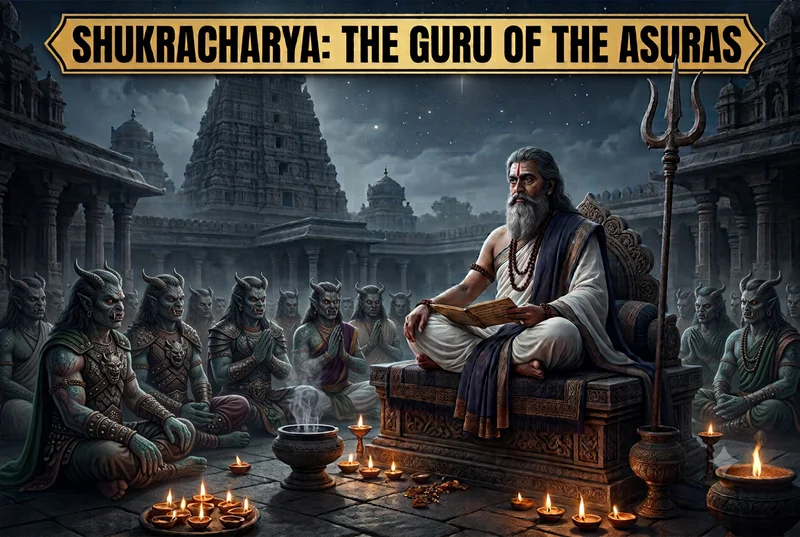
Shukracharya, the son of Sage Bhrigu, stands as one of the most prominent figures in Vedic and Tantric lore. He is the spiritual master of the Asuras (demons) and the divine recipient of the Mrit Sanjeevani Vidya.
His life of unprecedented austerity, mastery over esoteric secrets, and key role in transmitting sacred knowledge marked him as a central figure across Hindu texts, including the 16th chapter of the Kasikhand in Skand Puran, the Mahabharata (Adi Parva, Chapters 76 and 77), Devi Bhagavatam, and Shiv Maha Puran.
Shukracharya’s Early Devotion and the Severe Penance
Before waging war against the Devas, Shukracharya sought a power that could protect his disciples from permanent defeat. He resolved to obtain the Sanjeevani Mantra from Lord Shiv—a divine formula capable of restoring life to warriors slain on the battlefield.
To prepare for this endeavour, Shukracharya first installed the Shukreshwar Mahadev Lingam in Varanasi. He worshipped it continuously for 5,000 years with various floral offerings. Following this initial worship, he entered into an extreme form of spiritual practice.
According to the Devi Bhagavatam, he carried out this Tapas within his own hermitage, while the Kasikhand notes his deep connection to the Varanasi Ling from which Lord Shiv ultimately manifested.
Shukracharya undertook a continuous twenty-year penance, aligning with the Vimshottari Dasha period. He suspended himself upside down from a tree branch, directly above a fire fed by rice husk. As dense smoke swirled upward into his lungs, he purified his mind, senses, fears, and doubts through deep absorption in Shiv Dhyan. Lord Brihaspati, the Guru of the Devas, witnessed the prospect of such gruelling, severe vows and chose to observe Shukracharya undertake the challenge.
Lord Indra attempted to disrupt the Sadhana by sending his daughter, Jayanti. She added fiery chillies to the burning rice husks below him to force an interruption. Although the intense heat caused blood to bleed from Shukracharya’s eyes, nose, and mouth, his resolve remained unbroken, and he carried his penance to its completion.
How Shukracharya Received the Mrit Sanjeevani Vidya and the Title of Tapasvi Raj
Impressed by his unwavering mental focus and a spiritual lustre brighter than a thousand suns, Lord Shiv emerged from the Shukreshwar Ling. Addressing him as Bhargav, the storehouse of austerities, Lord Shiv offered him a boon. Shukracharya offered a heartfelt eulogy, prompting Lord Shiv to bestow upon him the Mrit Sanjeevani Vidya.
Lord Shiv revealed that this hidden mantra was evolved through his own penance and kept secret even from Lord Vishnu and Lord Brahma, granting Shukracharya the exclusive authority to revive the dead. Because of this unparalleled accomplishment, Lord Shiv proclaimed Shukracharya to be Tapasvi Raj, the king of spiritual discipline and penance.
This specific penance formed the foundation for Tapasvi Yoga in Jyotish (Vedic astrology), where Shukracharya represents the planet Venus (Shukra). The yoga defines an individual's capacity for intense spiritual discipline through the alignment of three planetary forces:
Venus (Shukra): Symbolising desire and its ultimate renunciation.
Saturn: Symbolising relentless hard labour and physical endurance.
Ketu: Symbolising the smoke inhaled during his ordeal and self-inflicted austerity.
Shukracharya’s Transmission of Knowledge and the Tale of Kacha
Amidst the endless clashes between the Devas and Asuras, King Vrishaparva led the demonic forces and emerged victorious each time. Shukracharya breathed life into the fallen demons with the Sanjeevani Vidya, rendering all the battle achievements of the Devas futile.
Lord Indra, realising that obtaining the Mrit Sanjeevani Vidya was non-negotiable for the survival of the Devas, devised a plan. He beseeched Lord Brihaspati to send his handsome and adorable son, Kacha, to learn this rare Madhu Vidya from Daitya Guru Shukracharya.
When Kacha approached Shukracharya, the sage initially hesitated due to Kacha's alliance with the Devas. However, Kacha reminded him that a true Guru’s Dharm is to impart knowledge to anyone who seeks it wholeheartedly.
Shukracharya relented and accepted Kacha into his Gurukul. Over time, Shukracharya’s beautiful daughter, Devayani, fell in love with Kacha.
News spread among the Asuras that Kacha was learning the sacred science. To thwart him, the demons plotted his death twice, but each time Shukracharya revived him upon Devayani’s tearful insistence.
On their third attempt, the Asuras killed Kacha, burned his body, ground his bones into powder, and secretly mixed the powder into Shukracharya’s surāpānam (a type of wine/alcohol).
When Devayani again grieved Kacha's disappearance, Shukracharya used his inner vision and discovered that Kacha lay inside his own stomach. Bound by his daughter's distress and Guru-Dharma, Shukracharya taught the Mrit Sanjeevani Vidya to Kacha while he was still inside his womb-like belly.
Once Kacha mastered the Vidya, he tore open Shukracharya’s abdomen and sprang to life, killing the Guru in the process. Having just learned the secret science, Kacha immediately recited the mantra to revive Shukracharya.
Grateful that Kacha kept his word and restored his life, Shukracharya blessed him. However, Devayani was heartbroken when Kacha prepared to depart for Devlok. She pleaded for him to marry her, but Kacha refused, explaining that having been reborn from Shukracharya’s body (Amsha), she was now his sister.
Heartbroken and realizing Kacha's sole intention was the Vidya, Devayani cursed him that he would never be able to personally invoke the mantra’s power. Despite the curse, Kacha departed relieved, knowing that even if he couldn't use the Mrit Sanjeevani Vidya himself, he could still transmit it to the Devas and his disciples for their benefit.
In a separate instance during a theological conflict regarding the relative superiority of Brahmans versus Kshatriyas, King Kshuva (a devotee of Lord Vishnu) struck Maharishi Dadhichi with a thunderbolt, severing his limbs.
Shukracharya, being an ancestor of Dadhichi, reattached his limbs, restored his life, and passed down the Maha Mrityunjay Mantra to him. Dadhichi later used this wisdom to perform penance, gaining three boons from Lord Shiv that made his bones as hard as diamonds and allowed him to defeat King Kshuva.
The mantra was eventually revealed (Shruti) to Vashisth Maharshi for global welfare, while its specific Bij mantras were received by Rishi Kahola in a state of Samadhi.
Esoteric Meaning: The Metaphysics of Śukra, Devayani, and Kacha
Beyond the historical narrative, the story carries profound esoteric and psychological truths:
Shukracharya and Mooladhar: Shukracharya represents the base centre within us at the Mooladhar Chakra; 'Shukra' literally translates to seed or vital fluid. Creative energy has three distinct functions:
To bring continuity in nature through procreation.
Being unlimited, it can connect and provide energy to any other subtle centre.
The potentiality of returning directly to its divine source.
Devayani as Urdhvaretas: The upward movement of this creative energy (Urdhvaretas) is called Dev Ayan—symbolised by Shukracharya’s daughter, Devayani.
The Asuras and Negative Emotions: The Asuras represent the recurring negative emotions within us—anger, jealousy, hatred, greed, and sensory indulgence. They seem to "never die" because every time we express negativity, we misuse our creative potential and inadvertently revive these destructive habits. In astrology, a powerful Shukra aspected by benefic planets like Jupiter ensures material well-being, yet under its unrefined influence, we relentlessly seek everlasting happiness in transient, physical gratification.
Brihaspati and Kacha: Brihaspati represents higher intellectual perception, while Kacha (meaning "to shine") is the wisdom gained through this elevated awareness. To build higher perception, our energies must connect with the Sanjeevani—an unlimited supply of vital energy achieved by transcending negative emotions. Kacha fails twice, but on the third attempt, he is destroyed by the Asuras (negative emotions) and purged through Shukracharya. When we break down our negative habits and contemplate them (Manthan), we recall our intrinsic nature (Sat-Chit-Anand).
Breaking the Cycle: Residual negativity normally lingers in the base centre, drawing fuel from gross desires to cause recurring mental patterns. Recalling life via Sanjeevani symbolises a conscious act of mindfulness. By introducing a pause in the cycle of negativity, we recall our intrinsic divinity, allowing the creative energy at Mooladhar to channelise upward along Dev Ayan.
Shukracharya’s Exposition on the Maha Mrityunjay Mantra
When instructing Rishi Dadhichi, Shukracharya provided a comprehensive breakdown of the Mahamrityunjay Mantra's structure, metaphysics, and meditation practices, as recorded in the Shiv Maha Puran. He explained that the mantra is composed in the Anushtubh Chandas metre, consisting of 4 padas of 8 syllables each, making 32 syllables in total.
Interpretation of the 4 Padas
1st Pada (trayaṁbakkaṁ yajāmahe): Shukracharya explained that this Pada praises Lord Tryambak (the three-eyed Shiv). The number 3 signifies Shiv as the master of the 3 worlds (Bhu, Bhuva, Svarga), 3 cosmic orbits (Surya, Som, Agni), 3 Gunas (Sattva, Rajas, Tamas), 3 fundamental truths (Atma, Vidya, Shiv), 3 sacrificial fires (Avahaniya, Garhapatya, Dakshinagni), 3 physical elements (Prithvi, Jal, Tejas), and the 3 primary deities (Brahma, Vishnu, Shiv). Turning inward (Antarmukham) opens the third eye, transcending the waking (Jagrit), dreaming (Swapna), and deep sleep (Sushupti) states.
2nd Pada (sugandhiṁ puṣṭivardhanam): Shukracharya defined Sugandhim as Lord Shiv’s pervasive presence throughout creation, living within all elements, Gunas, Devas, Ganas, and the 10 Indriyas (5 sensory organs and 5 organs of action). He defined Pushtivardhanam as the inward soul (Purush) that sustains physical nature (Prakriti) from the primordial state of matter (Mahatattva) to individual living beings.
3rd and 4th Padas (urvāruhamiva bandhanān mṛtyormūkṣīya māmṛtāt): Shukracharya highlighted this 16-syllable prayer for liberation, comparing a spiritual seeker to a ripe cucumber detaching naturally from its vine. The vine represents earthly attachments, limitations, and mental conditioning. A seeker who overcomes these mental limits achieves the state of a Jivanmukt (liberated while living), gaining freedom from the fear of death through Rudra's nectar.
The Dhyan Recited by Shukracharya
Before instructing Dadhichi in fire oblations, Shukracharya shared the foundational meditation verse (Dhyan Shlok):
hastāmbhojayugasthakumbhayugalādudghṛtya toyaṁ śiraḥ
siñcantaṁ karayoryugena dadhataṁ svāṅke sakumbhau karau |akṣastraṅmṛgahastamambujagataṁ mūrdhasthacandrastravat
pīyūṣārdratanuṁ bhaje sagirijaṁ tryakṣaṁ mṛtyuṅjayam ||

Shukracharya detailed the symbolic layers of this visualisation:
The 8 Arms: Represent the 8 directions of the zodiac wheel (Kalachakra), protecting the seeker from negative forces, fate, and time. Two lower hands hold nectar pots (Amrit Kalash) on the lap, 2 upper hands pour nectar over His head, 2 hold additional vessels, 1 holds a Rudraksh Mala indicating continuous Sadhana, and 1 holds the Mrig Mudra representing a focused mind.
The 3 Eyes: The right eye represents the Sun (Dharma and truth), the left eye represents the Moon (emotions and joy/sorrow), and the central eye represents Agni (supreme wisdom).
The Cosmic Abhishek: Water dripping from the crescent moon on Lord Shiv's head becomes Som (the nectar of life), soaking His body. Shukracharya linked this visualisation to the Rudrabhishek ritual. In astrological sciences, the Sun draws moisture from the oceans, which condenses around mountains to fall as life-sustaining rain. Shukracharya explained that this cycle reflects the life-giving Sanjeevani Shakti of Devi Parvati (Amriteshwari), seated alongside Lord Shiv, sustaining all terrestrial life.
Shukracharya’s Connection with Lord Bhairav and Tantra
In esoteric Hindu traditions and Shaiva Tantra, the connection between Shukracharya, Lord Kal Bhairav, and scriptures such as the Netra Tantra rests upon three core concepts: the mastery of life force (Shukra and Amrit), the secret of overcoming time and death (Mrityunjay), and the fierce practices (Ugra Sadhana) that bridge light and dark forces.
1. The Netra Tantra and the Essence of Shukra (Vital Force)
The Netra Tantra (also known as the Mrityunjay Tantra) is a primary non-dualist Shaiva text compiled around the 7th–8th century in Kashmir. Its central deity is Amritesheshwar Bhairav—a high, nectar-bestowing aspect of Lord Shiva/Bhairav who conquers death.
The Metaphor of Shukra: In the first chapter of the Netra Tantra, Lord Shiv explains to Goddess Parvati that the fiery, radiant essence within His 3rd eye is the source of all cosmic creation, protection, and destruction. Lord Shiv metaphorically refers to this supreme vitality and seed of consciousness as His own Shukra (vital nectar/essence) and Ojas.
Connection to Shukracharya: Shukracharya in the Puranas and Tantras is the personification of this Shukra—the bearer of Sanjeevani Vidya. In Tantric esoteric anatomy, Shukracharya’s legendary ability to revive the dead is the literalised myth of managing Shukra (vital essence/prana) via the 3rd eye of Bhairava to attain Amritatva (immortality/liberation).
2. Shukracharya’s Connection to Lord Bhairav
While the Devas sought guidance from Lord Brihaspati, the Asuras turned to Shukracharya, who leaned heavily toward fierce, left-hand, and protective practices (Ugra Tantric Sadhanas):
Devotee of the Fierce Aspect: Puranic and Tantric narratives hold that Shukracharya performed intense penances (Tapas) dedicated to Lord Shiv in His fiercest forms (including Bhairav) to obtain the Maha Mrityunjay Mantra and Sanjeevani secrets.
Taming Time (Kal): Kal Bhairav represents the terrifying velocity of Cosmic Time and absolute dissolution. Shukracharya’s path in Tantra involves mastering Kal (time/death) so that his disciples (the Asuras) could survive annihilation by the Devas. Because Kal Bhairav acts as the Kshetrapala (guardian of sacred thresholds and time), Shukracharya’s rites frequently invoke Bhairav to shield practitioners from premature death (Akal Mrityu) and karmic retribution.
3. The Netra Tantra and the Science of Transcendence
According to the Netra Tantra, harnessing the healing force of the Mrityunjay Mantra through Lord Bhairav allows a practitioner to transcend four primary subtle afflictions:
Bhut: The ghosts of our past regrets, resentments, and emotional baggage that we are unwilling to let go.
Yaksh: Our inner and outer demons that distort perception.
Graha: Cosmic and psychological forces that hold us captive or bound.
Unmad: Mental weakness, delusion, and emotional instability.
By channelling this divine force, seekers heal themselves on every level, echoing the sacred prayer of surrender:
Trāhi Māṁ Trāhi Māṁ, Pāhi Māṁ Pāhi Māṁ
Jagat-Sṛṣṭi-Pralaya Viśva, Saṅkaṭa Tava Nāśitām"O Mahadev, protect us, protect us! We surrender unto You. You alone create, sustain, and dissolve the world; please remove our perilous afflictions."
Shukracharya and Ma Kali
While no scriptural narrative depicts Shukracharya directly worshipping Ma Kali, examining their respective esoteric domains reveals the fundamental difference between defeating death and transcending death.
The Threshold of Mrit Sanjivani Vidya
As seen in Kacha's account, Shukracharya’s Sanjivani Vidya represents the absolute pinnacle of occult power over physical restoration—operating strictly within the boundaries of Time (Kal). It grants mastery over the threshold between death and renewed life by reversing physical mortality.
However, reviving an individual merely restores them to an embodied state where birth, aging, karma, and eventual death still apply. Sanjivani escapes a specific instance of death without overcoming the principle of mortality itself. It operates within the temporal loop: a being dies, and life is restored.
Ma Kali: Primordial Shakti Beyond Time
Where Shukracharya reverses death within Time, Ma Kali stands prior to Time itself. In the Mahakal Samhita (Guhya Kali tradition), a key verse from the Guhya Kali Sudha Dhara Stava highlights Her metaphysical nature as Parabrahman:
yadā naiva dhātā na viṣṇurna rudro
na kālo na vā pañcabhūtāni cātmā |tadā kāraṇībhūtasattyaikamūrtiṃ
tvamekā parabrahmarūpeṇa siddhā ||"When neither Brahma, nor Vishnu, nor Rudra, nor Time, nor the five elements, nor the individual self existed, You alone existed as the one ultimate reality, established as Parabrahman."
This theology is further expanded in the Kalika Puran (Chapters 52–71), which presents Ma Adya Kali as the beginningless sovereign of the entire universe, moving beyond Her battlefield persona to embody the dissolution of limitation itself. She does not merely restore what Time takes; She is the reality before which Time loses its sovereignty.
Raktabij and the Destruction of Karmic Recurrence
The Devi Mahatmya illustrates the practical distinction between Shukracharya's method and Ma Kali's power:
Shukracharya restores the fallen form: In Chapters 7 and 8, Ma Kali emerges as Chamunda to slay Chand and Mund, and later confronts Raktabij. Raktabij represents the endless cycle of karma, desire, and mental repetition—every drop of his spilt blood creates an identical Asur.
Ma Kali consumes the seed of origin: Chandika commands Ma Kali (viśīrṇaṁ vadanaṁ kuru) to expand Her mouth and consume the blood drops and newborn Asuras (bhakṣayantī chara raṇe tadutpannān mahāsurān). Ma Kali drinks his blood before it touches the earth, exhausting his source until he falls lifeless.
The Essential Distinction
Shukracharya’s Sanjivani asks: "Can the body return from death?" It restores life within the temporal order.
Ma Kali asks: "Who is the one who dies?" She reveals the uncreated consciousness that Time cannot touch.
Shukracharya conquers physical death within the field of Time; Ma Kali reveals the eternal reality beyond Time. His knowledge restores embodied existence; Her Vidya provides liberation from the cycle of embodiment altogether.
The Tantra Sadhana App
Crafted by the Himalayan monk Om Swami, the completely free and ad-free Tantra Sadhana App opens the sacred, once-guarded realm of the Das Mahavidyas—the 10 Wisdom Goddesses of Tantra—to every earnest seeker longing for the Divine Mother.
It draws the Sadhak into a breathtaking odyssey across immersive 3D worlds, spanning from the fierce protection of Ma Kali to the golden radiance of Ma Kamalatmika. Month by month, through the quiet cadence of Tantric Mantra Jap, sacred Yagna, and deep esoteric Sadhana, the seeker gently awakens each Mahavidya within their own consciousness.
The engaging Tantric Sadhanas in the app, such as Maa Kali’s virtual Shav Sadhana, invoke forms of Lord Bhairav, such as Mahakal Bhairav, as the Divine Masculine counterparts of the Mahavidyas embodying Divine Femininity.
Anchored in the unique path of Divyachar, this journey transcends physical ritual. Every offering is forged entirely in the silence of the heart. Om Swami himself mastered these mental rites in deep solitude and poured his own fully awakened chants into the app, infusing every practice with living spiritual power.
Guided step-by-step by his resonant voice through meticulously coded rituals, even a beginner without a personal Guru can walk this powerful Tantric path with complete safety, accessibility, and focus.