In this article, you will read about:
Temple Timings, Pujas and Sevas at Dakshineswar Kali Temple
How to Reach the Dakshineswar Temple and Best Times to Visit
Photos and History of Dakshineswar Kali Temple
Ramakrishna Paramahamsa and the Siddha Kshetra of Dakshineswar Temple
Tantra Sadhana App for Ma Kali Worship
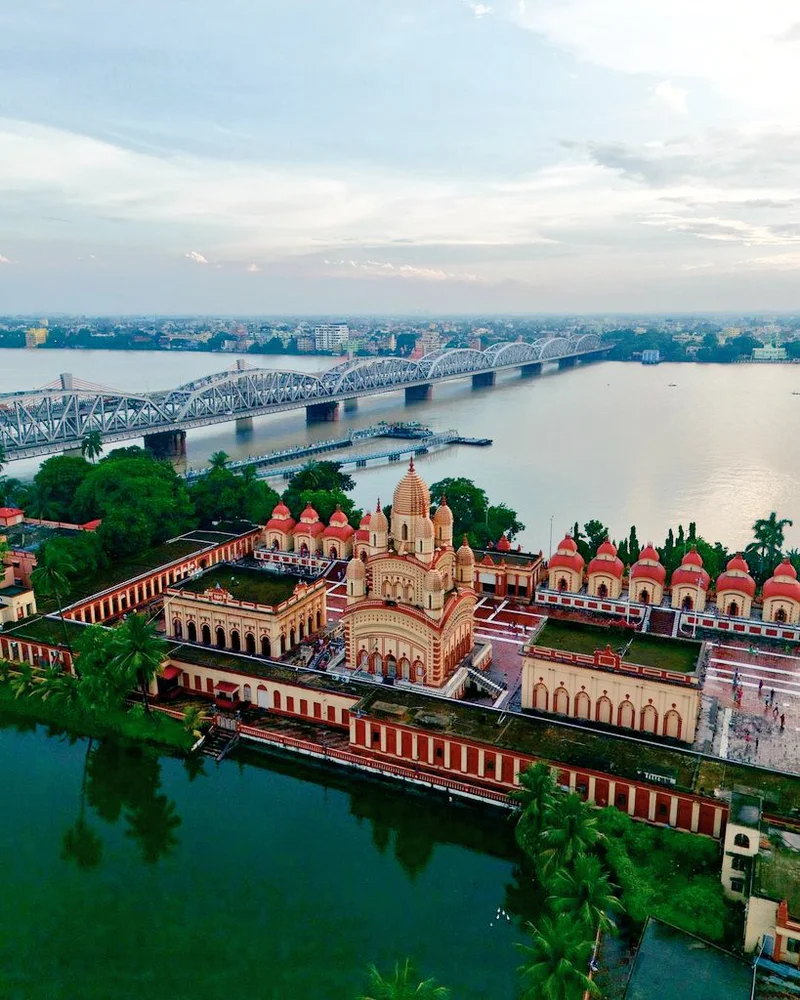
Overlooking the banks of the Ganga, the Dakshineswar Kali Temple stands as a powerful centre of devotion to Ma Bhavatarini.
Though built in the mid-nineteenth century, the temple carries a strong sense of sacred presence, shaped by intense worship, lived spiritual experience, and the deep imprint of Ma Kali’s Grace. Dakshineswar is closely woven with legend and devotion, inviting visitors into a space where the sacred feels immediate rather than distant.
Dakshineswar Kali Temple Timings
Summer (Apr to Sep)
Morning: 5:30 AM to 11:30 AM
Evening: 3:30 PM to 9:00 PM
Mangal Aarti: 4:00 AM
Bhog Aarti: 12:00 PM
Sandhya Aarti: 7:00 PM
Winter (Oct to Mar)
Morning: 6:00 AM to 12:30 PM
Evening: 3:00 PM to 8:30 PM
Mangal Aarti: 5:00 AM
Bhog Aarti: 12:00 PM
Sandhya Aarti: 6:30 PM
Pujas and Sevas at Dakshineswar Kali Temple
Pujas
Nitya Puja (Daily Rituals): The core foundational worship of Goddess Bhavatarini conducted by the head priests. It follows a strict daily format involving the purification of the space, ritual steps, and scripture recitations.
While devotees cannot sit inside the sanctum during these rites, they can view them from the courtyard and queues.
Sankalp Puja: Individualised prayer rituals performed by a priest on behalf of a specific devotee. Devotees book this at the administrative office by registering their name, birth star (Nakshatra), and family lineage (Gotra), which the priest chants during the main ritual to invoke direct blessings.
Amavasya Pujas: Special, highly elaborate ritualistic scriptural pujas performed during the night of every Amavasya (New Moon). Because the New Moon holds supreme spiritual significance in Ma Kali worship, these extended nocturnal sessions draw massive congregations of onlookers.
Shiva Linga Pujas: Independent ritual worship conducted at the 12 identical aat-chala (eight-eaves) architectural shrines lining the riverfront. Devotees perform these smaller-scale pujas under the guidance of the complex priests assigned to the individual Shiva deities.
Sevas
Dala Utsarga Seva: The primary physical offering service available to everyday pilgrims. Devotees purchase or bring a Puja Dala (a traditional wicker basket containing fresh hibiscus garlands, sweets, bael leaves, and sindoor) and hand it over to the duty priest at the threshold of the Garbha Griha (sanctum sanctorum).
The priest performs the offering at the feet of the deity and returns the basket.
Bhog Seva: The acts of sponsoring or participating in the temple's daily food offerings. Devotees can purchase Annamrita Bhog coupons from the designated temple administrative counters between 9:00 AM and 10:00 AM daily.
This service gives them access to partake in the sanctified communal lunch served inside the Bhog Ghar (dining hall).
Ganga Jal Seva: A self-guided, devotional water service where pilgrims collect holy water directly from the adjacent Hooghly River (Ganges) via the Bakul Tala or main bathing ghats to wash their hands and feet before entering the main shrine, or to pour directly over the riverfront Shiva Lingas.
How to Reach the Dakshineswar Temple
Reaching the temple complex is highly efficient due to multiple dedicated transport routes serving the northern region of Kolkata. Depending on your starting point, you can choose from the following transit methods:
By Metro (Fastest Route): Take the North-South Corridor (Blue Line) of the Kolkata Metro and disembark at the Dakshineswar Metro Station, which serves as the northern terminal. The temple is a brief, pedestrian-friendly walk away, made easier by the direct Dakshineswar Skywalk that safely routes visitors from the transit hub straight to the temple gates.
By Local Train: Board a suburban train heading towards Dankuni from the Sealdah Railway Station. Alight at the Dakshineswar Railway Station, which sits adjacent to the metro terminal and connects seamlessly to the temple approach paths.
By Road: Travel via private taxi, app-based cab services, or state buses operating along PWD Road (Sitaramdas Omkarnath Sarani). Direct buses drop passengers off near the temple crossing—roughly a 10 to 14 km drive from central Kolkata, depending on prevailing city traffic.
By Ferry (Scenic Route): Utilise the local river transport system by boarding a ferry from Baghbazar Ghat in Kolkata to the Ma Bhabotarini Jetty Ghat near Dakshineswar. The jetty is located roughly 350 m from the main temple complex, offering a scenic trip along the Hooghly River.
Festival Days: Best Times to Visit the Dakshineswar Temple
Dakshineswar observes several important festivals throughout the year, each rooted in the temple’s ritual calendar rather than general Kali worship alone. The principal observances are Phalaharini Kali Puja, Dipanwita Kali Puja, Ratanti Kali Puja, and the Navaratris (Durga Puja).
In addition, festivals such as Ratha Yatra, Snana Yatra, and Kalpataru Mahotsav are also marked with devotion and ceremony.
Among these, Dipanwita Kali Puja, observed on the new moon night, holds particular significance. A distinctive ritual associated with this observance at Dakshineswar is Ghat Snan, a ceremonial bath at the Ganga, a practice closely linked to the period of Sri Ramakrishna.
Another notable feature is the substitution of traditional Karan (wine) offerings with coconut water, reflecting the temple’s emphasis on ritual purity and restraint.
During festival days, the temple draws large numbers of devotees who gather for worship, prayer, and quiet vigil through the night. Lamps illuminate the temple façade and the riverbank, while the atmosphere remains focused on ritual observance rather than spectacle.
These occasions reinforce Dakshineswar’s identity as a living centre of practice, where tradition continues through carefully preserved forms rather than excess or display.
Photos of Dakshineswar Kali Temple


History of Dakshineswar Kali Temple
Origin: Rani Rashmoni and the Birth of Dakshineswar
Rani Rashmoni, widely revered as Lokmata Rani Rashmoni, was an influential businesswoman, zamindar, philanthropist, and social reformer of nineteenth-century Bengal.
She is remembered not only as the founder of the Dakshineswar Kali Temple but also as a formidable figure who challenged colonial authority and played a significant role in the early currents of the Bengal Renaissance.
At a time when women faced severe social and legal restrictions, her leadership, independence, and public influence were extraordinary.
In 1847, Rani Rashmoni planned a pilgrimage to Kashi. According to tradition, on the night before her departure, she experienced a powerful vision in which the Divine Mother instructed her to establish a temple on the banks of the Ganga instead.
Deeply moved, she cancelled her journey, acquired land along the river, and initiated the construction of the temple.
After eight years of effort and considerable personal expense, the Dakshineswar Kali Temple was formally consecrated on the auspicious occasion of Snana Yatra (Jyeshtha Purnima) in 1855.
At the time of Prana Pratishtha, the presiding deity was named Sri Sri Jagadiswari Kalimata Thakurani, which remains Her official name to this day.
The name Bhavatarini, by which the Goddess is popularly known, reflects a devotional understanding of Her grace rather than the formal consecration name.
The founding of Dakshineswar is thus remembered not merely as the result of a vision, but as a deliberate and historic act through which the Divine Mother’s presence was established in a living centre of worship, shaped by Rani Rashmoni’s devotion, courage, and social vision.
Ritual, Resistance, and Quiet Defiance
In nineteenth-century Bengal, access to temples was tightly controlled by caste, gender, and religious authority. For Rani Rashmoni, a widow from the Kaibartya (Shudra) community, to rise to prominence and undertake the construction of a major temple was extraordinary.
Her actions challenged not only colonial power but also deeply entrenched Brahminical orthodoxy within Hindu society.
This tension came sharply into focus during the founding of the Dakshineswar Kali Temple. When news spread that a Shudra widow intended to build a temple on the banks of the sacred Ganga, upper-caste landlords on the western bank attempted to block the effort by refusing to sell her land.
As a result, Rani Rashmoni acquired thirty-three acres on the eastern bank, a decision that would shape the temple’s identity and history.
Resistance did not end there. As the temple neared completion, many priests in Calcutta refused to recognise it as a legitimate Hindu place of worship due to its founder’s caste. Drawing upon scriptural provisions, Rani Rashmoni resolved this impasse by donating the temple land to a Brahmin priest, who then performed the consecration rituals.
This act ensured that the temple could function fully within orthodox religious frameworks, even as its very existence quietly unsettled them.
From its inception, Dakshineswar stood as more than a ritual space. It became a subtle but powerful statement — that devotion, spiritual authority, and access to the Divine were not the exclusive preserve of social elites, but open to all who approached the Mother with sincerity.
Lesser-Known Stories and the Hallmarks of the Unseen
Beyond its well-known history, Dakshineswar is also shaped by quieter narratives that circulate among devotees and local memory. The temple grounds are associated with stories of personal visions, unanswered questions finding clarity, and moments of quiet reassurance — accounts that are rarely documented but persist through lived experience.
One such detail concerns the land itself. The main temple was built on a site once known as Saheban Bagicha, purchased from an English owner during the colonial period.
This transition reflects a time of political uncertainty, but also one of possibility, where sacred space emerged within a changing social and historical landscape.
Ramakrishna Paramahamsa: The Legendary Saint of Dakshineswar Temple
The spiritual identity of the Dakshineswar Kali Temple is inseparable from Sri Ramakrishna Paramahamsa. Beginning his service as a temple priest, he gradually became the living centre of Dakshineswar through an intense and deeply personal devotion to Maa Kali.
Ramakrishna related to the Goddess not as an abstract ideal, but as a living Mother. His worship was marked by emotional immediacy — singing, prayer, silence, and periods of complete absorption in which he lost awareness of the external world.
These states, often described as Samadhi, drew visitors from across social and religious backgrounds, curious to witness a form of faith that was direct, unmediated, and uncompromising.
Despite growing recognition, Ramakrishna remained gentle and accessible, engaging freely with all who approached him.
Among those drawn to him was Swami Vivekananda, then known as Narendranath, whose questioning and eventual transformation would carry Ramakrishna’s influence far beyond Dakshineswar.
Ramakrishna’s small room above the temple’s northern veranda became a quiet centre of reflection and dialogue, where seekers gathered to explore questions of belief, doubt, and spiritual experience.
His Divine Vision of Ma Kali at Dakshineswar
Known as Gadadhar Chattopadhyay in his youth, Sri Ramakrishna served as the priest at the Dakshineswar Kali Temple. Yet, unlike other priests who performed rituals mechanically, his heart burned with a question that consumed his every waking moment:
“Is the Mother Kali merely a stone statue, or is She a living, responding presence?”
This longing was not born of curiosity, but of deep yearning for Divine Union. Day after day, he stood before the radiant idol of Ma Kali, singing the soul-stirring songs of Ramprasad Sen and Kamalakanta Bhattacharya, pouring out his heart in prayer:
“Mother, You revealed Yourself to Ramprasad — why won’t You show Yourself to me? I don’t want wealth, friends, or worldly pleasures. Just reveal Yourself to me!”
One evening, his anguish reached its breaking point. Overwhelmed by despair, he rushed to the sanctum and seized the ceremonial sword, crying,
“Mother, if You will not show Yourself to me, I have no desire to live!”
At that very instant — when human effort had reached its limit — Divine Grace descended. The temple was suddenly filled with a dazzling light. The walls, floor, and ceiling pulsed with consciousness itself.
And before him appeared the living form of Ma Kali — luminous, compassionate, and alive.
She was not fierce or fearsome, but infinitely tender — smiling, radiant, and full of maternal love. Her presence was more tangible than any material form.
Sri Ramakrishna felt Her breath, Her warmth, and the heartbeat of eternity itself.
The vision was so overwhelming that he lost all external awareness, merging into waves of divine bliss. Later, he described it as dissolving into an ocean of pure love, where “the self vanished, and only the Divine Mother remained.”
When he awoke, life itself had transformed. The stone image had become the living Ma Kali, and their relationship grew into an intimacy beyond comprehension.
From that day, Ramakrishna no longer saw Her as an idol — only as the embodied Mother of the Universe.
He would often sing this verse by Ramprasad Sen, describing the inner virtues one must cultivate to behold the Divine Mother:
Come, let us go for a walk, O mind, to Kali the Wish-fulfilling Tree,
And there beneath it gather the four fruits of life.
Of your two wives, Dispassion and worldliness,
Bring along Dispassion only on your way to the Tree,
And ask her son, Discrimination, about the truth.
When will you learn to lie, O mind, in the abode of blessedness,
With cleanliness and defilement on either side of you?
Only when you have found the way
To keep these wives contentedly under a single roof,
Will you behold the matchless form of Ma Kali.
Dakshineswar Kali Temple as a Siddha Kshetra
The spiritual stature of Dakshineswar is also affirmed by those who lived closest to Ramakrishna Paramahamsa. Swami Shivananda, a direct disciple of Sri Ramakrishna, described Dakshineswar as a sacred landscape shaped by sustained realisation rather than symbolism alone.
Referring especially to the Panchavati, where Sri Ramakrishna practised intense Sadhana for over twelve years, he spoke of the temple complex as a place of rare spiritual attainment, comparable to Kailasa or Vaikuntha.
According to him, the repeated visions, disciplines, and inner states realised there consecrated the very ground itself, making Dakshineswar not merely a site of worship, but a fully awakened spiritual field.
What Makes Dakshineswar Kali Temple So Great
The Dakshineswar Temple isn’t one of the 51 Shaktipeeths where the body parts of Devi Sati fell. It endures not because of Puranic legend, but because it became a Siddha Kshetra — a spiritually awakened space shaped by sustained sadhana and realised presence.
The temple’s deeper significance arises from the intense spiritual practices of Ramakrishna Paramahamsa and Sarada Devi, whose lives and penance transformed Dakshineswar from a newly built, beautiful shrine into a living centre of spiritual power.
Socially and culturally, the temple stands as a reminder that spiritual authority in Hindu tradition is not confined to lineage or status, but is revealed through direct experience and inner realisation.
For devotees and visitors alike, Dakshineswar is not approached as a monument, but as a place of active spiritual presence even today.
The enduring relevance of the temple lies in this continuity of practice — a space where Ma Kali is not only worshipped, but experienced through the discipline, surrender, and inner transformation exemplified by those who lived and realised the Divine here.
Know about the other most powerful temples of Maa Kali here.
Tantra Sadhana App for Ma Kali Worship
The Tantra Sadhana app is a digital medium to awaken the Das Mahavidyas (10 Wisdom Goddesses of Tantra) in your life by worshipping them in a structured manner, starting with Ma Kali and ending with Ma Kamalatmika.
Each Mahavidya, including Ma Kali, is awakened by the user in a specified number of days through Her Tantric Mantra Jap with Bijas, Yagna, and virtual Sadhana, such as Ma Kali’s Shav Sadhana.
The app follows the path of Divyachar, where no physical offerings or paraphernalia are ever required. It has been created by the Himalayan monk, Om Swami, to make Tantric worship of the Divine Mother through this particular path accessible to the masses, even without the guidance of a personal guru.
To facilitate this, all the rituals in the app have been mastered by Om Swami and then coded into the app along with guided instructions.
Furthermore, all the awakened chants have been recorded in Om Swami’s voice and can be heard by the user as they chant the Mantras and Shlokas.
Most importantly, the entire app journey is cost-free and ad-free, with the provision for users to offer an optional Dakshina whenever they wish.
Step into Ma Kali’s immersive 3D world within the app, and allow Her divine grace to illuminate your spiritual path ahead.