In this article, you will read about:
His Life Story and Other Stories at the Dakshineswar Temple
Sri Ramakrishna’s Intense Spiritual Practices and Stories
How Sri Ramakrishna Followed Other Faiths
His Greatest Disciple: Swami Vivekananda
His Tantra Sadhanas and Tantra Sadhana App
Sri Ramakrishna Paramahamsa (1836 – 1886 CE) is one of the most prominent Shakta saints (devotee of the Mother Goddess) ever. He was primarily a devotee of Ma Kali, the fierce Goddess of Time and Transformative Destruction.
Eventually, he attained non-dual Self-realisation and explored other paths to reach the same Ultimate Truth — within and beyond Sanatan Dharm.
One of the main reasons for his popularity among spiritual seekers worldwide is his disciple, Swami Vivekananda, one of the greatest spiritual and social reformers of the last century.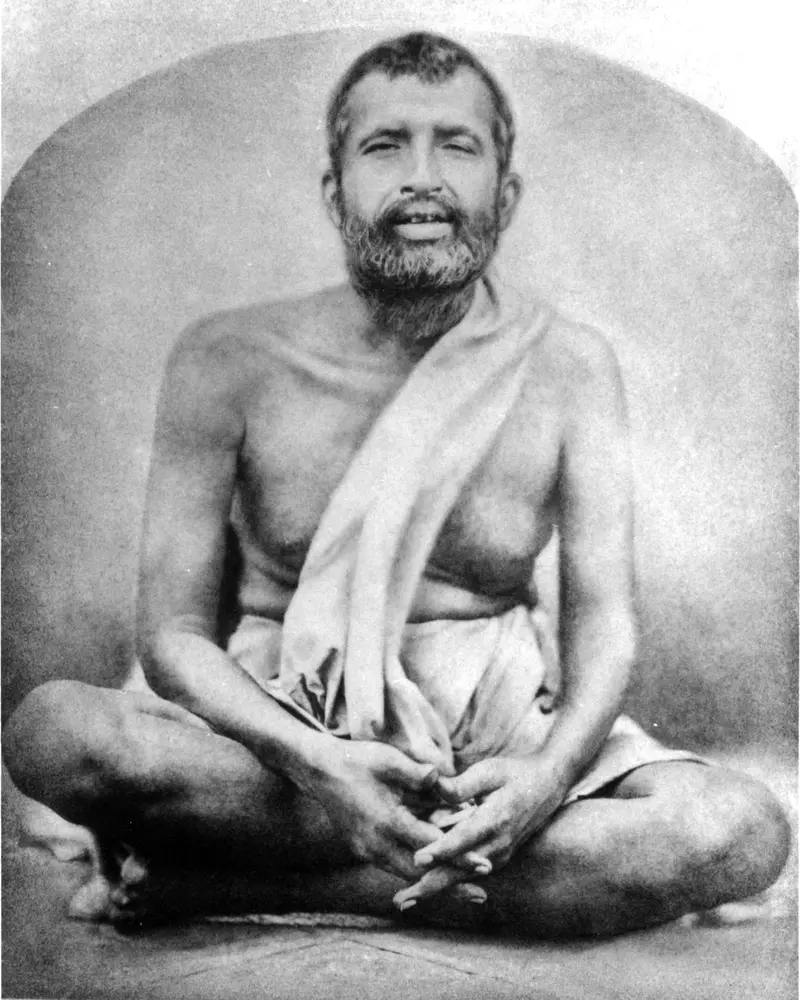
An Overview of His Life
Sri Ramakrishna was born on 18 Feb 1836 in the village of Kamarpukur, in the Hooghly district of the Bengal Presidency (now West Bengal), India.
Originally named Ramakrishna Chattopadhyay and nicknamed Gadadhar, he belonged to a poor but pious family that worshipped Lord Ram. His father, Khudiram Chattopadhyay, and his mother, Chandramani Devi, had 4 children — Ramakrishna being the youngest.
Ramakrishna began having supernatural experiences in childhood, at the ages of 10 or 11. One morning, when he was crossing a paddy field, eating puffed rice from a small basket, he looked up at the sky and saw a flock of white cranes flying.
Captivated by the sight, he entered a higher state of consciousness called Samadhi. He described seeing light, feeling bliss, and experiencing a great current in his chest, such as “the bursting of a rocket."
He had similar experiences in his childhood — once while worshipping Devi Vishalakshi, and another time while playing Lord Shiv in a drama during the festival of Shivaratri.
His parents, too, had a few mystical experiences, such as visions regarding his birth. In fact, Ramakrishna was nicknamed Gadadhar because, before his birth, his father had a dream of Lord Vishnu in the form of Gadadhar, who told him that Ramakrishna would be born as his son.
Ramakrishna’s father died in 1843, which worsened the family’s financial condition. His elder brother, Ramkumar, founded a Sanskrit school in Calcutta (now Kolkata) and also served as a temple priest there. Ramakrishna moved to Calcutta in his teens to assist Ramkumar in his priestly work.
His Life as a Priest at the Dakshineswar Temple
In 1855, Ramkumar became the chief priest of Ma Kali’s Dakshineshwar Temple, which was built by a wealthy woman named Rani Rashmoni.
Ramakrishna was assigned the task of dressing up the idol of Ma Kali, and Ramkumar even asked Ramakrishna to perform Her worship on a few occasions. Ramakrishna later became the temple’s priest, as Ramkumar grew old.
At age 20, Ramakrishna’s worship of Ma Kali deepened profoundly. After daily worship, he would sing devotional songs composed by saints like Ramprasad Sen and Kamalakant Bhattacharya as service to the Goddess.
Even beyond temple hours, Ramakrishna would meditate on Ma Kali in a nearby jungle.
His longing for a vision of Ma Kali became so extreme that he remained engaged in either Her worship or Her meditation throughout the day and night.
He finally saw Her in all Her glory only when he picked up the Khadga (sword) in the temple and threatened to end his own life out of desperation.
That is when he became a true saint — Sri Ramakrishna, leading other seekers on the path to Ma Kali.
In 1859, at the age of 23, he married Saradamani Mukhopadhyay, who is now known as Sri Sarada Devi. However, they never consummated their marriage as Sri Ramakrishna had become a Sannyasi (hermit).
Sarada became an ardent follower of Ramakrishna’s teachings. But to Sri Ramakrishna, she was the embodiment of the Divine Mother Herself, which is why he worshipped her during the ritual ceremony of Shodashi Puja.
Sri Ramakrishna’s Intense Spiritual Practices
During his service as the temple priest of the Dakshineswar Temple, Ramakrishna met diverse sages practising different methods of worship and Sadhana. Ramakrishna was initiated by some of them into multiple schools of Hinduism.
In 1861, a female hermit named Bhairavi Brahmani initiated him into Tantra Sadhana.
Under the guidance of a Vaishnava Guru named Jatadhari, he worshipped Lord Rama in His Bala Swarupa (child form).
In 1865, Ramakrishna experienced Nirvikalpa Samadhi under the guidance of Tota Puri, a Vedanta monk.
In 1866, a Hindu guru practising Sufism, named Govinda Roy, initiated him into Islam.
Finally, in 1873, Ramakrishna also followed the path of Christianity, having the Bible read to him.
Sri Ramakrishna Paramahamsa died in 1886 at the age of 50 due to throat cancer, which is said to have been a result of taking on other people’s karmas to relieve them of their suffering.
Before his death, Ramakrishna passed on his spiritual powers to Swami Vivekananda, declaring that Vivekananda would henceforth lead his other disciples. Swami Vivekananda then established the Ramakrishna Order, eventually spreading its mission posts across the world.
Stories From Sri Ramakrishna’s Life
How He Changed His View On Caste
When Ramkumar, his elder brother, was appointed chief priest at the Dakshineshwar temple, Ramakrishna argued that, as Brahmins, they should not officiate at ceremonies for lower castes.
But Ramkumar refused to listen. He performed menial tasks like cleaning toilets with his bare hands to eliminate feelings of hatred, shame, and pride.
This brought about a shift in the young Ramakrishna.
Later, when he assumed his brother’s position as chief priest, he began meditating on Ma Kali completely naked in nearby forests, even removing his sacred thread—the mark of a Brahmin.
When his nephew Hriday discovered this, he objected. But Ramakrishna explained that, in seeking God, one should abandon all attachments and the 8 servitudes:
Shame
Fear
Hatred
Ego
Aversion
Vanity
Good Conduct and
Noble Descent
Considering his sacred thread a display of his Brahmin ego, he kept it aside. Such was his change in perspective on caste.
His Various Bhavas Towards God
Sri Ramakrishna practised various spiritual moods of worship, called Bhavas, other than his usual way of invoking God as his Divine Mother.
He once worshipped Lord Krishna with Madhurya Bhava, the feeling of being His wife, dressing up and behaving as a woman, along with his wife, Sarada Devi.
He worshipped Lord Rama in Dasya Bhava — the attitude of being God’s servant, similar to Lord Hanuman — and in Vatsalya Bhava as well, where He worshipped a metallic image of Ramlalla (Lord Rama as a child), assuming the role of His mother.
Sri Ramakrishna didn’t just experiment with such Bhavas but walked their path till he attained God-realisation every time.
How Ramakrishna Attained the Formless
Ramakrishna’s Vedanta Guru, Tota Puri Baba, once realised that Ramakrishna saw himself and the Divine Mother as separate. This was limiting his spiritual progress.
So, he asked Ramakrishna to simply sit in meditation of the Self, freeing his mind from all names, forms and functions. Ramakrishna could easily withdraw his attention from his senses.
But then, the familiar form of Ma Kali would appear before him as a living, breathing presence, stopping him from immersing himself into the Formless Self.
Hearing this, Tota Puri found a broken piece of glass in his hut and pierced its sharp end between Ramakrishna’s eyebrows, instructing him to maintain unwavering focus on it and cut the Divine Mother’s image into two if She appeared again.
Ramakrishna took offence and protested, but in the end, he had to obey his Guru’s word. Only after following Tota Puri’s instructions did he realise the Self in a state of Nirvikalpa Samadhi.
How Sri Ramakrishna Followed Other Faiths
In 1866, Ramakrishna met a Hindu man practising Sufism, named Govinda Roy. Impressed by Govinda’s faith and love for God, he decided to practice Islam and was initiated by Govinda.
In just three days, Ramakrishna realised the Supreme as Allah through the prescribed Islamic path.
At the end of 1873, Ramakrishna began practising Christianity and studying the life and teachings of Jesus Christ. One of his devotees read the Bible to him.
Once, Ramakrishna saw an image of the Madonna and Child come to life. Effulgent rays of light emerged from the picture and merged into his heart. He also had a vision of Jesus Christ approaching him, embracing him and merging into his body.
Entering a trance state of higher consciousness, he realised the Formless Divine again.
His Greatest Disciple: Swami Vivekananda
Dr William Hastie, principal of Scottish Church College, Kolkata, was significantly influenced by Ramakrishna. He once told his students that if they wished to know the real meaning of the word “trance,” they must go to "Ramakrishna of Dakshineswar."
One of his students was Narendranath Dutta, who was inspired to visit Ramakrishna. He was none other than Swami Vivekananda.
Ramakrishna and Narendranath first met in November 1881 at the house of one of Ramakrishna’s followers. Ramakrishna asked Vivekananda to sing devotional songs.
Impressed by his performance, Ramakrishna invited him to the Dakshineshwar Temple, an invitation that proved life-changing for Narendranath.
His mindset, shaped by the Brahmo Samaj, which believed in a formless God and disapproved of idolatry, initially did not accept Ramakrishna as his guru.
However, Ramakrishna recognised his potential immediately, noting his lack of concern for his physical appearance and his lack of attachment to external objects.
Narendranath’s interest in Ramakrishna first piqued when he asked Ramakrishna if he had ever seen or experienced God, and Ramakrishna replied:
“Yes, I have seen God. I see Him as I see you here, only more clearly. God can be seen. One can talk to him. But who cares for God? People shed torrents of tears for their wives, children, wealth, and property, but who weeps for the vision of God? If one cries sincerely for God, one can surely see Him.”
He was bewildered, realising that Ramakrishna truly meant what he said.
In their next meeting, Ramakrishna suddenly placed his right foot on Narendranath’s chest, who began losing consciousness, feeling as if everything around him was vanishing.
Ramakrishna said that he was confident that Narendranath, in his previous birth, had attained "perfection.”
Narendranath then began to test Ramakrishna’s claims. One day, he placed a silver coin under Ramakrishna’s mattress to test his claim of being repulsed by them. Right after sitting on it, Ramakrishna jumped up in pain and asked a disciple to check his bed.
More such incidents finally convinced Narendranath to become his disciple, even though he had no devotion for Ma Kali.
In 1884, when his father passed away, Narendranath’s family became bankrupt. He requested Ramakrishna to pray to Ma Kali at the Dakshineshwar Temple for a solution to his financial problem.
Ramakrishna asked him to pray to Her himself.
When he stood before Ma’s idol, he found it radiant with Her living presence for the first time and could only bow down in reverence.
When Ramakrishna sent him there again to pray for money, he prayed to Her this time for wisdom, renunciation, discrimination, and Her uninterrupted vision.
Ramakrishna was delighted to hear this and ultimately prayed to Her for him.
And thus, Narendranath became Swami Vivekananda, an undying devotee of Ma Kali.
He even wrote a poem for Her titled ‘Kali the Mother.
After Ramakrishna’s demise, he led Ramakrishna’s community of followers through the Ramakrishna Order and created a spiritual revolution in India and the West.
Ramakrishna’s Tantra Sadhanas
Ramakrishna’s entire life was a Sadhana, from the worship of his family deity, Lord Ram, in his childhood, to the worship of Ma Kali as the head priest at the Dakshineshwar Temple.
It all culminated in Nirvikalpa Samadhi and Self-realisation under the guidance of Tota Puri, tying the threads of devotion, ritualistic worship, and knowledge of the Ultimate Reality, called Brahman.
After his father’s death in 1843, Ramakrishna began practising Sadhanas alone in a nearby cremation ground. Later, he worshipped Ma Kali at the Dakshineshwar Temple — not just as a professional priest, but as a seeker longing for Her Darshan (divine vision) rather than wealth, prosperity, or even his own life.
For him, rituals weren’t just scriptural procedures but the cries of a child for his Mother. Instead of placing Bhog (food offering) in front of Ma Kali’s idol, Ramakrishna would pick up morsels and hold them near Her idol’s mouth, as if he were feeding a real person.
Once, when he was practising a strict religious ritual, he saw a cat eagerly walking into the temple courtyard, looking hungry and weak with its ribs visible.
When it meowed as if it were asking for food, Ramakrishna immediately paused the ritual, brought some food from the kitchen, and started feeding the cat.
When the other priests objected to this, Ramakrishna calmly replied, “It was not a cat, it was Mother. Can’t you see? She came to me in that form, and she was hungry.”
A proficient Shakti Sadhak named Kenaram Bhattacharya used to visit the Dakshineshwar Temple frequently. When he initiated Ramakrishna into a Shakti Mantra, Ramakrishna went into a fit of ecstasy. Impressed with his devotion, Kenaram heartily blessed him.
Advanced Tantra Sadhana Under Bhairavi Brahmani
According to the book ‘Sri Ramakrishna, The Great Master,’ Ramakrishna delved deep into Ma Kali’s Tantra Sadhana from 1860 to 1863 under the guidance of his female guru, Bhairavi Brahmani.
Bhairavi Brahmani consecrated 2 Panchamundi seats for Ramakrishna’s Tantric Sadhana — one under the Vilva tree on the temple garden’s northern boundary, and the other in the Panchavati planted by Ramakrishna.
Under her guidance, Ramakrishna not only practised but also perfected all the disciplines from the 64 prominent Tantras.
During this period, Ramakrishna also saw various forms of the Divine Mother other than Ma Kali, some of whom conversed with him and gave instructions. Although all of them were extraordinarily beautiful, none compared to Ma Tripura Sundari.
Ramakrishna said, “I saw in a vision the beauty of the person of Shodashi, which melted and spread all around, illumining the quarters.”
Tantra Sadhana App: Worshipping the Goddess
Just like Ramakrishna, you too can practise Tantra Sadhana and form your connection with the Divine Mother.
Founded by master Tantra practitioner Om Swami, Tantra Sadhana App houses advanced Tantric practices like Shav Sadhana, Khand-Mund Sadhana, and Kaag Sadhana to awaken the Das Mahavidyas, or 10 Tantric forms of the Divine Mother.
Following the divine path of Divyachar, worship is mental and requires no physical apparatus.
The app presents 10 immersive worlds for the 10 Mahavidyas (Wisdom Goddesses) of Tantra, which can be unlocked in sequence by completing their respective rituals.
The sequence of rituals is as follows -
Ma Kali - Shav Sadhana
Ma Tara - Shmashan Sadhana
Ma Tripura Sundari - Sri Yantra Sadhana
Ma Bhuvaneshwari - Matsya Sadhana
Ma Bhairavi - Pancha Mundi Sadhana
Ma Chinnamasta - Khand-Mund Sadhana
Ma Dhumavati - Kaag Sadhana
Ma Bagalamukhi - Aranya Sadhana
Ma Matangi - Pipilika Bhojan Sadhana
Ma Kamalatmika - Sri Suktam Sadhana
All rituals follow the scriptures and are safeguarded by awakened mantras. So, there is no possibility of error when performed in the app. They are safe, protected and authentic.
The entire journey can be completed free of cost and ad-free, with the option to offer Dakshina voluntarily.
A great saint like Sri Ramakrishna Paramahamsa isn’t moulded overnight. Take your first step on the path of Tantric Shakti Upasana today, and let the Divine Mother show you the way forward.
References: