In this article, you will read about:
Chronology of Hindu Scriptures
The Vedic Tradition
The Tantric Tradition
Comparing the Paths: Vedic vs. Tantric
Tantra Sadhana App: A Modern Way to Walk an Ancient Path
Before exploring the differences between Vedic and Tantric traditions, it is important to first understand the broader framework of Sanatana Dharma, commonly referred to as Hinduism.
Hinduism is not based on a single scripture or founding text. Instead, it is a vast and evolving body of knowledge composed of numerous texts written across different periods, regions, and lineages.
This diversity allows for multiple philosophical systems, ritual approaches, and spiritual paths to coexist within the same tradition. Both Vedic and Tantric streams arise from this shared civilisational foundation, yet they approach spiritual practice, symbolism, and authority in distinct ways.
Chronology of Hindu Scriptures
Here are the scriptures that form the unchanging core of Sanatana Dharma, listed according to their chronological order of emergence:
The Vedas
The Vedas form the earliest foundation of Sanatana Dharma and are regarded as apaurusheya - revealed knowledge perceived by rishis rather than authored by any individual. Transmitted orally with great precision, they are classified as shruti, or that which is heard.
Traditionally, this body of knowledge was systematised by Veda Vyasa, who acted as a compiler rather than an author. Early tradition recognises three Vedas initially, with the Rigveda being the oldest.
The Atharva Veda is understood as a later inclusion, incorporated under Vyasa’s guidance, traditionally on the advice of Rishi Parashara, and reflecting growing concerns with protection, healing, and social order.
Each Veda comprises four categories of texts. The Samhitas are collections of hymns used in Vedic rituals and the worship of Deities. The Brahmanas are prose texts that explain the meanings of these hymns and detail ritual procedures and sacrificial rites.
The Aranyakas, or “forest texts”, are associated with hermitages and meditative practice, often serving as a bridge between ritual performance and philosophical inquiry. The Upanishads move further toward metaphysical reflection and inner knowledge.
The Atharva Veda contains adapted verses from the Rigveda alongside hymns addressing household life, healing, and unseen forces. Two recensions - Paippalada and Shaunakiya - survive today and are significant for preserving material that later informed Tantric ritual and symbolic traditions.
The Upanishads
The Upanishads represent the philosophical culmination of the Vedic tradition and explore the deeper metaphysical questions underlying Sanatana Dharma. They shift the focus from ritual performance toward inquiry into reality, consciousness, the self, and the nature of ultimate truth.
There are 108 Upanishads in total, preserved across different Vedic traditions. Among these, 10 to 13 are recognised as the Mukhya Upanishads, meaning the principal or foundational texts.
These include the Isha, Kena, Katha, Prashna, Mundaka, Mandukya, Taittiriya, Aitareya, Chandogya, and Brihadaranyaka Upanishads, with some traditions also including the Shvetashvatara, Kaushitaki, and Maitri.
The Mukhya Upanishads are considered especially authoritative because they were extensively commented upon by later philosophical schools and form the basis of classical Hindu metaphysics.
While rooted in the Vedic corpus, their emphasis on inner knowledge and direct realisation later influenced multiple spiritual streams, including Tantric thought, without being identical to it.
Itihasas: Valmiki Ramayana and Mahabharata
The Itihasas consist of two major texts - the Valmiki Ramayana and the Mahabharata. Each narrates an epic historical account rich in moral, spiritual, and philosophical lessons.
The events of the Ramayana are traditionally placed in the Treta Yuga, while those of the Mahabharata unfold in the Dwapara Yuga, the third and fourth phases of the four-Yuga cycle described in Hindu texts. We are currently in the fourth age, Kali Yuga, which is traditionally understood to have begun around 5,125 years ago.
Several Maharishis who appear prominently in the Ramayana - Vashishtha, Vishwamitra, and Agastya - are also regarded as important Vedic seers, reinforcing the continuity between the Vedas and the Itihasa tradition.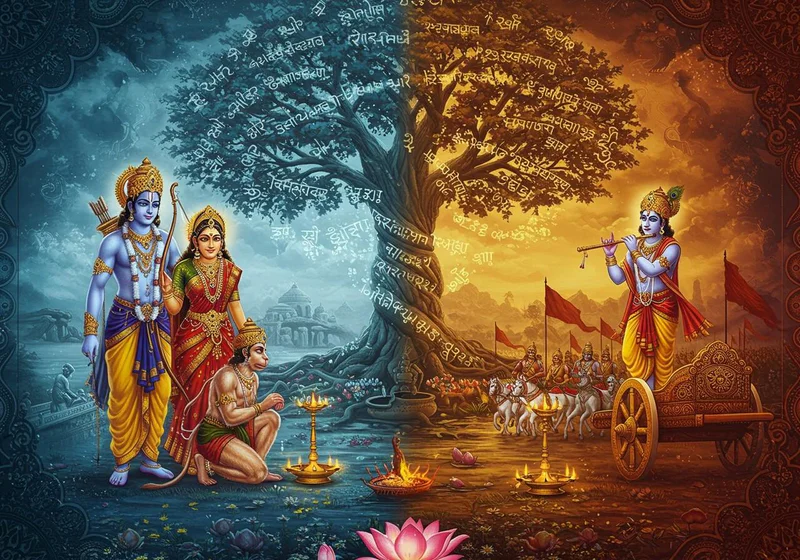
Puranas: 18 Maha Puranas and Other Upa Puranas
The Puranas are encyclopedic texts that cover cosmology, genealogy, Dharma (ethical conduct and way of life), and the interconnected narratives of the five main Deities, or Panchadevatas, of the Hindu pantheon - Lord Shiva, Lord Vishnu, Ma Durga, Lord Ganapati, and Lord Surya Narayan. They serve as an important bridge between philosophy, mythology, and lived religious practice.
The 18 Maha Puranas are considered foundational and are revered by Hindus across India and beyond. Traditionally, they are attributed to Maharishi Veda Vyasa. The Upa Puranas, composed by other sages, expand upon this tradition and often focus on regionally and culturally prominent forms of the Deities described in the Maha Puranas.
Agamas and Nigamas
The Agamas and Nigamas form the basis of Hindu temple architecture, image consecration, ritual practices such as Pujas and Abhishekas, Mantra-Shastra, and yogic disciplines. Together, they provide the ritual and philosophical framework for organised worship.
The Agamas function as practical guides revealed by the Deities themselves. They prescribe methods for constructing temples, consecrating images, and performing rituals in ways believed to maximise their potency and efficacy.
The Nigamas, by contrast, are more philosophical in nature. They present dialogues in which the Deity responds to questions posed by the devotee, often after the ritual knowledge of the Agamas has been revealed.
Different Agamic traditions correspond to different Deities. Shaiva Agamas are followed for Lord Shiva, Vaishnava Agamas for Lord Vishnu, and Shakta Agamas for the various forms of Aadi Shakti.
Esoteric Tantric Texts
Esoteric Tantric texts are initiatory in nature and were traditionally transmitted in restricted settings. They focus on subjects such as Prana Shakti (life force), Kundalini, Chakras, Bija Mantras (seed syllables), Yantras (sacred geometric forms), inner alchemy, and certain external rituals. Many of these practices are described as operating outside accepted social norms and were therefore performed in secrecy and solitude.
Some foundational Tantras include the Rudra Yamala Tantra, often regarded as one of the earliest Tantras, Tantraloka by Abhinav Gupta, Kularnava Tantra, Vijnana Bhairava Tantra, and Mahanirvana Tantra. These texts build upon strands of knowledge associated with the Atharvaveda, traditionally regarded as the fourth Veda.
Because of the vast body of literature at the core of Sanatana Dharma, different Hindu traditions gradually emphasised specific texts and practices over time. This led to the formation of diverse yet interconnected spiritual paths, each drawing from the same foundational worldview.
One of the broadest ways to understand these traditions is through the distinction between Vedic and Tantric approaches, alongside classifications such as Vaishnava, Shaiva, and Shakta.
The Vedic Tradition
What is commonly referred to as the Vedic tradition is rooted not only in the Vedas, but also in the Maha and Upa Puranas and the two Itihasas. The spiritual framework established by the Vedas was not lost over time. Instead, it evolved alongside the historical and cultural developments reflected in the Itihasas and the later emergence of the Puranic tradition.
In the early Vedic period (roughly 1500–500 BCE), spiritual practice was centred primarily on Yagyas or Homas (sacred fire offerings). Image worship and temple-based rituals were not yet prevalent. Temple construction and Vigraha worship developed much later, from around the 1st century CE onward, and became widespread during the Gupta period (c. 320–550 CE).
This marked a shift toward more accessible, form-based worship, while remaining anchored in Vedic principles. Magnificent temples such as Kailasa at Ellora, Meenakshi at Madurai, and Angkor Wat in Cambodia belong to this later phase of religious expression. Alongside them, rituals such as Abhishekas and Pujas of Lingams, Murtis, and Vigrahas became widely practised, existing alongside older Vedic fire rituals rather than replacing them.
Within this continuity, the Itihasas reinforce the Vedic lineage. Lord Rama, as described in the Ramayana, is traditionally said to have consecrated and worshipped the Jyotirlinga at the Ramanathaswamy Temple, giving Rameshwaram its sacred identity. His gurus, Maharshi Vashishtha and Rishi Vishwamitra, are also counted among the important seers associated with the Rigveda, the oldest of the Vedas.
The Tantric Tradition
The Tantric tradition draws upon the Atharvaveda (the fourth and last Veda), along with the Agamas, Nigamas, and later Tantric texts. While certain Tantric practices associated with early Rudra-oriented tribes are understood to predate the formal Vedic period, the Tantric literature available today emerged after the composition of the first three Vedas.
The ritual-oriented Sadhana Khanda of the Vedic corpus includes the last several thousand Vedic verses, the majority of which belong to the Atharvaveda. For this reason, the Atharvaveda is regarded as a foundational source for much of Hindu Tantric thought and practice.
Over time, Vedic knowledge became increasingly structured and regulated. Its ritual complexity, strict adherence to rules, and emphasis on precise transmission meant that it was largely preserved and practised by Brahmins and Kshatriyas. For householders and other sections of society, these systems were often difficult to access and sustain in daily life.
Tantra evolved as a parallel and complementary framework, offering forms of worship that were more adaptable to domestic settings, including simpler ritual observances such as Upachara Pujas that could be performed within the home.
Lord Shiva is traditionally regarded as the source of Tantra Shastra, which is transmitted in two forms. In the Agamas, Lord Shiva responds to the questions of Devi Uma. In the Nigamas, the roles are reversed, with Devi Uma answering Lord Shiva’s queries. Together, they establish both the practical and philosophical foundations of Tantric worship.
Rishi Parashara, the father of Maharishi Veda Vyasa, is traditionally remembered as a highly accomplished Tantra practitioner. He is said to have guided Vyasa in compiling and preserving Tantric knowledge within the Atharvaveda.
In the centuries that followed, esoteric Tantras emerged through spiritual inquiry and devotional transmission, gradually expanding upon this foundation. In this sense, the Tantras remain firmly rooted within the Hindu textual and ritual tradition, much like the Puranas.
Comparing the Paths: Vedic vs. Tantric
Now, we can get straight to the Tantric Vedic comparison, covering the similarities as well as differences of the two popular Hindu traditions.
Similarities
Both Vedic and Tantric traditions:
Are grounded in Vedantic philosophy, recognising Brahman as the Supreme Reality that pervades all existence, even though they may approach this understanding through different methods.
Share a common civilisational and scriptural foundation, with Tantra historically understanding itself as drawing from Vedic revelation, particularly the Atharvaveda, rather than standing outside the Vedic framework.
Seek Moksha through a combination of devotion, knowledge, disciplined action, and ritual practice, rather than through belief alone.
Engage in Deity worship, incorporating shared ritual elements such as Vedic hymns, Mantras, Stotras, fire, incense, Naivedyas (food offerings), and Yagyas or Homas (fire offerings), though these are structured differently within each system.

Honour a long lineage of Siddhas and realised sages who played key roles in shaping spiritual practice and transforming religious life across India.
Preserve knowledge through the Guru–Shishya tradition and established Kulas or lineages, ensuring continuity of teaching, practice, and transmission across generations.
Recognise the role of karma and emphasise the importance of Dharma as the ethical foundation for both individual growth and social harmony.
Rely on Jyotish Shastra to determine Muhurtas (auspicious timings) for rituals, worship, and spiritual disciplines.
Differences
Ultimately, both the Vedic and Tantric traditions are equally valid paths within Sanatana Dharma. The question of Tantra vs. Veda is not about superiority, but suitability. What matters most is which approach aligns better with your temperament, stage of life, and lived environment.
Tantra Sadhana App: A Modern Way to Walk an Ancient Path
The Tantra Sadhana app has been created by the Himalayan monk, Om Swami, to make Tantric Shakti Upasana possible for all spiritual seekers interested in Tantra, including beginners and adepts.
As the app follows the mentally immersive path of Divyachar, no physical offerings or Puja apparatus are required.
Users begin an elaborate journey of awakening each of the Das Mahavidyas (10 Wisdom Goddesses of Tantra) in sequence, starting from Ma Kali and ending at Ma Kamalatmika.
They progressively unlock the virtual 3D world of each Mahavidya and complete their required rituals, such as Tantric Mantra Jap, Yagna, and Sadhana.
This entire app journey is free and ad-free, with an option to offer Dakshine online.
Sadhaks do not require any personal guidance from a Guru to complete the journey, because all the rituals are coded into the app according to Om Swami’s instructions after he mastered all the included Sadhanas himself.
In fact, his awakened chants can be heard as voice recordings while you perform the rituals in the app. Such advantages of modern technology make the esoteric path of Tantra accessible to anyone who wishes to explore it today.
If you feel pulled towards powerful forms of the Divine Feminine, the Tantra Sadhana app is likely to open an exciting new spiritual chapter in your life.