In this article, you will read about:
Introduction to the Bhavas in Worship – Different Stages in the Evolution of Seekers
Classification Into Three Bhavas
The Characteristics of the Three Bhavas
A Sadhak’s Journey Through All the Bhavas
Divyachar – The Path of Divine Conduct
Tantra Sadhana and Divyachar Worship
Introduction to the Bhavas in Worship – Different Stages in the Evolution of Seekers
The word Sadhana comes from the Sanskrit root Sadh, meaning to strive, exert or accomplish. It refers to spiritual striving, a disciplined practice and worship undertaken to attain Siddhi, or fulfillment. This fulfillment may be worldly or spiritual, or as per our shastras, spiritual growth, well-being in this world and beyond, and ultimately liberation. According to our scriptures, sorrow in life arises from the condition of duality, the play of opposites such as like and dislike, pleasure and pain. However, within each of us, these coexist, creating inner conflict. The purpose of any Sadhana, including Tantra Sadhana, is inner purification to gradually move from this divided experience toward the realization of oneness as the true nature of existence. The Tantric approach tries to accomplish this unity not by turning away from worldly experiences and restraining desires. It teaches that the experiences and energies of life need not always be rejected. When approached with awareness, discipline, and right understanding, even the forces that seem to bind us can become means of transformation. Tantric teachings, therefore, express a profound insight: the very forces that lead to bondage, when properly understood and guided, can become instruments of liberation. This idea is expressed in the well-known dictum:
yāreva patanaṁ dravyaiḥ siddhistaireva
(Kulārṇava Tantra - 5.48)
“That by which one falls is also that by which one rises.”
However, it is also true that spiritual aspirants differ widely in capacity, temperament, knowledge, and stage of development. Because of this, the methods of practice through which they are guided must also differ. Practices suitable for advanced seekers may be difficult for beginners, while simpler disciplines may already have been surpassed by those further along the path. This necessitates a gradual path, unfolding through stages of understanding in which the practitioner gradually builds their spiritual eligibility and competency, also termed “adhikara”.
The Tantric understanding of human nature is connected to the doctrine of the three Gunas. All beings are expressions of Prakriti, the primordial creative power of the universe, which manifests through three fundamental qualities: Sattva (clarity and harmony), Rajas (activity and dynamism), and Tamas (inertia and stability). Every individual embodies these Gunas in varying proportions, and their predominance shapes temperament and inclination. Because of these differing temperaments, Tantric texts describe three broad orientations or dispositions among seekers. In the Shakta Tantras, these are known as:
Pashu Bhava – the bound or instinct-driven disposition
Vira Bhava – the Heroic disposition
Divya Bhava – the Divine disposition
Here, the term Bhava refers to an inner disposition or mental orientation. It is defined as a property or quality (Dharma) of the mind (Manas), as described in texts such as the Pranatoshini Tantra. These categories are not meant as rigid labels, but as broad stages in the evolution of spiritual understanding. They help explain why the Tantric tradition offers different methods of worship and discipline, each designed to guide seekers step by step toward deeper awareness and realization.
Classification Into Three Bhavas
The Kularnava Tantra, one of the important Tantric texts that discusses Achara (modes of practice) and Bhava (inner disposition), explains that human beings may broadly be understood in three categories: Divya (divine), Vira (heroic), and Pashu (bound). Each of these corresponds to a particular orientation of mind and a corresponding mode of discipline suited to that stage of development. The text declares:
divyaṁ paśuṁ vīraṁ caiva tridhā puruṣasañjñakāḥ।
paśubhyo dharmaḥ paśubhyas tu vīrebhyo dharmaḥ kīrtitaḥ॥
vīrebhyo dharmo divyaś ca divyaṁ paramakāraṇam।
tasmāt sarvaprathamaṁ divyaṁ tataḥ paśuṁ tataḥ param॥
(Kularnava Tantra, Chapter 1, Verses 122–127)
Translation:
“Human beings are of three kinds: the divine (Divya), the heroic (Vira), and the bound (Pashu). For the Pashu there is the discipline suited to the Pashu; for the Vira there is the discipline suited to the Vira. From the Vira arises the Divine discipline, which is the supreme cause. Thus the Divine state stands as the highest principle.”
Another important scripture, the Mahanirvana Tantra, also describes these three Bhavas in relation to the predominance of the three Gunas.
sattvapradhānas tu khalu divyabhāvaḥ syāt।
rajoguṇapradhānas tu vīrabhāva ucyate।
tamoguṇapradhānas tu paśubhāvaḥ prakīrtitaḥ॥
nītyatantraṁ bravīti yaḥ sa paśuḥ syāt।
vīraḥ syād yastu nītyatantraṁ jighranti।
divyaḥ syād yaḥ sarvaṁ brahmamayaṁ paśyati॥
(Mahanirvana Tantra, Chapter 4, Verses 13–15)
Translation:
“He in whom Sattva predominates is said to possess Divya Bhava. He in whom Rajas predominates is known as possessing Vira Bhava. He in whom Tamas predominates is described as having Pashu Bhava. One who rejects the Tantric disciplines is called a Pashu; one who engages with them is a Vira; and one who perceives all existence as pervaded by the Supreme (Brahman) is Divya.”
The Characteristics of the Three Bhavas
As above, these three inner dispositions in spiritual life viz. Pashu, Vira, and Divya Bhava, correspond broadly to the animal, human, and divine tendencies within the seeker. They represent not social categories but different stages of inner evolution through which a spiritual aspirant gradually grows.
These stages also reflect the way we encounter the world. Every experience and every object has a gross form, a subtle form, and a divine essence. In the same way, the seeker too moves through stages of understanding, from the outward and instinctive, to the consciously disciplined, and finally to the luminous perception of the divine within all things. Tantra, therefore, teaches that no stage of experience should be rejected outright as an obstacle. Instead, each stage must be experienced, understood, purified, and transcended through direct personal experience.
In the Pashu Bhava, the quality of tamas operates mainly, giving rise to tendencies such as confusion (bhranti), dullness or drowsiness (tandra), and inertia or sloth (alasya). However, it would be incorrect to assume that a person of this disposition is necessarily immoral or inferior. A seeker in the Pashu stage may, in fact, possess many virtues and may even surpass someone in the next stage who misuses the greater freedom he has gained. Within the Pashu category itself, there are many degrees. The very word Pashu comes from the root pasha, meaning “to bind”. The Kularnava Tantra (13/90) declares eight bonds (pashas), which are causes for animalistic or pashu bhava in a person. Those are:
Aversion (Ghrina)
Suspicion (Shanka)
Fear (Bhaya)
Temerity (Lajja)
Disgust (Jugupsa)
Family (Kula)
Nature (Sheela)
Birth (Jati)
The Vira, meaning “heroic,” is the seeker who begins to consciously confront these limitations. In the stage of Vira Bhava, the dynamic quality of Rajas works more strongly in relation to Sattva. The seeker at this stage begins to move beyond passive limitation and develops the courage to engage consciously with life and with spiritual discipline. Though Rajas may still generate actions that bring struggle or sorrow, the aspirant increasingly uses energy, effort, and awareness to transform these experiences. Within this stage, too, there are many degrees, as the seeker gradually grows in strength and clarity.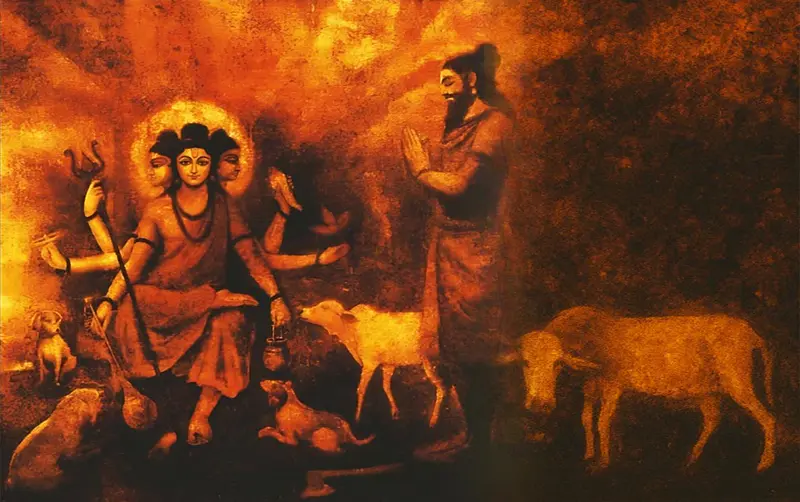
The highest stage is Divya, the divine disposition, in which the mind becomes naturally pure and refined. Here, Sattva becomes firmly predominant, and the mind becomes increasingly clear, luminous, and peaceful. At this stage, spiritual practice becomes largely inward, expressed through meditation, mantra, devotion, manasik or mental offerings, and the direct recognition of the Divine presence in all existence.
A Sadhak’s Journey Through All the Bhavas
At the same time, it is important to remember that none of the Gunas are ever completely absent; they exist in a cyclical nature, varying in proportions within every individual at different times and stages of life. Several Tantric texts describe the relationship between these three dispositions as a gradual unfolding of spiritual maturity. The Nitya Tantra states that among the three Bhavas, the Divya is the highest, the Vira comes next, and the Pashu is the lowest. This, however, is not meant as a rigid judgment of anyone, but as a description of stages in spiritual growth. The Pashu state is the natural starting point of Sadhana, the Vira stage represents the seeker who has begun to rise beyond limitation with courage and effort, and Divya Bhava is the flowering of the divine nature within. The scriptures explain that Divya Bhava is awakened through Vira Bhava. The seeker first rises from the bound condition of Pashu, develops the strength of the Vira, and through this discipline gradually awakens the divine disposition.
The Picchila Tantra describes the distinction between Vira and Divya in an interesting way. The Vira is said to possess uddhata, a quality of intensity or passionate activity, driven by the predominance of Rajas. This arises from the strong movement of Rajas, which drives the seeker to strive vigorously toward the cultivation of Sattva. The Divya, on the other hand, reflects a calmer and more naturally Sattvic temperament, where clarity and harmony have become steady.
The accomplished Divya sadhaka completely manifests the Deva-nature, where Sattva shines in stable clarity. Such beings are said to be inwardly free and no longer dependent on external or physical ritual practices. Ultimately, the aim of all Sadhana—whether practised in the Pashu, Vira, or Divya disposition—is the gradual cultivation and predominance of Sattva.
It is worthwhile to remember that the pasha or bonds that bind the individual soul are also the creations of Maya or Avidya-Shakti. For this reason, Divine Mother is depicted as holding these bonds in her hands. However, She alone reveals Herself as Vidya Shakti, the power of liberating knowledge, cutting the very bonds asunder, freeing the soul from its limitations. Because She alone is Pashupasha Vimocini, “the Liberator from the bonds of the pashu/bound soul,” as mentioned in verse 78 of the Lalita Sahasranama.
Divyachar – The Path of Divine Conduct
Divyachar (Divya-ācāra) literally means “divine conduct” or “the path of the divine-minded practitioner.” In Tantra, it refers to a way of practice in which the seeker approaches the Divine with purity of heart, inner refinement, and the awareness that everything in existence is sacred. Because of this maturity, the practitioner rises beyond raga-dvesha, mental constructs, and conditionings, relating to the Divine in a sattvic, contemplative, and deeply devotional manner rather than through intense or confrontational forms of ritual.
In many Shakta traditions, especially those reflected in scriptures such as the Kularnava Tantra and the Mahanirvana Tantra, Divyachar is described as the path of one who has gradually transcended lower impulses and duality. Its foundation is Divya Bhava—the attitude of seeing the Divine everywhere.
In this stage of spiritual evolution, the practitioner begins to experience a deeper unity in life. The opposites that usually disturb the mind, pleasure and pain, gain and loss, praise and blame, no longer bind the heart in the same way. Worship becomes increasingly internal, and the awareness of the Divine begins to permeate everyday life.
Divyachar is often described as the culmination of Tantric Sadhana, where the practitioner moves toward a direct recognition of the Divine presence within and around. In this state, the seeker gradually begins to see all existence as pervaded by the Divine, and spiritual practice becomes a natural expression of that awareness.
The scriptures describe certain qualities and practices that characterise a practitioner walking the path of Divyachar.
The Mahanirvana Tantra describes the Divya as one who is almost like a Deva, pure in heart and free from the disturbances of duality. Such a person remains inwardly steady (dwandwateeta), rising above conflicts (dwandh) in the midst of life’s changing conditions, pleasure and pain, heat and cold, while remaining compassionate, forgiving, and unattached to worldly distractions.
Similarly, the Kubjika Tantra describes several marks of the Divya practitioner. The Divya maintains a life of daily discipline and purity. He performs regular ablutions, Sandhya, and wears clean clothing along with sacred marks such as the tripundra or sandal paste, and ornaments like rudraksha beads. He performs japa and worship regularly, offers charity, and maintains deep faith in the Veda, Shastra, Guru, and Deva. He also worships the Devas and Pitris and performs the daily rites prescribed by the tradition.
The Divya practitioner is said to possess great knowledge of mantra and treats the mantra not as mere syllables but as the living presence of the Devata. His relationship with the Guru is central; meditation on the Guru and remembrance of the Guru’s teachings remain an important part of daily practice. In the Tantric understanding, the Guru is not merely an individual instructor but a living channel of the divine lineage. It is Shiva, the Adi Guru abiding in Mount Kailash, who speaks through the voice of the earthly Guru at the sacred moment of mantra initiation, transmitting the living power of the mantra to the disciple.
The practitioner performs worship of the Devi at night, does japa or mantra-chanting during the night, and mentally offers all actions and experiences to the Supreme Devi.
Another essential aspect of Divyachar is the cultivation of reverence for all manifestations of Shakti. The practitioner sees the entire universe as pervaded by the union of Shiva-Shakti. The ultimate manifestation being that the divya sadhaka bows at the feet of women, regarding them with the respect one offers to a Guru. In this vision, Shiva and Shakti are present in all beings. In women, the aspect of Shakti is more dominant. In men, the aspect of Shiva is more dominant. And the entire creation is pervaded by Shiva-Shakti as Purush-Prakriti.
Because of this understanding, the Divya practitioner strives to live with truthfulness, compassion, and harmlessness. Cruelty and harmful actions are avoided. Friend and foe are regarded with equal vision, and the practitioner seeks to maintain the inner awareness of the Divine in all beings.
This cultivation of Devata-bhava, the awareness of the divine presence, becomes a central practice of the Divya path. The practitioner continually strives to maintain this sacred vision until it becomes natural, and gradually the seeker himself begins to reflect the qualities of the Divine.
Tantra Sadhana and Divyachar Worship
The Tantras dictate that the conditions and character of the Kali Yuga are not conducive to the cultivation of even pure Pashu Bhava. In earlier times, life itself was structured in a disciplined way through the Ashrama system. Individuals would pass through stages, such as:
Brahmacharya, dedicated to study and restraint
Grihastha, dedicated to family life, work and contribution to society
Vanaprastha, a gradual withdrawal from worldly attachments and duties after the age of fifty
Sannyasa, the final stage of complete detachment and renunciation for liberation
In the present age, however, these disciplines are seldom observed in any form whatsoever. The texts, therefore, observe that those who are not guided or restrained by the discipline of the Vedas cannot expect the full fruits of Vedic observances. Social conditions have changed, and many traditional structures that once supported such practices are no longer maintained.
Recognising these circumstances, when Devi Adya Shakti asked the way out to Lord Shiva (in Mahanirvana Tantra), out of compassion for humanity in the Kali Yuga, Lord Shiva revealed the teachings of the Agamas and Tantras as alternative paths suited to the conditions of the age.
This is where the Tantra Sadhana App comes in, introducing practitioners to devotional and contemplative forms of Tantric worship through mental offerings, in adherence to authentic wisdom from the Atharva Veda. The essence of this approach is aligned with the spirit of Divyachar, where the emphasis lies not on external ritual but on inner worship and a sacred awareness throughout the day. Divyachar can be practised either through Dakshinachara or Vamachara ritual practices. In either case, it becomes a purely inward act through mental offerings with a sattva bhaav.
Through guided practice, the seeker learns to mentally offer worship to Maa in Her various forms as Das Mahavidyas, the ten great cosmic manifestations of Shakti. The app is a doorway for sincere seekers in the modern age, guiding them to the Divine Mother, through the use of technology. In these practices, the practitioner inwardly journeys through sacred spaces traditionally associated with Tantra. The consciousness becomes the temple, sometimes a cremation ground, sometimes a cave, sometimes Her celestial palace. The seeker lives through the day, every experience being Her domain, calling out to Her with devotion.
References:
https://www.dlshq.org/messages/tantra-sadhana/
https://sacred-texts.com/tantra/sas/sas26.htm
Shakti and Shakta - Arthur Avalon
Mahanirvana Tantra - Arthur Avalon