In this article, you will read about:
Significance of Hanuman Jayanti
Its Dates and Timing for 2026
Rituals and Celebrations
Lord Hanuman and Das Mahavidyas
Tantra Sadhana App to Awaken Das Mahavidyas
In Sanatan Dharm, Hanuman Jayanti is the most important day to worship and celebrate Lord Hanuman — the Chiranjeevi Vanar (immortal monkey-being).
Significance of Hanuman Jayanti
The significance of Hanuman Jayanti is deeply rooted in ancient Hindu scriptures, such as the Valmiki Ramayan, Skanda Puran, and Brahmand Puran, along with later texts like Ramcharitmanas by Saint Tulsidas.
Hanuman Jayanti marks the birth of Lord Hanuman. He is the son of Anjana (also called Anjani) and Vayu, the Hindu God of Wind — which why He is also known as Anjaneya and Vayuputra.
He was born in Kishkindha, the region where the Vanars dwelled during the times of the Ramayan.
Lord Hanuman is the Rudransh (fierce partial Avatar) of Lord Shiv who helped Lord Ram in His quest to rescue Ma Sita from the demon king Ravan’s city, Lanka.
One of His famous childhood stories is of Him attempting to fly the Sun to eat it, believing that it is a ripe fruit. To stop Him, Lord Indra struck Him with the Vajra (thunderbolt), causing Him to fall back to earth and leaving a mark on His chin.
Seeing Him injured, Vayu, the Wind God and Hanuman’s father, withdrew the air from the world in grief, bringing all life to distress. To pacify Vayu, the gods revived Hanuman and granted Him many divine boons, blessing Him with immense strength, protection, and near invincibility.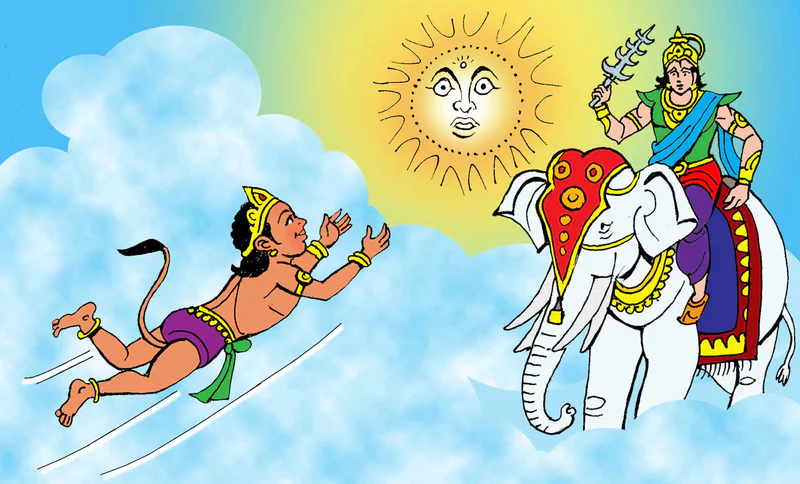
He is celebrated as the greatest devotee of Lord Ram and a perfect idol of virtue, strength, courage, humility, and selfless service. But He is also worshipped as a complete embodiment of the Divine.
Hanuman Jayanti - Dates and Timing for 2026
As per the Hindu calendar, Hanuman Jayanti is on Chaitra Purnima (the full moon day in the month of Chaitra).
Hanuman Jayanti: 1-2 April 2026 (Wed-Thu)
Beginning of Purnima Tithi: 7:06 AM on 1 Apr (Wed)
End of Purnima Tithi: 7:41 AM on 2 Apr (Thu)
Note:
Hanuman Jayanti is celebrated on different dates in different regions of India, according to their beliefs and calendar type being followed.
In Telangana and Andhra Pradesh, Hanuman Jayanti is observed for 41 days, starting from Chaitra Purnima and ending on the 10th day of Krishna Paksh in the month of Vaishakh.
Hanuman Jayanti is called Hanumath Jayanthi in Tamil Nadu, and is celebrated on the Tithi of Margashirsh Amavasya in December or January.
Karnataka observes it on Shukla Paksh Trayodashi during the month of Margashirsh, calling it Hanuman Vratam.
Rituals and Celebrations
In the domain of Karma Kand (ritualistic worship), the rituals performed in homes and temples include:
Pujas, Abhishekams, and Yagnas
Recitations of Sundar Kand, Bajrang Baan, Hanuman Chalisa, and other Stutis
Jap of Hanuman Mantras or simply the name, ‘Ram’
Sattvic offerings of Sindoor (vermillion), jasmine oil, fruits, and flowers

As Lord Hanuman Himself is a great example of Bhakti (devotion), Hindus glorify and celebrate Him by singing His countless Bhajans (devotional songs) in different languages.
Kirtans and group-singing are quite common in temples and religious organisations, with acclamations of “Jai Hanuman!” and “Jai Shri Ram!” on Hanuman Jayanti.
Lord Hanuman and the Das Mahavidyas
Tantric scriptures and esoteric traditions describe Lord Hanuman as a manifestation of Rudra, Lord Shiva’s fierce form. As the Das Mahavidyas are embodiments of Lord Shiva’s Shakti, Lord Hanuman naturally lies within their cosmic field.
Essentially, He embodies the dynamic consciousness that awakens, stabilises, and serves the Divine Mother’s whole spectrum of energies.
Moreover, Tantra says that Prana is the vehicle through which these energies move. As the son of the Wind God, Vayu, Lord Hanuman is deeply linked to Prana, the very life-force that animates the mind and body.
He therefore represents the awakened Prana that harmonises the energies of the Das Mahavidyas within a Sadhak.
Parashar Samhita portrays Lord Hanuman as the conscious vessel of these 10 primordial powers of the universe. And Agama texts describe Lord Hanuman, in His Vishvaroop (cosmic form), as the well-balanced integration of all their energies.
Here, we explore how Lord Hanuman is associated with some of the Mahavidyas:
Ma Kali and Lord Hanuman
Mahakal Samhita states that Lord Ram performed the Mantra Sadhana of Saptadashakshari Mahaguhyakali along with Nav Durga Sadhana for 9 days to defeat King Ravan. He also initiated Lord Hanuman into the Ekakshari Guhyakali Mantra, making Lord Hanuman one of the greatest Guhyakali Sadhaks.
The direct relation between Lord Hanuman and Ma Kali is explained in Krittivasi Ramayan, written by Krittibash, in a passage titled Mahirabonerpala.
Their meeting takes place in the Yuddha Kand of Ramayan. King Ravan sought the help of Mahiravan, his trusted brother and the King of Patal Lok, to kill Lord Ram and Sri Lakshman.
One night, Mahiravan used his Maya to take the form of Vibhishan. He entered Lord Ram's camp and cast the Nidra Mantra on the Vanar Sena (the monkey army who fought King Ravan’s forces under Lord Ram).
He then kidnapped Lord Ram and Sri Lakshman, taking them to Patal Lok. Mahiravan was an adherent devotee of Goddess Kali and Ma Durga. King Ravan had convinced him into sacrificing the 2 brothers to Her.
When Lord Hanuman realised what had happened, he travelled to Patal Lok to rescue His Lord. Just as the sacrificial ritual was set to begin, He shrunk Himself to the size of a bee and went towards the huge idol of Mahakali.
He asked Her to let him save Lord Ram, and She agreed. Lord Hanuman took Her place, while She disappeared. When Mahiravan asked Lord Ram and Sri Lakshman to bow before Ma, they refused.
As Mahiravan was about to force them into it, Lord Hanuman took His Panchamukhi form, blew the 5 oil lamps in 5 directions and severed Mahiravan’s head.
He then flew back, carrying Lord Ram and Sri Lakshman on His shoulders.
Pleased with Lord Hanuman’s devotion to His Lord, Ma Kali blessed Him to be Her gatekeeper.
Hence, we usually find Kal Bhairav and Lord Hanuman on either sides of the entrance of Her temples.
Ma Dhumavati and Lord Hanuman
Dhumravarahi Tantram and Kalamrityu Tantram clearly describe that, when Lord Hanuman was harmed by Devraj Indra, His father Pavan Dev (Vayu) initiated Him into Ma Dhumavati's powerful Shodashakshar Sarva-samharak Mantra.
It safeguarded Lord Hanuman from all kinds of divine weapons.
Ma Bagalamukhi and Lord Hanuman
According to Bagalamukhi Rahasyam of Uchchhista Tantram and Uttar Sankhyayan Tantram, when Lord Hanuman was acquiring knowledge from Lord Surya, Lord Aditya initiated Him into the Shatakshari Mantra of Prachand Sthambhini Ugra Bagalamukhi for His protection.
The scriptures called this ‘Bagalamukhi Amogh Paramahavidya’. In other words, no power in the world could save an enemy if this Mahavidya is awakened.
Therefore, Lord Hanuman remains invincible forever. Even when He destroyed the shrine of Goddess Nikumbhila, whom Ravan worshipped, Ma protected Him.
Awaken the Das Mahavidyas That Protected Lord Hanuman Himself
The Tantra Sadhana App, created by Himalayan monk, Om Swami, offers devotees of the Divine Mother an unparalleled opportunity to begin Das Mahavidya Sadhana.
Each of the 10 Mahavidyas reside in Their virtual abode, where seekers sequentially awaken them through Mantra Jap, Yagna, and esoteric Sadhanas, starting with Ma Kali and ending with Ma Kamalatmika.
Every mantra on the app has been awakened and consecrated by Om Swami, making the entire process of worship incredibly potent and completely safe with no margin for error.
Free and ad-free, the sole purpose of Tantra Sadhana App is to bring sincere seekers closer to Mother Divine and walk the spiritual path fearlessly.
Seekers can choose to offer Dakshina, if they so wish. It is entirely optional.
Celebrate Hanuman Jayanti by invoking the primordial Shaktis that empower Him and His Ashta-Siddhis.
Jai Bajrang Bali!
References: