In this article, you will read about:
Who Is Ma Tripura Sundari Devi?
Origins of Maa Tripura Sundari
The Significance of Lalita Tripura Sundari
The Step-by-Step Process of Sri Vidya Sadhana
Sri Chakra: Sacred Geometry of Consciousness
Daily Practice Structure
Worshipping Lalita Tripura Sundari on Tantra Sadhana App
Sri Vidya Sadhana represents one of the most profound spiritual disciplines within Hindu Tantra, centring on the worship of the Divine Mother in Her magnificent form as Tripura Sundari.
This sacred practice combines the powerful elements of Tantra Sadhana, including mantras (sacred sounds), yantras (geometric diagrams), and elaborate rituals, to create a transformative spiritual journey that can profoundly change one's life.
The Sri Vidya tradition has been preserved through an unbroken lineage of enlightened masters for thousands of years, each guru adding unique insights while maintaining the essential teachings that guide practitioners toward self-realisation and divine union.
Who Is Ma Tripura Sundari Devi?
Maa Lalita Tripura Sundari, also known simply as MaaTripura Sundari, embodies supreme beauty, wisdom, and the creative energy of the universe. As one of the Das Mahavidyas, She appears as a sixteen-year-old maiden adorned with celestial ornaments, seated upon a diamond throne, surrounded by sages, devas, and divine beings.
She is known by several sacred names, including Shodashi, Lalita, Kameshwari, Srividya, and Raja Rajeshwari. Her glory is extensively described in the Lalita Sahasranama, which contains a thousand names that highlight her greatness and compassion toward all living beings.
The practice of Maa Tripura Sundari Sadhana offers both spiritual benefits, such as enhanced wisdom and divine connection, as well as material benefits, including prosperity, protection, and the fulfilment of desires.
Iconography and Symbolism of Lalita Tripura Sundari
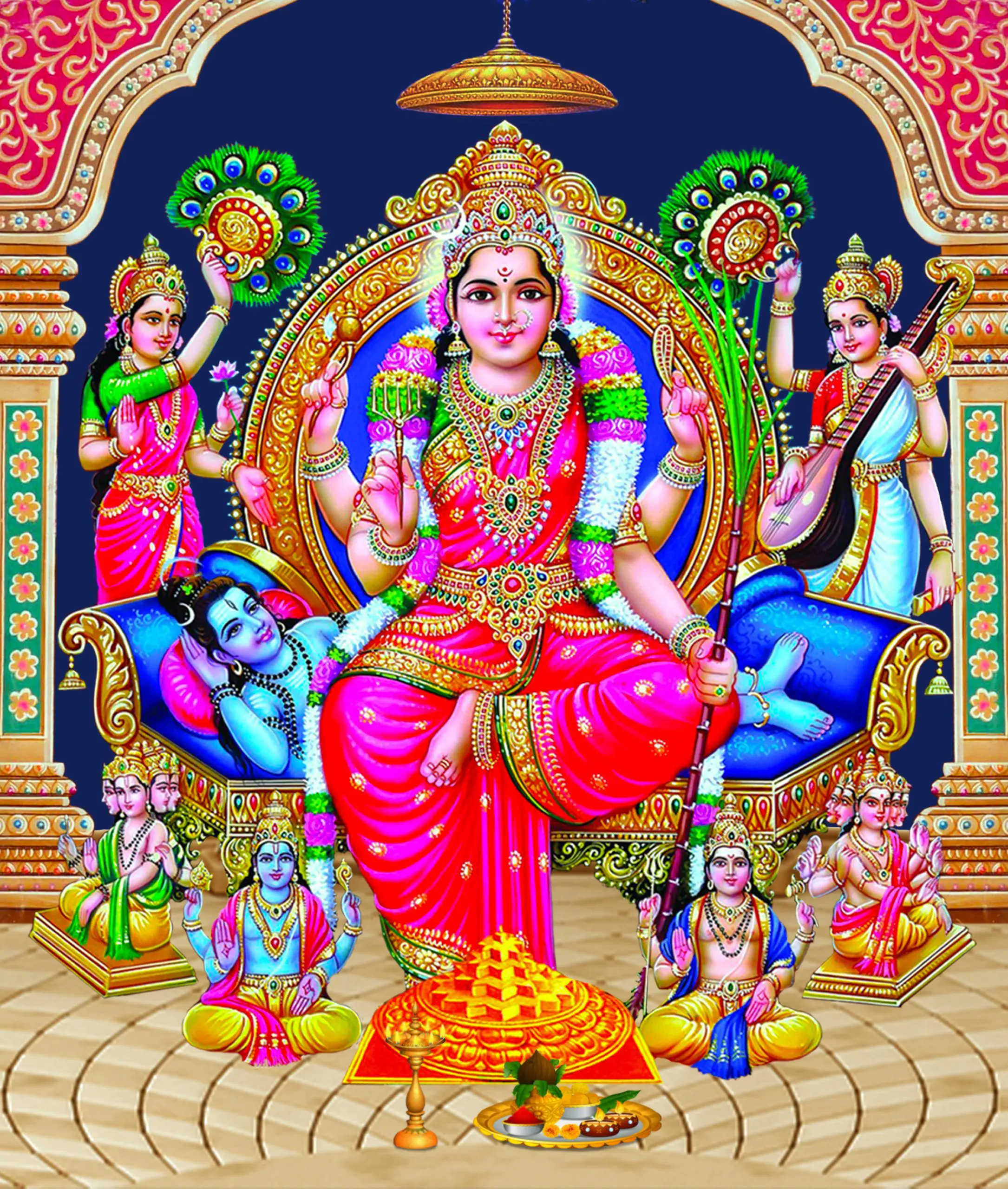
Lalitha Tripura Sundari is traditionally depicted as a sixteen-year-old Goddess of incomparable beauty, seated upon Her consort, Lord Shiva in His supremely handsome form Kameshwara, who lies on a throne known as the Panchapretasana. This throne is supported by the 5 deities—Brahma, Vishnu, Rudra, Ishvara, and Sadashiva—symbolising Her supreme authority over the fundamental forces of creation, preservation, and dissolution. Her complexion is often described as a brilliant, glowing red, like the rising Sun or a pomegranate blossom, representing Rajasic energy and cosmic passion. She is typically portrayed with 4 arms, holding 4 specific symbolic armaments: a noose (Pasha), a goad (Ankusha), a sugarcane bow (Ikshu-Dhanush), and 5 flower-arrows (Pushpa-Baan). She wears a crown adorned with a crescent moon, signifying Her role as the sovereign of time and the cycles of nature.
The symbolism of Lalita Tripura Sundari's attributes provides a profound map of human consciousness and spiritual liberation. The sugarcane bow represents the mind, while the 5 flower arrows signify the 5 senses as well as 5 elements, suggesting that She governs how we perceive and interact with the material world. The noose symbolises attachment or worldly desire, and the goad represents repulsion or anger. By holding these, She demonstrates Her power to bind the ego and goad the devotee toward spiritual awakening. The Goddesses Lakshmi (representing material prosperity) and Saraswati (representing spiritual knowledge) stand on either side of Her throne, gently fanning Her with Chaamars (fly-whisks). It illustrates that Lalitha Tripura Sundari is the source from which both worldly abundance and intellectual mastery flow.
Origins of Maa Tripura Sundari
According to the Lalitopakhyana (a section of the Brahmand Puran), the origin of Maa Tripura Sundari, also known as Lalitha Tripura Sundari, is tied to the cosmic necessity of defeating the demon Bhandasur. After Manmatha (the god of love) was reduced to ashes by Lord Shiva’s third eye, a powerful entity named Bhandasur arose from those ashes. Bhandasur performed intense penance and gained boons that made him nearly invincible, eventually conquering the three worlds and paralyzing the activities of the gods. Distressed and powerless, Indra and the other Devas performed a massive sacrificial ritual known as the Maha Yagna, where they offered their own flesh and blood into the sacrificial fire to invoke the supreme creative power of the universe.
In response to this supreme sacrifice, the Divine Mother manifested from the centre of the Chidagni Kunda (the fire of pure consciousness) in the form of Goddess Tripura Sundari. She appeared seated upon a celestial chariot, glowing with the radiance of a thousand suns, and holding Her iconic four weapons: the sugarcane bow, flowery arrows, a noose, and a goad. This manifestation was the Purna-Shakti (complete energy), emerging as the empress of the cosmos to restore Dharma. The scripture details that She was then wed to Kameshwar (an extremely beautiful form of Lord Shiva), representing the union of static consciousness and dynamic energy, before She led Her army of Shaktis from the Sri Chakra to eventually annihilate Bhandasur and restore the spiritual order of the universe.
The Significance of Lalita Tripura Sundari
Maa Tripura Sundari, also known as Shodashi or Lalita Tripura Sundari, holds a preeminent position among the Das Mahavidyas as the "Tantric Parvati" and the supreme manifestation of the Divine Mother. While other Mahavidyas often represent terrifying or specialised aspects of reality, Goddess Tripura Sundari represents the Purna-Vidya (Complete Knowledge)—the harmonious synthesis of beauty, power, and wisdom. In the hierarchy of the Mahavidyas, She is the "Third" but is considered the most sublime, embodying the creative energy that governs the three worlds (Tripura). Her significance lies in Her ability to bridge the gap between the mundane and the spiritual; She is the empress of the universe (Rajeswari) who grants both worldly prosperity (Bhoga) and ultimate liberation (Moksha), making her the central focus of the most sophisticated Tantric systems.
In the realms of Tantra and Shaktism, Ma Lalita Tripura Sundari is the soul of the Sri Vidya tradition, one of the most intellectually and spiritually rigorous paths of Hindu Tantra. She is intrinsically linked to the Sri Yantra, a complex geometric representation of the cosmos and the human body, where She resides at the central point, the Bindu. Her worship emphasises the non-duality of the seeker and the Divine, teaching that the entire universe is a playful manifestation (Lila) of Her own consciousness. Unlike traditions that demand the renunciation of the world, Shaktism, through Maa Tripura Sundari, teaches that the world itself is a reflection of her beauty. By meditating on Her form—which is described as glowing with the light of a thousand rising suns—the practitioner seeks to transform their own consciousness into a vessel of pure, radiant bliss.
The Step-by-Step Process of Sri Vidya Sadhana
Tantra Sadhana within Sri Vidya begins with the crucial step of guru initiation (Diksha). This formal initiation establishes a sacred connection between the student and the divine lineage, creating a protective spiritual shield through the Sri Vidya Guru Paduka Mantra.
The preparation phase requires a thorough study of fundamental concepts, including the nature of consciousness, the interplay between Shiva and Shakti energies, the science of sound vibrations, and the process of kundalini awakening.
Personal purification through saucha (cleanliness of body, mind, and environment) becomes essential, with many practitioners adopting sattvic dietary habits to support their spiritual progress.
Progressive Kramas: The Structured Path
Sri Vidya Sadhana follows a carefully structured progression through multiple kramas (levels), each building upon the foundation established by the previous one.
Ganapati Kramam: The journey begins with Maha Ganapati Sadhana, which involves practices such as Ganapati Tarpanam (water offerings) and yantra worship. This stage removes obstacles and negative karmic influences while stabilizing the mind for deeper practices.
Bala Kramam: This level introduces the worship of Sri Bala Tripurasundari through daily Nitya Puja with 16 ritual offerings (Shodasopachara). The foundational Bala Mantra becomes the cornerstone for all subsequent practices, establishing the devotee's connection with the Divine Mother in her most accessible form.
Shyama Kramam: Practitioners learn the worship of Raja Shyamala (Matangi), focusing on dissolving mental delusions and understanding the illusory nature of the mind. This stage brings profound clarity about the concepts of fullness (Purna) and emptiness (Shunyata).
Varahi Kramam: The worship of Maha Varahi illuminates consciousness from both relative and absolute perspectives, awakening practitioners to the inherently luminous nature of the mind itself.
Central Practice: Maa Tripura Sundari Mantras
The heart of Maa Tripura Sundari Sadhana involves the practice of powerful mantras that carry immense transformative energy. Advanced practitioners work with the Shodashi Mantra, a sixteen-syllable formula considered one of the most potent mantras in the Sri Vidya tradition.
Regular chanting of these Maa Tripura Sundari Mantras during meditation, especially on Fridays and full moon days, significantly amplifies their beneficial effects.
Sri Chakra: Sacred Geometry of Consciousness
The practice intensifies with the Sri Chakra Navavarana Puja, a worship of the sacred geometric diagram that represents both the cosmos and the body of Tripura Sundari. You can perform this practice through external worship (Bahiryagam) with a physical Sri Chakra or internal worship (Antaryagam), where practitioners visualise the 9 enclosures within their subtle bodies.
Each of the 9 enclosures (Avaranas) represents different aspects of consciousness and divine energy.
Practitioners progressively move through these levels, from the outer square representing waking consciousness to the lotus petals symbolizing various aspects of manifestation, and finally reach the central Bindu, where Shiva and Shakti unite in perfect balance.
Daily Practice Structure
A committed Sri Vidya practitioner dedicates approximately two hours daily to Tantra Sadhana, typically divided between morning and evening sessions.
The morning practice includes breath awareness, Nadi Shodhana (alternate nostril breathing), Sushumna activation, and visualisation of sacred geometry within the energy centres.
The evening practice focuses on Sri Chakra meditation, mantra japa, and offerings to the guru and Divine Mother.
Advanced Tantra Sadhana incorporates various Nyasas (ritual placement of mantras on the body), specific Mudras (hand gestures), and elaborate visualisation practices.
These techniques work systematically to purify the subtle body, activate dormant spiritual energies, and prepare the consciousness for higher realisations.
Worshipping Lalita Tripura Sundari on Tantra Sadhana App
In the digital age, the sacred practice of Sri Vidya has found a new vessel through the innovative Tantra Sadhana App created by Om Swami.
This revolutionary application brings the esoteric practices of the Das Mahavidyas (Ten Wisdom Goddesses), including Maa Lalita Tripura Sundari, into the palm of your hand, making ancient Tantric wisdom accessible to sincere seekers worldwide.
Om Swami, a renowned spiritual leader with decades of personal experience in Vedic and Tantric practices, created Tantra Sadhana App to democratise access to authentic Tantric practices.
Having spent years in intense meditation in the Himalayas, including dedicated Sri Vidya Sadhana, He designed this digital platform as a bridge between ancient wisdom and modern technology.
Condensing all the above-mentioned steps of Maa Lalita Tripura Sundari Sadhana into one potent, consecrated Sadhana, Swamiji describes the Tantra Sadhana app as a “portal into Sri Vidya" for those interested in practising Sri Vidya.
He elaborates on the pathway to Sri Vidya Sadhana through the app, which is designed to be a comprehensive and authentic journey without shortcuts.
Completion of the Das Mahavidya Cycle: First, a practitioner must complete one full cycle of all 10 Mahavidyas within the app. This process involves 11 days of preparatory rituals (Japa and Yagna) for each Mahavidya, followed by a central ritual lasting either 21 or 40 days, depending on the specific Sadhana. Completing one cycle of the Das Mahavidyas is estimated to take approximately 423 days.
Maa Lalita Tripura Sundari's Cycle Repetition: After successfully completing the cycle for the 10 Mahavidyas, those interested in Sri Vidya worship are required to repeat the Maa Lalita Tripura Sundari cycle 10 more times. Detailed worship of the Sri Yantra is the core of the Sadhana.
The Tantra Sadhana app represents a new frontier in spiritual technology, where ancient wisdom and modern innovation merge to create accessible pathways to transformation.
For those drawn to the path of Sri Vidya and the worship of Maa Lalita Tripura Sundari, the Tantra Circle community provides an authentic entry point into practices that have traditionally been shrouded in secrecy and available only to a select few.
Tantra Circle helps you perform Tantric worship with workshops, live sessions and hand-held guidance on using Tantra Sadhana App.