In this article, you will read about:
The Three Schools
The Origins of Samayachar
The Heart as Temple
The Practice
Tantra Sadhana App
Samayachar Tantra is the inward path of Shakti worship, where every ritual unfolds within the seeker rather than in the outer world.
Out of the various schools of Tantra, it is broadly recognised as the path of internal worship.
This article explores the origins, philosophy, and practice of Samayachar Tantra, a tradition that regards the human heart itself as the living shrine of the Divine Mother.
The Three Schools
The worship of the Divine as Mother is also called Shakti Sadhana. Shakti is the Mother’s living power, the power by which She creates, sustains, and acts; Sadhana is the disciplined practice through which the seeker approaches Her.
Within Shakti Sadhana the tradition counts three Acharas, three schools of practice, each suited to the seeker’s temperament and readiness. All three work to awaken Kundalini, the dormant Goddess-energy at the base of the spine (Muladhar), and to guide Her ascent to the crown of the head (Sahasrar), doing it in their own specific way.
Kaulachar: outward worship
The seeker worships the Goddess outwardly, through Yantras, the sacred geometric forms of the Goddess, and other ritual instruments. The body is engaged, the senses are involved, and the practice unfolds in the visible world. Kaulachar works to awaken the divine force at the Muladhar, the root chakra, through external means.
Mishrachar: the mixed path
Mishra means combination. Here the seeker begins to internalise what was once external. The Yantras and mandalas are still studied, but their meaning is now turned inward, the focus moving from the root toward the Anahat, the heart centre, where the seeker learns to guide Kundalini with devotion.
Samayachar: inward worship
The most inward of the three. No outer image. No outer rite. The whole worship unfolds within the seeker’s own heart, and the body itself becomes the living shrine. It is taken up only by those prepared by years of inner work.
But the path of Samayachar opens only to one who has reached Divya-Bhav (Divine Disposition), a state of calm, clarity, and equanimity.
The Origins of Samayachar
The word Samayachar comes from Samaya, the union of Shiv and Shakti, the coming-together where duality ceases. It also conveys the idea of equality (Sama): the Goddess worshipped as the equal of Shiv.
From that same root comes the name of the inward path of worship, enacted within the heart’s inner sky (Daharakash), which many traditions regard as the highest way of approaching Her.
Samayaa is also Her own name. Among the thousand names of the Lalita Sahasranama, She is called Samayachara-tatpara, devoted to this very path.
Bhaskararaya, the eighteenth-century scholar whose commentary on those thousand names is still read today, gives the path more than one source: he grounds the inward worship in five scriptures of the sages who first received it, which he aligns with the Veda, and he points to ten chapters of the Rudra Yamala for the conduct itself. By conduct, he means the inward worship in which the Goddess is raised through the centres of the body to Her union with Shiv at the crown, then returned to Her rest. He highlights that one learns about this conduct and practice only from a Guru. And this is the practice the rest of the article describes.
The path follows a lineage, with tradition tracing it to Shiv and the sages who first received it. From them, it passed down the centuries to Adi Shankaracharya, who gave it its hymn in the Saundarya Lahiri, and later the commentator Lakshmidhar interpreted that hymn verse by verse as a map of the inward ascent. It is this name, and this worship, that the practitioner of the path, the Samayin, takes up.
The Heart as Temple
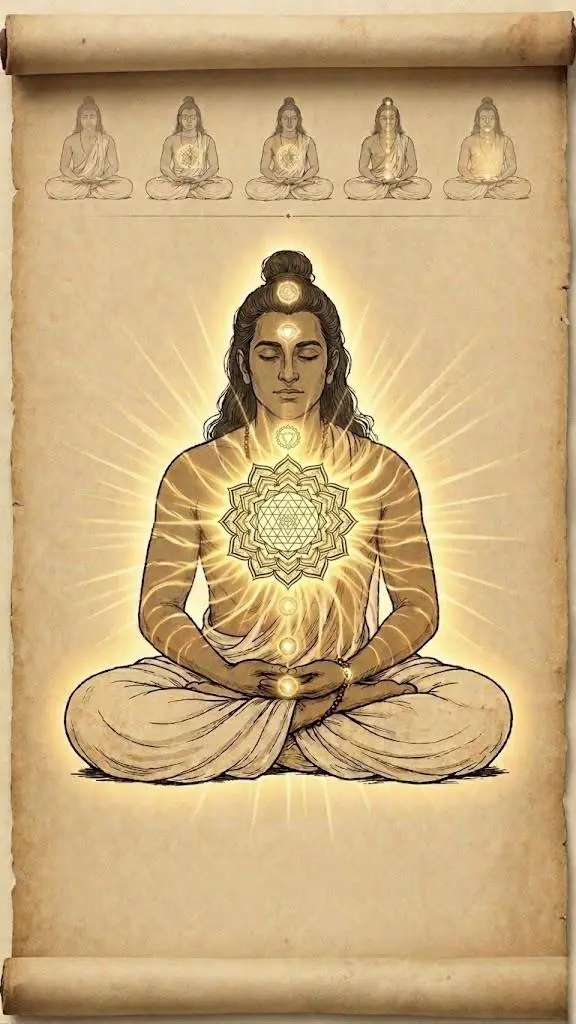
Samayachar begins with a refusal. It refuses the outward rituals of worship: no image is installed, no rite is performed with the hands, no object is offered. What the outer paths perform in the visible world, the Samayin does within. The body is not left behind in this. It becomes the ground of the work, the temple in which the whole worship is raised.
The Bhavanopanishad, which maps the Goddess and Her Sri Chakra onto the seeker’s own body, gives this inward worship its definition. The true offering, it teaches, is the contemplation (Bhavana) in which knower, knowledge, and known are seen as one, no longer three. That contemplation is itself the worship of the Sri Chakra.
Such a practice, though, is not opened to everyone who asks for it. A seeker becomes a Samayin only when the Guru recognises readiness. The Guru looks for three signs in the seeker: Vivek, the power to tell the real from the unreal; ethical clarity, a life lived in alignment with truth and right conduct; and Mumukshutva, a longing for liberation. Until these are present, the path stays closed; it opens only to one who can walk it without harm.
Upon recognition, at the moment of initiation (Diksha), the Guru bestows the mantra and imparts the inner architecture of the practice: what is to be built within, and in what order.
And what does a Samayin do? They sit. They steady the breath. They draw the senses back from their wandering, and in the quiet that opens, they begin to build the whole worship within.
The Practice
The Practice has five stages, each unfolding into the next.
Stage 1: Preparation
In this stage, the Samayin settles the body and steadies the breath. This is not the practice yet. This is the start, which can take years of quiet effort.
Stage 2: The Inner Field
The second stage involves composing the inner field of worship, known as the Daharakash (inner sky), or the cave of the heart. This is the space where all subsequent events of the practice will occur.
With the body still and attention turned inward, the Sri Chakra rises into being. The Sri Chakra is the Goddess Herself, manifesting in line and form. To compose Her form inwardly is to invite Her to take shape within.
Stage 3: The Mantra
This stage involves the practice of the Panchadashi, the fifteen-syllable sound-form of the Goddess. The mantra is silently and continuously repeated until it becomes the rhythm of the Samayin’s breath and thought.
Stage 4: The Rising (Ascent of Kundalini)
With the establishment of inner concentration and the steady flow of the mantra, the Samayin invites Kundalini, the dormant Goddess-energy that sleeps coiled at the base of the spine (Muladhar), to awaken and rise.
She ascends through the Chakras until She meets Shiv at the crown of the head (Sahasrar). This meeting within the seeker’s body is the Samaya, the union for which the path is named.
None of this happens quickly. Samayachar is the work of years, even lifetimes. The path asks for steadfastness, the dedication to return every day to the same sitting, the same breath, the same silent mantra, even when nothing seems to be happening.
It asks for purity, the patient clearing of selfishness, anger, and restless desire from the Samayin’s inner life, until the mind grows luminous enough to see the Truth: that which has always been there.
Stage 5: The Recognition
And then, after long years of such inner effort, a quiet understanding arises. The Divine, who was always present in the seeker but veiled, is now revealing Herself.
"Blessed are the few who worship You, the wave of Consciousness and Bliss, in the mansion of wish-granting gems on the isle of gems amid the ocean of nectar, seated upon a couch that is Shiv Himself."
— Saundaryalahari, verse 8 (Adi Shankaracharya)
Tantra Sadhana App
This path of Samayachar that the series will unfold is the inward way of approaching one of the Das Mahavidyas, the ten manifestations of the Mother Goddess: Lalita Tripura Sundari, the supremely beautiful Empress who governs the three worlds. She is the third of the ten and Her sadhana is performed through the Sri Yantra, Her form in geometry.
The sadhana of all ten Mahavidyas is taught and practised on the Tantra Sadhana App, founded by the Himalayan Siddha Om Swami. Each mantra on the app is awakened through Swamiji’s penance and a step by step practice is offered for the sincere seeker.
If you feel drawn to walk further into Her sadhana, the Tantra Sadhana App is where the teaching opens.