In this article, you will read about:
About Adi Shankaracharya
How Adi Shankaracharya Preserved Sanatan Dharm
Adi Shankaracharya's Timeless Spiritual Compositions
Adi Shankaracharya's Relation with the Mother Goddess
Adi Shankaracharya's Contributions to Tantra & Shakti Upasana
Tantra Sadhana App and the Path of Divyachar
The 1239th Birth Anniversary of Adi Shankaracharya: 10 May 2027 (Monday)
Panchami Tithi (IST) — 6:22 AM (10 May) to 3:47 AM (11 May)
About Adi Shankaracharya
Jagadguru Adi Shankaracharya was a self-realised Indian spiritual philosopher and theologian who consolidated the doctrine of Advaita Vedanta.
Born in Kalady, Kerala, to a Nambudiri Brahmin family in the 8th century, he is historically believed to have lived between 788 and 820 CE, though some traditional accounts, such as those from the Dwaraka Peetham, suggest an earlier date.
According to the Shankara Vijaya texts (biographies written by his followers), he showed exceptional intellectual prowess at a young age, mastering the Vedas by age 8 and entering the monastic order (Sannyasa) shortly thereafter under his Guru, Govinda Bhagavatpada.
Shankaracharya’s primary contribution was the systematisation of the Upanishads, Bhagavad Gita, and Brahma Sutras, collectively known as the Prasthanatrayi. He believed in a non-dualistic reality where the individual soul (Atman) is identical to the Supreme Reality (Brahman), asserting that ignorance (Maya) is the only barrier to this realisation.
To establish this philosophy, he travelled extensively across the Indian subcontinent, from Kanyakumari to Kashmir, engaging in intellectual debates with scholars of Buddhist, Jain, and Mimamsa schools.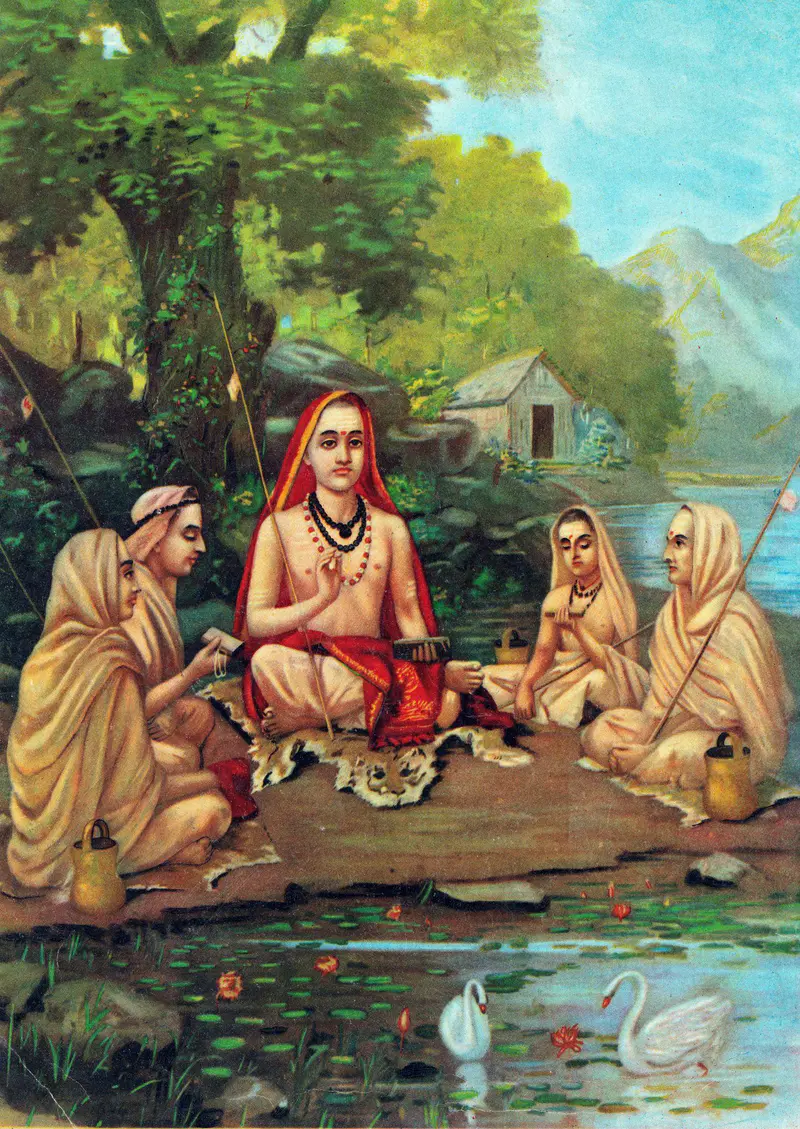
How Adi Shankaracharya Preserved Sanatan Dharm
Adi Shankaracharya is credited with reviving Sanatan Dharm during a period when Vedic influence was waning due to the rise of ritualistic complexities and the dominance of non-Vedic traditions.
One of his most structural contributions was the establishment of the Dashanami Sampradaya, an organised monastic order for Sannyasis (Hindu monks), which brought discipline and unity to the ascetic community.
He categorised monks into 10 names based on their lineage and duties — a system that persists today in the Akhada traditions of India.
To ensure the geographical and spiritual integrity of the tradition, he established 4 primary monasteries (Mathas) in the 4 corners of India: Sringeri (South), Puri (East), Dwaraka (West), and Jyotirmath (North).
These institutions were tasked with preserving the Rig, Yajur, Sama, and Atharva Vedas respectively. Furthermore, he introduced the Panchayatana Puja system, which allowed for the simultaneous worship of Lord Shiv, Lord Vishnu, Shakti, Lord Surya, and Lord Ganesh (or Lord Kartikeya).
This decentralised approach mitigated sectarian conflicts between Vaishnavas and Shaivas, promoting a cohesive Smarta tradition.
Adi Shankaracharya's Timeless Spiritual Compositions
Shankaracharya’s literary output is categorised into commentaries (Bhashyas), introductory texts (Prakarana Granthas), and devotional hymns (Stotras). His commentaries on the Brahma Sutras and the 10 principal Upanishads are considered the foundational pillars of Advaita literature.
These works use rigorous logic to dismantle dualistic interpretations of Vedic texts, focusing on the Mahavakya ‘Aham Brahmasmi’ (I am Brahman).
On the other hand, his devotional hymns also praise and glorify different deities, intertwining Vedantic philosophy with Puranic lores and cosmic truths. Devotees recite them regularly to invoke Divine Grace, purifiy the mind, and dissolve the ego to attain a state of oneness with the deity and eventual self-realisation.
Popular compositions from his vast body of work include:
Bhashyas
Brahma Sutra Bhashya
Bhagavad Gita Bhashya
Brihadaranyaka Upanishad Bhashya
Chandogya Upanishad Bhashya
Taittiriya Upanishad Bhashya
Prakarana Granthas
Vivekachudamani
Atma Bodha
Tattva Bodha
Upadesha Sahasri
Aparokshanubhuti
Stotras
Nirvana Shatakam
Bhaja Govindam
Bhavanyashtakam
Kaala Bhairava Ashtakam
Adi Shankaracharya's Relation with the Mother Goddess
While Shankaracharya is often associated with Nirgun Brahman, his relationship with the Divine Mother (Shakti) represents the synthesis of intellect and devotion.
Tradition holds that his initial focus was purely on the formless (Nirakar) and attributeless (Nirgun), but through encounters with local practitioners and spiritual experiences—most notably in Varanasi and at the Kamakhya temple—he integrated the worship of the Sagun (manifested) Goddess into his framework.
He viewed Shakti not as separate from Shiv or Brahman, but as the dynamic power (Vimarsa) of that static, unchanging consciousness (Prakash).
Shankaracharya is credited with installing or consecrating the Sri Chakra (a sacred geometric representation of Ma Lalita Tripura Sundari) in several major temples, including the Kamakshi Amman Temple in Kanchipuram and the Mookambika Temple in Kollur. By doing so, he transitioned the worship of the Goddess from potentially extreme or fringe practices into the mainstream Vedic fold. His works, Soundarya Lahari and Ananda Lahari, serve as a testament to this relationship, where he describes Ma Tripura Sundari as the source of all energy, without whom Shiv remains ‘Shav’ (a corpse).
Adi Shankaracharya's Contributions to Tantra & Shakti Upasana
Shankaracharya played a pivotal role in ‘Vedanticising’ Tantra, stripping away transgressive elements to create the Samayachara school of Sri Vidya — the tradition that worships Ma Tripura Sundari as the Supreme Being. This school emphasises internal worship (Antaryaga) and meditation on the Sri Yantra over external, ritualistic Tantra.
His commentary and structural influence helped align Shaktism with the ethical and philosophical boundaries of the Vedas, making Shakti Upasana accessible to the broader community of practitioners.
His most significant technical contribution to this field is the Prapanchasara Tantra, a text attributed to him that details the rituals, mantras, and meditations associated with various deities.
He emphasized that the worship of the Divine Mother is the most effective way to achieve both worldly prosperity (Bhukti) and liberation (Mukti).
Tantra Sadhana App and the Path of Divyachar
Jagadguru Adi Shankaracharya encouraged the practice of Manas Puja, where ‘Manas’ means mind. The entire Shodashopchar or Panchopchar Puja of a deity is performed mentally, through the mind’s eye, including their 16 or 5 offerings. No physical apparatus is used. Adi Shankaracharya considered it superior to external worship, as it demands complete immersion of the mind, with no distractions.
The Tantra Sadhana App by Himalayan monk, Om Swami, is based on the same principle, called Divyachar in Tantra. The 10 virtual worlds of the Das Mahavidyas in the app act as a medium to worship the Tantric Goddesses through Sadhanas mastered by Om Swami Himself.
They are unique Tantric Sadhanas that go beyond the traditional Vedic Pujas of mainstream deities.
The app is free and ad-free, with a seeker guided through every ritual step-by-step. This makes it accessible and safe for even those spiritual seekers who wish to explore the path of Tantra for the first time, without the guidance of a personal Guru.
All the mantras in the app are awakened and chanted by Swamiji Himself.
This Adi Shankaracharya Jayanti, begin Tantra Sadhana in a way the great saint considered the purest and most effective.