In this article, you will read about:
Kanakadhara Stotram Lyrics and Meaning in English
The Story Behind Kanakadhara Stotram
Kanakadhara Stotram’s Spiritual and Symbolic Meaning
Why Kanakadhara Stotram Is Considered Powerful
Adi Shankaracharya, Manas Puja and the Tantra Sadhana App
The Kanakadhara Stotram, the title which literally translates to “a stream/shower of gold”, is one of the most beloved and seminal devotional hymns composed by the incredible Adi Shankaracharya. It showcases not only his poetic brilliance and the theological depth of Sanatan Dharm, but above all — the transformative power of Anugrah, i.e., Divine Grace.
The poem is rich in long Samas (compound words), abundant in Alankars (poetic figures), and saturated with devotion, calling out to the resplendent Goddess Lakshmi by way of Her many appellations and attributes: Sagara Sambhavayah, Sampatkarani, and Narayana Vallabha, to name just a few.
This “Kanakadhara” nomenclature comes from the composition’s legendary origins, where Shankara caused a miraculous downpour of golden gooseberries to alleviate the destitution of a pious but impoverished woman.
Kanakadhara Stotram Lyrics in English
Download the Stotram as PDF to read it again later:
aṅgaṁ hareḥ pulakabhūṣaṇam āśrayantī bhṛṅgāṅganeva mukulābharaṇaṁ tamālam |
aṅgīkṛtākhilavibhūtir apāṅgalīlā māṅgalyadāstu mama maṅgaladevatāyāḥ ||1||
mugdhā muhur vidadhatī vadane murāreḥ prema-trapā-praṇihitāni gatāgatāni |
mālā dṛśor madhukarīva mahotpale yā sā me śriyaṁ diśatu sāgarasambhavāyāḥ ||2||
āmīlitākṣam adhigamya mudā mukundam ānandakandam animeṣam anaṅgatantram |
ākekarasthita-kanīnika-pakṣma-netraṁ bhūtyai bhaven mama bhujaṅga-śayāṅganāyāḥ ||3||
bāhvantare madhujitaḥ śrita-kaustubhe yā hārāvalīva harinīlamayī vibhāti |
kāmapradā bhagavato'pi kaṭākṣamālā kalyāṇam āvahatu me kamalālayāyāḥ ||4||
kālāmbudālilalitorasi kaiṭabhāreḥ dhārādhare sphurati yā taḍidaṅganeva |
mātus samasta-jagatāṁ mahanīya-mūrtiḥ bhadrāṇi me diśatu bhārgava-nandanāyāḥ ||5||
prāptaṁ padaṁ prathamataḥ khalu yat-prabhāvāt māṅgalyabhāji madhumāthini manmathena |
mayyāpatet tad iha mantharam īkṣaṇārdhaṁ mandālasaṁ ca makarālayakanyakāyāḥ ||6||
viśvāmarendra-padavi-bhrama-dāna-dakṣaṁ ānanda-hetur adhikaṁ muravidviṣo'pi |
īṣan-niṣīdatu mayi kṣaṇam īkṣaṇārdham indīvarodara-sahodaram indirāyāḥ ||7||
iṣṭāviśiṣṭamatayo'pi yayā dayārdra- dṛṣṭyā triviṣṭapapadaṁ sulabhaṁ labhante |
dṛṣṭiḥ prahṛṣṭa-kamalodara-dīptir iṣṭāṁ puṣṭiṁ kṛṣīṣṭa mama puṣkara-viṣṭarāyāḥ ||8||
dadyād dayānupavano draviṇāmbu-dhārāṁ asminn akiñcana-vihaṅga-śiśau viṣaṇṇe |
duṣkarma-gharmam apanīya cirāya dūraṁ nārāyaṇa-praṇayinī-nayanāmbuvāhaḥ ||9||
gīr-devateti garuḍa-dhvaja-sundarīti śākambharīti śaśi-śekhara-vallabheti |
sṛṣṭi-sthiti-pralaya-keliṣu saṁsthitāyai tasyai namas tribhuvanaika-guros taruṇyai ||10||
śrutyai namo'stu śubha-karma-phala-prasūtyai ratyai namo'stu ramaṇīya-guṇārṇavāyai |
śaktyai namo'stu śatapatra-niketanāyai puṣṭyai namo'stu puruṣottama-vallabhāyai ||11||
namo'stu nālīka-nibhānanāyai namo'stu dugdhodadhi-janma-bhūmyai |
namo'stu somāmṛta-sodarāyai namo'stu nārāyaṇa-vallabhāyai ||12||
namo'stu hemāmbuja-pīṭhikāyai namo'stu bhū-maṇḍala-nāyikāyai |
namo'stu devādi-dayā-parāyai namo'stu śārṅgāyudha-vallabhāyai ||13||
namo'stu devyai bhṛgu-nandanāyai namo'stu viṣṇor urasi sthitāyai |
namo'stu lakṣmyai kamalālayāyai namo'stu dāmodara-vallabhāyai ||14||
namo'stu kāntyai kamalekṣaṇāyai namo'stu bhūtyai bhuvana-prasūtyai |
namo'stu devādibhir arcitāyai namo'stu nandātmaja-vallabhāyai ||15||
sampatkarāṇi sakalendriya-nandanāni sāmrājya-dāna-vibhavāni saroruhākṣi |
tvad-vandanāni duritāharaṇodyatāni mām eva mātaran-iśaṁ kalayantu mānye ||16||
yat-kaṭākṣa-samupāsanā-vidhiḥ sevakasya sakalārtha-sampadaḥ |
santanoti vacanāṅga-mānasaiḥ tvāṁ murāri-hṛdayeśvarīṁ bhaje ||17||
sarasija-nilaye saroja-haste dhavalatamāṁśuka-gandha-mālya-śobhe |
bhagavati hari-vallabhe manojñe tribhuvana-bhūtikari prasīda mahyam ||18||
dig-hastibhiḥ kanaka-kumbha-mukhāvasṛṣṭa- svarvāhinī-vimala-cāru-jala-plutāṅgīm |
prātar namāmi jagatāṁ jananīm aśeṣa- lokādhi-nātha-gṛhiṇīm amṛtābdhi-putrīm ||19||
kamale kamalākṣa-vallabhe tvaṁ karuṇā-pūra-taraṅgitair apāṅgaiḥ |
avalokaya mām akiñcanānāṁ prathamaṁ pātram akṛtrimaṁ dayāyāḥ ||20||
stuvanti ye stutibhir amībhir anvahaṁ trayīmayīṁ tribhuvana-mātaraṁ ramām |
guṇādhikā gurutara-bhāgya-bhāgino bhavanti te bhuvi budha-bhāvitāśayāḥ ||21||
Kanakadhara Stotram Meaning in English
Download a PDF of the Stotram with its meaning to review later:
aṅgaṁ hareḥ pulakabhūṣaṇam āśrayantī bhṛṅgāṅganeva mukulābharaṇaṁ tamālam |
aṅgīkṛtākhilavibhūtir apāṅgalīlā māṅgalyadāstu mama maṅgaladevatāyāḥ ||1||
To Hari, who wears supreme happiness as an ornament, Sri, Goddess Lakshmi is attracted — like bumble bees drawn to the unopened buds of the black Tamala tree.
Let Her, the Goddess of all good things, who holds within Her body the opulence of the entire universe, grant me a glance that will bring auspiciousness.
mugdhā muhur vidadhatī vadane murāreḥ prema-trapā-praṇihitāni gatāgatāni |
mālā dṛśor madhukarīva mahotpale yā sā me śriyaṁ diśatu sāgarasambhavāyāḥ ||2||
Again and again return those glances, filled with hesitation and love — of Her who is born from the ocean of milk — to the face of Murari, like honeybees to the pretty blue lotus.
Let those glances shower me with wealth and good fortune.
āmīlitākṣam adhigamya mudā mukundam ānandakandam animeṣam anaṅgatantram |
ākekarasthita-kanīnika-pakṣma-netraṁ bhūtyai bhaven mama bhujaṅga-śayāṅganāyāḥ ||3||
With half-closed eyes, She gazes at Mukunda, filled with happiness, shyness, and the great science of love. With unwinking eyes, She holds the ecstasy-filled face of Her Lord.
From the corner of that eye, let a ray of glance take wing — let Her, the consort of Him who sleeps on the serpent, shower me with wealth.
bāhvantare madhujitaḥ śrita-kaustubhe yā hārāvalīva harinīlamayī vibhāti |
kāmapradā bhagavato'pi kaṭākṣamālā kalyāṇam āvahatu me kamalālayāyāḥ ||4||
He who won over Madhu wears the Kaustubh as an ornament, and also the garland of Her glances — blue as Indraneel — filled with love to protect and grant His wishes.
Let those glances of Her who dwells on the lotus fall on me and grant me all that is good.
kālāmbudālilalitorasi kaiṭabhāreḥ dhārādhare sphurati yā taḍidaṅganeva |
mātus samasta-jagatāṁ mahanīya-mūrtiḥ bhadrāṇi me diśatu bhārgava-nandanāyāḥ ||5||
Like a streak of lightning on a dark rain cloud, She shines on the broad chest of Him who killed Kaitabh.
Let the eyes of the great Mother of All the Universe, the daughter of Sage Bhargav, fall on me lightly and bring me prosperity.
prāptaṁ padaṁ prathamataḥ khalu yat-prabhāvāt māṅgalyabhāji madhumāthini manmathena |
mayyāpatet tad iha mantharam īkṣaṇārdhaṁ mandālasaṁ ca makarālayakanyakāyāḥ ||6||
Through the power of Her kind glances alone, the God of Love could reach the killer of Madhu. Let that same sidelong glance — auspicious, indolent, loaded with blessing — fall on me too.
viśvāmarendra-padavi-bhrama-dāna-dakṣaṁ ānanda-hetur adhikaṁ muravidviṣo'pi |
īṣan-niṣīdatu mayi kṣaṇam īkṣaṇārdham indīvarodara-sahodaram indirāyāḥ ||7||
Her sidelong glance of a single moment is capable of making one the king of Devas — it made Indra regain his kingdom, and it fills the slayer of Mura with supreme joy.
Let Her, with Her blue-lotus eyes, glance at me, even a little.
iṣṭāviśiṣṭamatayo'pi yayā dayārdra- dṛṣṭyā triviṣṭapapadaṁ sulabhaṁ labhante |
dṛṣṭiḥ prahṛṣṭa-kamalodara-dīptir iṣṭāṁ puṣṭiṁ kṛṣīṣṭa mama puṣkara-viṣṭarāyāḥ ||8||
By Her compassion-filled glance alone, even ordinary devotees attain heaven — a place otherwise difficult to reach.
Let Her sparkling eyes, bright as the fully opened lotus, fall upon me and grant me all my desires.
dadyād dayānupavano draviṇāmbu-dhārāṁ asminn akiñcana-vihaṅga-śiśau viṣaṇṇe |
duṣkarma-gharmam apanīya cirāya dūraṁ nārāyaṇa-praṇayinī-nayanāmbuvāhaḥ ||9||
Send Your mercy like a wind and shower the rain of wealth on this parched land.
Quench the thirst of this little Chatakbird; drive far away the heat of my accumulated bad karma — O beloved of Narayan — through the glance of your cloud-dark eyes.
gīr-devateti garuḍa-dhvaja-sundarīti śākambharīti śaśi-śekhara-vallabheti |
sṛṣṭi-sthiti-pralaya-keliṣu saṁsthitāyai tasyai namas tribhuvanaika-guros taruṇyai ||10||
She is the Goddess of Knowledge. She is the beloved of Him whose flag bears Garuda. She is Shakambhari. She is the wife of Him who wears the crescent moon. She presides over creation, sustenance, and dissolution.
Salutations to this Lady, worshipped by all three worlds.
śrutyai namo'stu śubha-karma-phala-prasūtyai ratyai namo'stu ramaṇīya-guṇārṇavāyai |
śaktyai namo'stu śatapatra-niketanāyai puṣṭyai namo'stu puruṣottama-vallabhāyai ||11||
Salutations to You as the Vedas, source of the fruits of good action. Salutations to You as Rati, ocean of beautiful qualities. Salutations to You as Shakti, who dwells in the hundred-petalled lotus.
Salutations to You as Pushti, consort of Purushottama.
namo'stu nālīka-nibhānanāyai namo'stu dugdhodadhi-janma-bhūmyai |
namo'stu somāmṛta-sodarāyai namo'stu nārāyaṇa-vallabhāyai ||12||
Salutations to Her whose face is as lovely as a lotus in full bloom. Salutations to Her born from the ocean of milk. Salutations to Her, sister of the Moon and of Amrit. Salutations to the consort of Narayan.
namo'stu hemāmbuja-pīṭhikāyai namo'stu bhū-maṇḍala-nāyikāyai |
namo'stu devādi-dayā-parāyai namo'stu śārṅgāyudha-vallabhāyai ||13||
Salutations to Her whose throne is the golden lotus. Salutations to the leader of the universe. Salutations to Her who showers compassion on the devas.
Salutations to the consort of Him who wields the Sharang bow.
namo'stu devyai bhṛgu-nandanāyai namo'stu viṣṇor urasi sthitāyai |
namo'stu lakṣmyai kamalālayāyai namo'stu dāmodara-vallabhāyai ||14||
Salutations to the Goddess, daughter of Bhrigu. Salutations to Her who rests on the sacred chest of Vishnu. Salutations to Lakshmi, who dwells in the lotus.
Salutations to the consort of Damodar.
namo'stu kāntyai kamalekṣaṇāyai namo'stu bhūtyai bhuvana-prasūtyai |
namo'stu devādibhir arcitāyai namo'stu nandātmaja-vallabhāyai ||15||
Salutations to Her who is the light dwelling in the lotus. Salutations to Her who is the earth and the Mother of the earth. Salutations to Her who is worshipped by the devas.
Salutations to Her who is the consort of the son of Nanda.
sampatkarāṇi sakalendriya-nandanāni sāmrājya-dāna-vibhavāni saroruhākṣi |
tvad-vandanāni duritāharaṇodyatāni mām eva mātaran-iśaṁ kalayantu mānye ||16||
Giver of wealth, giver of pleasure to every sense, giver of sovereign power — O lotus-eyed one, O Mother — let my salutations to You, which swiftly dissolve all sorrow, remain with me always.
yat-kaṭākṣa-samupāsanā-vidhiḥ sevakasya sakalārtha-sampadaḥ |
santanoti vacanāṅga-mānasaiḥ tvāṁ murāri-hṛdayeśvarīṁ bhaje ||17||
The one who worships Your sidelong glances is blessed with every known wealth and prosperity. By word, body, and mind, I offer my salutations to You — the Queen of the heart of Murari.
sarasija-nilaye saroja-haste dhavalatamāṁśuka-gandha-mālya-śobhe |
bhagavati hari-vallabhe manojñe tribhuvana-bhūtikari prasīda mahyam ||18||
O seated-on-the-lotus, lotus-in-hand, clothed in dazzling white, adorned with garlands and sandal paste — Goddess, beloved of Hari, enchanter of the mind, bestower of prosperity on the three worlds — be pleased with me.
dig-hastibhiḥ kanaka-kumbha-mukhāvasṛṣṭa- svarvāhinī-vimala-cāru-jala-plutāṅgīm |
prātar namāmi jagatāṁ jananīm aśeṣa- lokādhi-nātha-gṛhiṇīm amṛtābdhi-putrīm ||19||
The eight elephants of the directions pour, from golden vessels, the pure waters of the heavenly Ganga for Her sacred bath. In the morning, I bow to Her — Mother of the worlds, wife of the Lord of All Realms, daughter of the ocean of Amrit.
kamale kamalākṣa-vallabhe tvaṁ karuṇā-pūra-taraṅgitair apāṅgaiḥ |
avalokaya mām akiñcanānāṁ prathamaṁ pātram akṛtrimaṁ dayāyāḥ ||20||
O Lotus One, beloved of the Lotus-Eyed — with glances rippling with waves of compassion, look upon me, the poorest of the poor. Make me the first and truest vessel of Your grace.
stuvanti ye stutibhir amībhir anvahaṁ trayīmayīṁ tribhuvana-mātaraṁ ramām |
guṇādhikā gurutara-bhāgya-bhāgino bhavanti te bhuvi budha-bhāvitāśayāḥ ||21||
Those who recite these hymns daily — to Her who embodies the three Vedas, Mother of the Three Worlds, Goddess Rama — will undoubtedly be blessed with noble qualities, the greatest of fortunes, and recognition even from the learned.
Translated by P. R. Ramachander (with minor adaptations for theological precision).
The verses end. But the story they arose from does not.
The Kanakadhara Stotram was not composed in a study or a temple. It arose in a moment of compassion, from a young boy who had nothing to offer except the full force of his heart steeped in devotion.
The Story Behind Kanakadhara Stotram
A Young Brahmachari at a Poor Woman’s Door
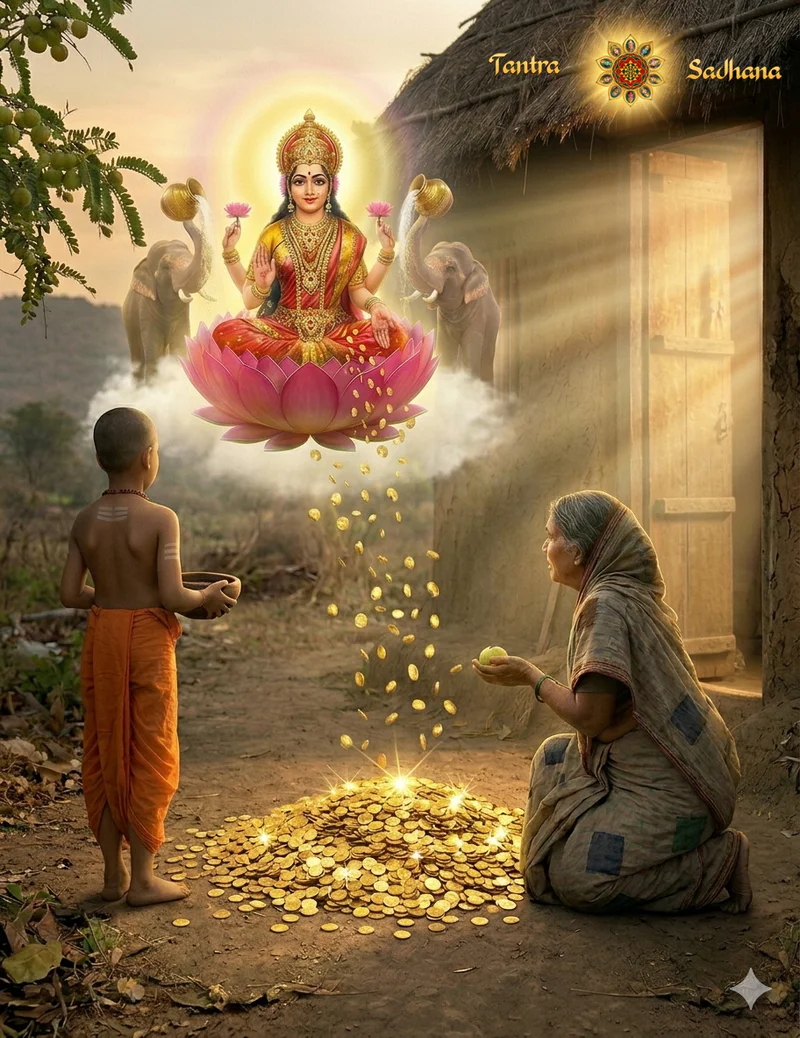
After his Upanayana (thread ceremony) at the age of five, Shankara was living as a Brahmachari (student) in a Gurukul. Once, on a Dwadashi (the twelfth day of the lunar cycle), he set out for Bhikshatan (the practice of seeking alms from householders to sustain himself and his teacher) and approached a dilapidated hut.
Its resident was a woman of noble character but profound poverty, who found herself unable to fulfil the sacred duty of providing alms to the Brahmachari. After searching her bare home, she located a single, dried amalaki (Indian gooseberry), the very fruit, perhaps, that she had been saving to break her own Ekadashi fast.
Moved by a sense of duty and overwhelming devotion, she offered this meagre fruit to Shankara with such humility and shame at having nothing more to give, that the young boy, moved to tears, began to pray to the Goddess for her.
“Bhagavan does not live in a small heart, and He does not leave a big heart.”
— Om Swami
The Debate With The Goddess: Grace vs. Karma
Some accounts, as found in the Anandagiri Shankara Vijaya, describe a visionary dialogue where the Goddess initially hesitates at the request for wealth — explaining to Shankara that the woman’s current poverty is an inescapable fruit of her past karma (Prarabdh Karm), as she had not performed acts of charity in previous incarnations.
Shankara’s rebuttal — that this single act of selfless giving, offering her only possession with pure devotion, was sufficient to override all karmic limitations — forms a crucial moment in the theology of grace.
The Devi, persuaded and pleased by his compassionate plea and the poetic brilliance of his invocation, manifests a shower of golden amalakis — thus transforming the woman’s destiny!
In Kerala, tradition identifies the site of this incident as Swarnathu Mana ("the Golden House") in Punnorkode, Pazhamthottam — an ancient Namboothiri ancestral home in Ernakulam district. The Kanakadhara Mahalakshmi Temple, consecrated on the grounds in 2013, now stands as a monument to the event.
Kanakadhara Stotram’s Spiritual and Symbolic Meaning
While it is easy to associate this hymn with material wealth, it is more important to underscore that Divine Grace is real, that selfless generosity transcends karmic limitation, and that the Divine Feminine actively intervenes in elevating human suffering: manifesting as abundance, harmony, and consciousness itself. Wealth, in this framework, is only one expression of Her presence.
The episode also demonstrates that Divine Grace flows as an inexhaustible current, not a rationed outpouring. It is not strictly bound by visible merit or ritual performance.
The woman had no resources, no offerings, no ritual performance. Yet, what she had was a heart that could not bear to send the Brahmachari away hungry, even when her own stomach was empty. And that itself was enough.
The Devi Bhagavatam is unflinching on this point: the Goddess moves by Her own compassion, not by our arithmetic. Where the heart breaks open, Devi arrives — Karma or no Karma.
The story, and by extension the Stotram itself, is also theologically significant, offering a sophisticated alternative to strict karmic determinism. Its position within the broader Advait (meaning 'not two' — the absolute oneness of reality) framework demonstrates how non-dual philosophy accommodates rather than rejects devotional practice.
The Benediction in the Sidelong Glance
Central to the Stotram is the concept of the Kataksha: the “playful sidelong glance” of Goddess Lakshmi as a vehicle of Divine Grace.
Rather than seeking a direct encounter, Shankara beseeches a brief flicker from the corner of Her eyes towards the devotee — the very eyes that are perpetually fixed in love upon Narayana.
This Kataksha represents the overflow of Divine love: as Lakshmi gazes at Her consort, the sheer intensity of Her bliss spills over as grace for the rest of creation.
The Multi-Faceted Identity of the Goddess
In the tenth verse, Shankara makes a striking identification, recognising Lakshmi as one with other Feminine Divinities and addressing Her as:
Vāgvadinī / Gīrdēvatā — the Goddess of Speech and Wisdom (Saraswati)
Garuḍadhvajasundarī — the darling of Him who has Garuda as flag (Hari Priya)
Śākambharī — the Goddess of vegetation and nourishment
Śaśiśekhara-vallabhā — the consort of the moon-adorned Shiva (Parvati)
In doing so, Shankara asserts that 'wealth' is not merely currency but the very energy that drives the cosmic cycle. This aligns with the Advait view that the manifold world is but a manifestation of a single, non-dual reality (Brahman) perceived through different names and forms.
Sound, Flow, and Invocation
From a Tantric perspective, the Kanakadhara Stotram illustrates the principle that Divine energy (Shakti) is not static but flows like a current. The “stream of gold” symbolises the removal of inner and external blockages, allowing natural abundance to manifest rather than being artificially created.
The role of sound is no less significant. In Tantric thought, especially in texts like the Kularnava Tantra, the deity is said to reside within the Mantra or Stotram. When a realised being like Adi Shankaracharya composes and utters a hymn, it becomes a living force rather than mere words. The Kanakadhara Stotram is therefore understood as an energised invocation, not just poetic praise.
Why Kanakadhara Stotram Is Considered Powerful
Ultimately, the Stotram’s greatest demonstration lies in highlighting how Divine Grace can override Prarabdh Karm, and how an adverse destiny is dissolved through the alchemy of selfless giving, saintly intercession, and Divine compassion.
The Divine response is deliberately disproportionate — a show of how grace can exceed merit: a single gooseberry yields a shower of golden ones!
Adi Shankaracharya, Manas Puja and the Tantra Sadhana App
Manas Puja is the worship carried entirely within, where the only currency is "presence", and the only offering is the "self".
It is no coincidence that the same Shankara who summoned a shower of gold through inner prayer also gave us the Shiv Manas Puja — a hymn in which every offering, every garland, every lamp is conjured from the mind alone. The Kanakadhara story and the Shiv Manas Puja are, in truth, the same teaching — one lived, one codified.
In the five-verse composition of Shiv Manas Puja, the entire offering to Lord Shiv is made through Sankalp (sacred resolve) alone: through imagination and visualisation. Nothing physical is needed. Only the mind, fully present and fully surrendered. Within that inner sanctum, the devotee offers a gem-studded throne, the cool waters of the Himalayas, Divine garments, flowers, incense, lamps, and food — all of it conjured from the heart that yearns only for HIM.
What makes the Shiv Manas Puja extraordinary, however, is not just this internalisation but where it takes you. In its fourth verse which is the philosophical (Advait) and devotional climax, the very distinction between the one who worships and the One who is worshipped quietly disappears.
"You are my Self. Parvati is my intellect. My vital breaths are Your attendants. My body is Your temple. Every sensory experience is Your worship. My sleep is Samadhi. My every step, circumambulation of You. Every word I speak is a hymn in Your praise. Whatever action I perform, O Shambhu, let it all be an act of worship to You.”
This is not simply a method of worship. It is Advait lived within. The practitioner is no longer doing worship but is being it.
Within the Advait understanding, the mind is recognised as a more direct instrument than the body. External worship may waver, such as the hands move while the mind wanders. But mental worship cannot be performed without absolute presence; because in mental worship, there is nowhere to hide! The moment the mind wanders, the garlands wilt, the lamp goes dark, and the throne stands empty.
It is this very demand — of total, unbroken presence — that makes Manas Puja a more intimate and rigorous path. Not because the outer is lesser, but because the inner is simply closer to the truth of what we are!
The ancient Tantric tradition had already named this state and mapped the path to it.
Divyachar and the Tantra Sadhana App
In the Tantric tradition, this path of entirely internalised worship is known as Divyachar — the divine disposition. The Kularnava Tantra and Mahanirvana Tantra speak of the Divyachar practitioner as one who has outgrown all external markers of practice. For such a one, ritual lives entirely within. Every breath, every act, is already worship. This is Divya Bhav, the highest of the three foundational dispositions, above Pashu and Vir both. This in essence, is the very realisation that breathes the Shiv Manas Puja's fourth verse into form.
Most of us are not yet there. But every path has a beginning, and this one has been laid with extraordinary care.
The Tantra Sadhana App by Himalayan monk Om Swami is built entirely on this principle. It is offered freely, with no fee and no advertisements, so that every Shakti Upasak may walk the path of the Das Mahavidyas, the Ten Wisdom Goddesses of Tantra, from Ma Kali to Ma Kamalatmika.
Each Mahavidya has Her own dedicated virtual world within the app, where the seeker can unlock and perform:
Tantric Mantra Chanting
Fire Offerings
Special Tantra Sadhana of that Mahavidya for a specific number of days
Once one Mahavidya's Sadhana is complete, the seeker moves to the next. Every ritual has been personally performed, mastered, and curated by Om Swami, which means even those without a personal Guru can embark on this journey fearlessly, from the safety and sanctity of their own home. All Dakshina is entirely voluntary.
This is the ancient principle of Manas Puja, the inner altar to which Adi Shankaracharya gave form and now made accessible to every sincere seeker through modern technology.
After all, the woman in that dilapidated hut had no app, no auspicious date, no Guru, and no ritual. She had only a dried gooseberry and a heart that could not turn away. That was enough for the Goddess. Your sincerity will be enough too.
If you feel drawn to this path, Adi Shankaracharya Jayanti on 21 April 2026 is perhaps the most fitting day to begin.