The Emergence of Divine Harmony
In this article, you will read about:
The Importance of ‘9’ in the Shakta Tradition
Mool Durga, the Primordial Shakti
Ma Tripura Sundari — Divine Harmony
Ma Tripura Sundari’s Connection with Navadurga, Devi Chandraghanta
Worship Ma Tripura Sundari This Chaitra Navratri
Chaitra Navratri represents a progressive unfolding of Shakti through nine stages of spiritual transformation. Each day reveals a different dimension of the Divine Mother and a corresponding shift in the seeker’s inner journey.
Day 1 — Ma Kali: Dissolution of inertia and ego
Day 2 — Ma Tara: Guidance and protection during transformation
Day 3 — Ma Tripura Sundari: Emergence of balance, harmony, and divine order
On the third day, the intense inner purification of the first two days begins to stabilise. The focus shifts from destruction and guidance toward alignment and harmony in consciousness.
The Importance of ‘9’ in the Shakta Tradition
In Shakta and Tantric traditions, the number Nine holds deep symbolic meaning.
Nine represents completeness before renewal — the final stage before a new cycle begins.
In the context of Shakti worship, Nine appears in many sacred structures.
Navadurga — nine forms of Durga worshipped during Navratri
Nine forms of Prakriti — manifestations of cosmic nature
Navavarana — nine enclosures of the Sri Chakra in Sri Vidya worship
In the Sri Vidya tradition, the Goddess is worshipped through the nine enclosures of the Sri Chakra, which represent the journey from outer reality to the inner Bindu — the centre of Pure Consciousness.
The Symbolic Meaning of ‘9’
Mathematically, Nine contains the complete cycle of digits within itself.
In Shakta metaphysics, Nine represents the full manifestation of cosmic energy.
From these foundational energies, the diversity of Creation emerges.
Sacred Structures Built Around ‘9’
Several sacred concepts in Shakta Tantra are structured around Nine.
These include:
Navayoni — nine sources of creation
Navachakra — nine subtle energetic centres
Navayogini — nine attendant Shaktis
Navayoga — nine limbs of yogic discipline
Navamudra — nine ritual seals
Navabhadrakona — nine interlocking triangles in the Sri Yantra
During Navratri, these symbolic structures reflect the complete cycle of Shakti awakening within the seeker.
Mool Durga, the Primordial Shakti
Behind the nine forms of the Goddess lies Mool Durga, the original, undifferentiated form of Shakti.
Mool Durga represents:
the primordial source of Divine Energy
the unified field from which all forms emerge
the root power behind Navadurga and Mahavidya manifestations
The nine forms of Durga are functional expressions of this one underlying energy.
When Shakti differentiates, She appears as:
Protective
Nourishing
Dissolving
Fierce
Illuminating
However, these distinctions exist only for the purpose of worship. At the fundamental level, all forms arise from one Consciousness.
Understanding this removes the apparent multiplicity of divine forms.
Mool Durga in the Shakta and Tantric Traditions
In Durga Tantra, Mool Durga is described as Mool Prakriti, the primordial force that powers both the universe and spiritual awakening.
Within the human body, she corresponds to Kundalini Shakti resting in the Muladhara Chakra.
She represents:
Dormant spiritual energy
The source of all Divine manifestations
The root of spiritual transformation
Traditional Iconography
Mool Durga is traditionally described as:
Dark green in colour, like Durva Grass
Holding a Chakra and Shankh
Sometimes depicted with a bow and arrow
Sometimes showing the Abhaya and Varada Mudras
The Durga Dhyanam from Chandi Paath Paddhati describes the form of Mool Durga:
ॐ दुर्गां ध्यायेतु दुर्गतिप्रशमनीम्
दुर्वादलश्यामलाम् चन्द्रार्धोज्ज्वलशेखराम्
त्रिनयनाम् आपीतवासो वसम्।
चक्रम् शङ्खम् इक्षुधनुश्च दधतीम्
कोदण्डबाणाम्शयोर्मुद्रे वाभयकामदे
सकटिबन्धाभीष्टदाम् वनयोः॥Meaning:
“I meditate upon Goddess Durga, who removes suffering, dark like Durva Grass, crowned with the crescent moon, three-eyed and clothed in yellow garments. She holds a discus, conch and sugarcane bow, grants fearlessness and fulfils both material and spiritual wishes.”
She is associated with the removal of difficulties, and is therefore known as:
Durgati Prashamini, the Remover of Adversity
The Worship of Mool Durga Across Traditions
Different spiritual traditions worship Mool Durga in different ways.
Examples include:
Jagaddhatri in Bengal
Vaishnav Durga in Kerala
Vishnu Durga in Tamil Nadu
She is also associated with the Durga Suktam, a well-known Vedic hymn dedicated to the Goddess.
In some Sri Vidya traditions, She acts as a guardian deity of the Sri Vidya path
In other traditions, She functions as a Bali Devata, receiving ritual offerings on behalf of Ma Lalita Tripura Sundari.
Thus, the form and role of Mool Durga vary according to the Guru Parampara (lineage).
Ma Tripura Sundari — Divine Harmony
By the third day of Navratri, the intense purification of the earlier days gives way to balance and harmony.
The presiding Mahavidya for this stage is Ma Tripura Sundari, also known as:
Shodashi
Lalita
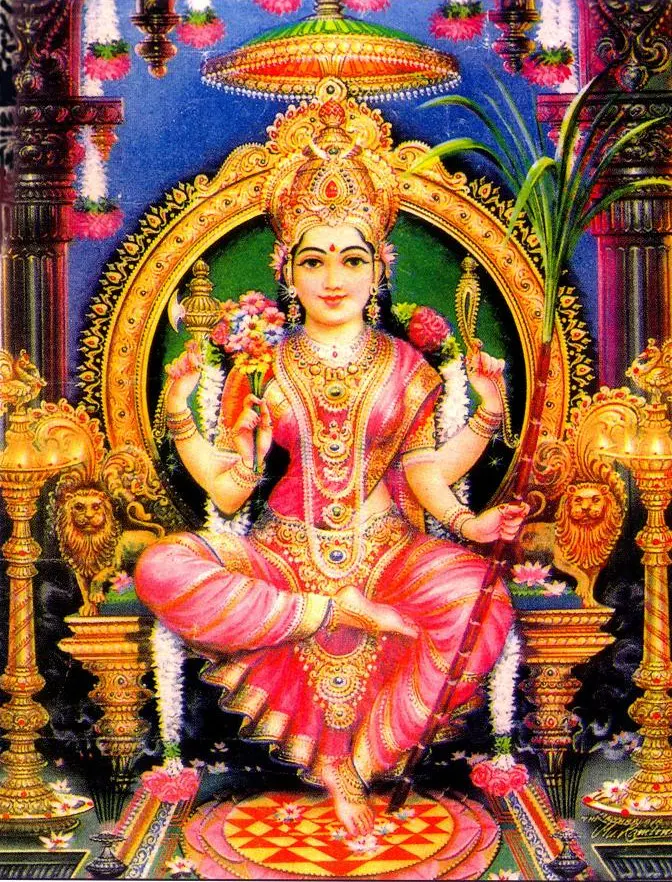
In the Sri Vidya tradition, she is revered as the Empress seated at the Bindu of the Sri Chakra, the point of Pure Consciousness.
Her appearance marks a shift in the spiritual journey.
Spirituality is no longer focused solely on destroying ignorance. Instead, the seeker begins to perceive the inherent harmony and beauty of existence.
Ma Tripura Sundari represents:
Balance of power and wisdom
Harmony in creation
The recognition of Divine order in the universe
Ma Tripura Sundari’s Connection with Navadurga, Devi Chandraghanta
On the third day of Navratri, the Navadurga worshipped is Devi Chandraghanta.
She represents:
Courage
Calm strength
Protection from negativity

Her bell-like aura is said to dispel negative forces while maintaining serenity.
This stage corresponds to Ma Tripura Sundari, who represents:
Harmony
Balance
Refined consciousness
The spiritual journey now moves from austerity toward the realisation that Existence itself is a Divine expression.
Ma Tripura Sundari’s Bij Mantra
The primary Bij mantra associated with Ma Tripura Sundari is:
श्रीं (Shreeng)
This mantra is discussed in several Tantric texts, including Tantrasara by Abhinavagupta.
A verse from Mantra Sangrah of Ma Tripura Sundari states:
श्रीं बीजं त्रिपुरायाः स्यात् सौभाग्यप्रदमुत्तमम् ।
Meaning:
“Śhrīng is the seed mantra of Tripura, the supreme giver of fortune and beauty.”
The sound Shreeng represents:
Divine beauty
Auspiciousness
Harmonious manifestation
Ma Tripura Sundari is also worshipped through the Panchadashi and Shodashi mantras, which form the core of Sri Vidya practice. 'Shreeng' is the Bij mantra of the Shodashi mantra.
Worship Ma Tripura Sundari This Chaitra Navratri
The third day of Chaitra Navratri represents the emergence of harmony in the spiritual journey.
After the purification of Ma Kali and the guidance of Ma Tara, the seeker begins to experience the balance and beauty represented by Ma Tripura Sundari.
She represents the realisation that spiritual awakening is not only about dissolving ignorance, but also about recognising the inherent harmony within creation.
Through disciplined practice during Navratri, the seeker gradually moves toward the complete awakening of Shakti.
This Chaitra Navratri, the Tantra Sadhana App by Himalayan monk, Om Swami, offers Shakti Sadhaks access to its Secret Shrine.
Each day of Navratri, the Shrine allows seekers to recite the Dhyan Shlok and Mool Bij Mantra of a Mahavidya. The Shloks and mantras, awakened and consecrated by Om Swami, make the worship potent, safe and in accordance with the scriptures.
Once your Chaitra Navratri Sadhana is done on 15 April 2027, you can also begin your worship of the Das Mahavidyas, awakening each Mahavidya with their Tantric Bij mantra and esoteric Sadhana, one at a time - starting from Ma Kali to Ma Kamalatmika.
The app is free and ad-free, with an entirely optional Dakshina.
The Chaitra Navratri of the Das Mahavidyas begins on Amavasya, 6 April 2027.
Enter the Secret Shrine to worship Ma Tripura Sundari with Her Dhyan Shlok and Panchadashi Mantra.
May the blessings of the Das Mahavidyas make this Chaitra Navratri a transformative period in your life.