Ma Kali and Ma Tara: Two Radiances of the One Supreme Mother
In this article, you will read about:
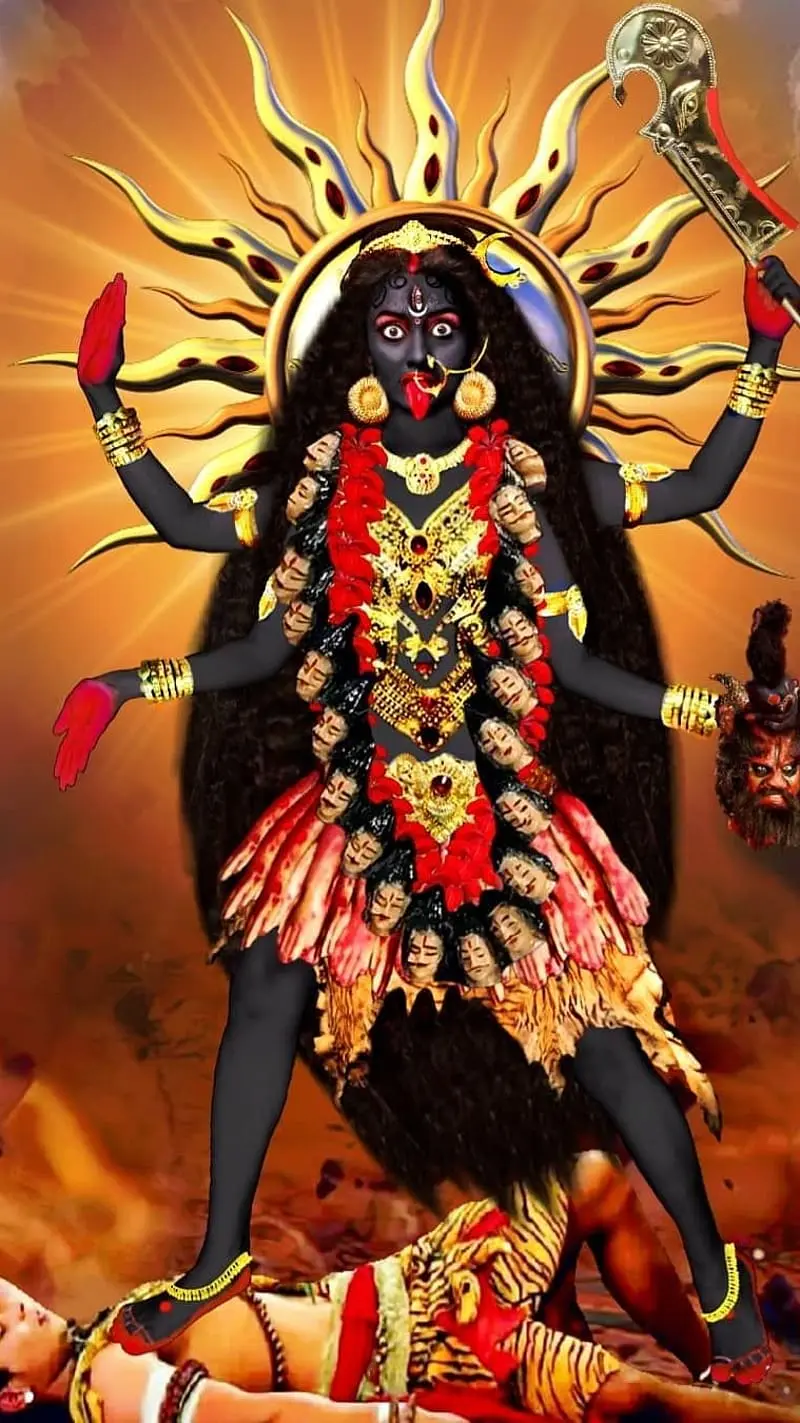
In the vast ocean of Shakti worship, few manifestations embody both terror and tenderness as profoundly as Ma Kali and Ma Tara.
Emerging from the secret currents of Tantra, they are not two beings but two faces of the same cosmic Mother, the first two Mahavidyas - one who devours ignorance and one who delivers liberation.
The Rudrayāmala Tantra hails Ma Tara as the “Saviour who ferries beings across the ocean of existence,” while the Kālī Tantra celebrates Ma Kali as “She who stands beyond Time itself.”
According to various Āgamic texts, the first revelation of the Daś Mahāvidyās occurred when Lord Shiv forbade Goddess Sati from attending the Daksha Yajna - a sacrificial ceremony to which both were not invited by Her father, Prajapati Daksh.
Overcome with Divine rage, Devi Sati manifested ten fierce and resplendent forms, the Mahāvidyās, surrounding Lord Shiv in all directions - Ma Kali, Ma Tara, Ma Tripura Sundari, Ma Bhuvaneshwari, Ma Bhairavi, Ma Chinnamasta, Ma Dhumavati, Ma Bagalamukhi, Ma Matangi and Ma Kamalatmika.
Each form represented an aspect of the Supreme Shakti - from wisdom to wrath, from compassion to annihilation.
Beyond this episode, the Purāṇas and Tantras offer other accounts too where Ma Kali and Ma Tara arise independently in moments of cosmic necessity, embodying the Mother’s active intervention in restoring balance.
Ma Kali: Nature and Manifestation
Ma Kali personifies the ultimate reality beyond all attributes, embodying the inseparable forces of creation and destruction that sustain transformation and enlightenment.
The Kālī Tantra describes Her as the boundless cosmic energy that manifests in a fierce and radiant form to dispel darkness and ignorance - an eternal source and dissolver of the universe, guiding beings toward spiritual awakening and liberation.
Her origin is detailed in the Devi Mahatmayam, when the Mother Goddess manifested to annihilate the Asuras Chand, Mund, and Raktabīj, Her wrath crystallized into a terrifying form - Ma Kali.
When Ma Durga once waged war against the Asuras, Chand and Mund, the brutal Generals of Asuras Shumbh and Nishumbh, could not be subdued by the gentler forms of the Goddess.
Their ferocity and sheer aggression required a manifestation of equal and overwhelming intensity.
Thus Ma invoked Her inner wrath, and from Her brow sprang Ma Kali, the embodiment of unrestrained cosmic power.
Clad in the hue of a storm cloud, with disheveled hair, bloodied tongue, and a garland of severed heads, She represented the primal power that consumes ignorance and ego to restore Dharma.
Her very presence shattered their arrogance, and She swiftly destroyed them, earning the epithet Chamunda.
However, the most formidable foe was yet to appear—Raktabīj, whose every drop of spilled blood generated another demon identical to him. No conventional divine form could annihilate such a being.
Only a deity who could consume the blood before it touched the earth—and do so with ferocious speed—could defeat him.
Ma Kali, with Her protruding tongue and endless hunger for Adharma, was uniquely capable of this task. As She roared across the battlefield, She drank every drop of Raktabīj’s blood, devouring his proliferating forms until the entire field was cleared of his presence.
She emerged as the Ultimate Purifier, the Devourer of the very seed of evil, restoring balance where no other divine energy could.
Just as Ma Kali arises in moments of cosmic crisis to devour overwhelming darkness, Ma Tara emerges in moments where the devotee — or even the gods themselves — require rescue, nourishment, and deliverance across insurmountable danger.
Ma Tara: Nature and Manifestation
Tara Ma’s origins are primarily rooted in the Rudrayāmala Tantra, the Tārātantra, Todala Tantra and the Tara Rahasya, where She is depicted as the one who ferries beings across the ocean of suffering (Saṃsāra), embodying the Mother’s grace in its most protective and salvific form.
One of the most widely referenced accounts that appears in Tantric scriptures is where Lord Shiv is overwhelmed by the poison Halahal during the churning of the ocean, and it is Ma Tara who appears, placing the Lord upon Her lap and breastfeeding Him the nectar that neutralises the poison.
In this narrative, Tara Ma does not arise from wrath but from compassion intense enough to rescue even Mahadev himself.
Her blue complexion, Her potence as Ugra-Tara, and Her role as the Supreme Saviour (Tāriṇī) all emerge from this foundation, positioning Her as the embodiment of Divine protection, guidance, and spiritual crossing-over.
Are Ma Kali and Ma Tara the same?
While Ma Kali and Ma Tara appear strikingly similar at first glance—both dark-complexioned, both standing upon the inert form of Lord Shiv, both bearing the sword and the skull-cup, both adorned with bone ornaments and seated in the cremation-ground—the Tantric scriptures remind us that their essences unfold differently when contemplated with subtle attention.
Both are described as having dark blue or black complexions.
Through these associations, the Tantras reveal that even while Ma Tara and Ma Kali appear strikingly similar in form, their inner essence harmonises with different cosmic movements: one dissolving all into the Absolute, the other ferrying all towards Liberation.
Both forms arise from the same transcendental Mother, acting as fierce protectors, compassionate guides, and liberating forces.
And like all forms of the Divine Feminine in Tantra, their worship is never based on iconography alone.
It unfolds through the sacred triad of Mantra, Yantra, and Tantra—the vibrational essence, the geometric body, and the ritual process through which Ma becomes present and active in the seeker’s life.
The Bij Mantras
In the Tōḍala Tantra, the Bīj mantra of Ma Kali is revealed as Krīm (pronounced Kreeng), a sound regarded as the very heart of Her transformative energy. Lord Shiv Himself explains its hierarchy of meaning:
The letter Ka signifies the all-encompassing Absolute, present in every limb and particle of creation.
Ra is the inner essence of the sun, the moon, and fire—radiant, self-luminous, and the source of cosmic bliss.
Ī is the subtle form of Kāma, the life-impulse and creative desire.
The Bindu is the giver of liberation, while the Nād that follows it bestows Mahāmoksha, the highest emancipation.
Thus Krīm (pronounced Kreeng) condenses within itself the totality of existence—the Absolute, its radiance, its creative impulse, and its liberating power.
In Tantric practice, it becomes both a shield and a sword, purifying the practitioner while awakening the grace of Ma Kali.
Strīṁ (pronounced Streeng) is revered as the Śabda-Brahma of Tara Ma - the sound-form through which Her rescuing grace flows. Traditional esoteric explanations state:
Śa embodies Maha-Karunā, the supreme compassion with which Tara liberates beings from suffering.
Tra (Ta + Ra) unites two forces: Ta, the firmness and unwavering steadiness of the Divine Saviouress (Tarini), and Ra, the inner fire of wisdom (Jnanagni) that dissolves impurities.
Ī signifies the gentle stream of Divine nectar, Ma Tara’s Amrit-like Grace that nourishes and protects.
The final Bindu (ṁ) represents the point where duality ends, marking the consummation of Ma Tara’s liberating power in Moksh itself.
According to Ekajata Tantra, the original Bīj mantra of Tara Ma was TrĪm, but it is said to have fallen under the curse (Shapat) of Sage Vashishtha.
Seeking to free the mantra from its impediment, he undertook intense Tara Sadhana (as per the Mahachin Kram), and through the act of Shapa-Vimochan, the fully liberated Bīj Strīṁ arose as the mantra through which Ma Tara’s compassionate power could once again flow unobstructed to the seeker.
The mantra is Her presence, Her protection, and Her path to liberation.
The Yantras
In Tantra, sound becomes form, and form becomes a gateway.
Just as the Bij mantras reveal the sonic essence of Ma Kali and Ma Tara, their Yantras embody the same forces in geometric form.
It is the visual body of the mantra, the diagram through which the seeker enters the living presence of the Goddess.
Ma Kali Yantra

According to the Tantric scriptures, the geometry of the Kali Yantra is a sacred mapping of the cosmos and the human being, revealing how the One Reality unfolds into manifestation.
The outer square (Bhupur) with its 36 corners represents the 36 Tattvas—the entire spectrum of creation, from the most subtle and transcendent principles down to the densest forms of material existence.
At the very heart of the Yantra lies the Bindu, the central point from which all emanates. This Bindu is the seat of the Ātman, the soul’s luminous core, and simultaneously the presence of Ma Kali Herself, the infinite matrix from which all phenomena arise.
In the Tantric understanding, Ma Kali as the dynamic Shakti remains eternally united with Shiv, the Silent Absolute, and from this union, creation flows outward.
Encircling the Bindu are 5 inverted concentric triangles, 2 circles, and an eight-petalled lotus, each layer carrying a profound metaphysical meaning.
The 5 inverted triangles signify the 5 Kośas or sheaths that veil the soul:
Annamayakośa: The Physical
Prāṇamayakośa: The Vital
Manomayakośa: the Mental-Emotional
Vijñānamayakośa: The Intuitive-Wisdom and
Ānandamayakośa: The Bliss
Their downward-pointing form symbolises the feminine regenerative power of Shakti.
The 15 corners formed by these triangles correspond to the 15 foundational principles of experience -
Jñānendriyas - The 5 Organs of Knowledge
Karmendriyas - The 5 Organs of Action and
Tanmātras - The 5 Subtle Essences of Sound, Touch, Form, Taste, and Smell
Surrounding these triangles are 2 circles, representing the ceaseless cycle of birth and death through which each soul journeys. The seeker must penetrate these circles by meditating upon the Bindu to transcend the repetitive cycle and realize the Absolute.
Enfolding the triangles are the 8 lotus petals, which symbolise Prakṛti, the creative matrix of the Universe. These 8 petals correspond to the 8 Tattvas that constitute manifest existence -
The 5 Elements - Earth, Water, Fire, Air, and Ether
The 3 Aspects of the Inner World (Antaḥkaraṇa) - Mind (Manas) and Intellect (Buddhi), and Ego-Sense (Ahaṁkāra).
Through this sacred geometry, the Yantra becomes a complete representation of the Universe, the individual, and the path back to the Supreme Mother.
Ma Tara Yantra

Ma Tārā Yantra embodies the Goddess as the liberating force who guides the seeker across the ocean of fear, bondage, and samsāra. Each element of the Yantra is a metaphysical symbol revealing a different aspect of Her saving grace.
The outer square, or Bhupur, represents the 4 cosmic directions—symbolic gateways through which the seeker enters the field of Ma Tara’s protection. These are known as the Doors of Space indicating that She pervades and guards all quarters of existence.
Within this square lie the lotus petals, the sacred seat (Pīṭh) of the Goddess. The lotus signifies purity amidst Samsaric turbulence, and here, it marks the unfolding of Ma Tara’s compassion (Mahā-Karuṇā), the quality by which She rescues beings from suffering.
Enclosed within the lotus is the circular Chakra, the symbol of infinite movement, indicating the ceaseless flow of cosmic energy (Śakti) that Ma Tara directs. This unbroken circle reflects Her role as the eternal guide through the cycles of birth, death, and rebirth.
At the heart of the Yantra lies the downward-facing triangle, the primordial Yoni - the seat of all creation and the gateway to spiritual birth. It signifies not only creation but also dissolution of obstacles, fear, and Karmic knots.
Finally, at the very centre rests the Bindu, the point from which all manifestation emerges and into which all dissolves. It represents the unmanifest potential of creation— Ma Tara Herself in Her absolute, Nirguṇa essence.
The Bindu is the soul, the spark of consciousness being guided, protected, and eventually liberated by Ma Tara.
Worshipping Ma Kali and Ma Tara on Tantra Sadhana App
While different Āgamic and Tantric scriptures prescribe highly specific methods of worship—many of which require Dīkṣā (initiation), the physical presence of a qualified Guru, and ritual ingredients that are neither easy to procure nor appropriate for an unsupervised practitioner—a more accessible yet scripturally harmonious discipline is now available for householders and aspirants.
The Tantra Sadhana App, which houses the awakened Tantric practices of the Das Mahavidyas, allows a seeker to worship the 10 forms of the Mother Goddess, beginning with Ma Kali and then, unlocking Ma Tara’s world.
All from the comfort of home.
Following the path of Divyachar or Divine Conduct, the app has consecrated, awakened mantras that follow scriptural mandates. The path of worship is Mansik or done through the mind alone, the highest form of worship.
The seeker is initiated into the Tantric Bij mantras of Ma Kali and Ma Tara, and Their Tantric fire offerings.
By chanting the mantras 1008 times and performing 11 fire offerings over 11 days, the seeker preparates for the main ritual or Sadhana - the 21-day Shav Sadhana of Ma Kali and 40-day Shmashan Sadhana of Ma Tara.
Through Tantric rituals, the seeker meditates upon death, impermanence, and the dissolution of the ego.
Ma Kali’s Shav Sadhana
The scriptures describe the seeker worshipping Ma Kali, seated upon a Shav (corpse), placing a lamp in its mouth, and offering mantras and visualised oblations for 21 days.
Symbolically, this represents transcending the fear of mortality and surrendering the illusory self completely at the feet of the Divine Mother.
Upon the completion of this period, the texts state that the seeker receives the grace and blessings of Ma Kali.
The app follows the same scriptural injunctions.
Ma Tara’s Shmashan Sadhana
In Ma Tara’s Shmashan Sadhana, the practitioner establishes themselves within a protective triangular Maṇḍala, the primordial Yoni-geometry that symbolises Ma Tara’s sheltering power.
The Maṇḍala is traditionally illuminated with lamps, each lit while reciting specific protective Mantras, symbolising the invocation of Ma’s guardianship in all three worlds.
As the ritual unfolds, various forces of nature may appear in symbolic or outer form. These are not merely animals but embodiments of inner obstacles and primal energies—fear, distraction, instinct, memory, and the elemental currents of the cremation-ground itself.
Yet, none of these cross the boundaries of the consecrated Mandala, for it represents the Goddess’s own protective field.
Held within Her refuge, the seeker continues their ritual with unwavering focus, gradually attuning to the fierce compassion of Ma Tara.
In both the Shav Sadhana and Shmashan Sadhana, the outward rituals are ultimately mirrors of an inner journey. The offerings symbolise surrender, the Mandalas symbolise protection, and the presence of Nature’s forces reflects the seeker’s own inner turbulence slowly coming under the Mother’s Grace.
Saints and Siddhas Who Worshipped Them
Across centuries, great saints, mystics, and adepts have walked these paths, invoking Ma Kali and Ma Tara with unmatched devotion and surrender.
Their lives stand as radiant testimonies to the transforming power of the Divine Mother, showing that these fierce goddesses do not merely preside over ancient rituals—they awaken, guide, and liberate those who approach Them with faith.
Those Who Worshipped Ma Kali
Ma Kali has been the chosen deity of many towering saints across the centuries, each of whom approached Her with a distinct blend of devotion, surrender, and tantric insight.
Foremost among them is Sri Ramakrishna Paramahamsa, the 19th-century mystic of Dakshineshwar, whose life stands as a luminous testament to Kali-Bhakti.
For him, Ma Kali was not merely a deity but the living, breathing Mother of the Universe, revealing Herself in mystical states of ecstasy and non-dual realisation.Long before Ramakrishna, the 18th-century poet-saint Ramprasad Sen transformed Bengali spirituality through his soul-stirring songs.
His poetry—simple and intimate—remains among the most powerful expressions of personal devotion to Ma Kali.Alongside him stands Kamalakanta Bhattacharya, another renowned Shakta poet whose verses echo profound longing and surrender within Ma Kali’s fierce form.
Equally influential was Krishnananda Agamavagisha (16th–17th century), one of Bengal’s foremost Tantric scholars.
As the author of works such as the Tantrasara, he systematised Bengal’s Tantric practice and helped establish Ma Kali’s worship as a foundational pillar of Shakta Sadhana.
Those Who Worshipped Ma Tara
Just as the luminous path of Ma Kali has drawn seekers of extraordinary depth, the grace of Ma Tara has called forth Her own lineage of mystics and adepts—those who approached the Divine Mother not in Her devouring aspect, but in Her guiding and liberating form.
Some of them are:
Sage Vashishtha – Considered one of the earliest sages to propitiate Tara Ma, as described in the Rudrayāmala Tantra and Ekajata Tantra, it is because of him that Ma Tara is often referred to as Vashishtharadhya.
Lord Buddha and the Mahasiddhas - In Vajrayāna traditions, Ma Tara is revered as a central deity.
She is said to have arisen from the tears of Avalokiteshvara and is worshipped by Siddhas such as Nagarjuna, Atisha, Dipankara, and Saraha, who invoked her as the Mother of swift liberation.Bamakhepa - He is perhaps the most renowned Tara Sadhak of the modern era. Living in the 19th–20th century, he performed intense Shmashan Sadhana at Tarapith, where Ma Tara is worshipped in Her most esoteric aspect.
His life is celebrated as a testament to Ma Tara’s boundless compassion and immediacy.
In the end, whether one approaches Her as Ma Kali or Ma Tara, the seeker stands before the same infinite Mother—sometimes fierce, sometimes tender, always compassionate.
Each path offers its own rhythm of surrender and strength, yet both lead toward the same stillness within.
Through Mantra, Yantra, and sincere devotion, the Mother meets the devotee exactly where they are, annihilating their tendencies and guiding them gently across the ocean of life toward freedom.
References:-
1. archive.org
3. archive.org
4. archive.org