In this article, you will read about:
When Was Navratri First Celebrated?
The Four Annual Navratris
Ma Bhairavi’s Connection With Navadurga, Devi Skandamata
Ma’s Bhairavi Bij Mantra
Worship Ma Bhairavi This Chaitra Navratri
Chaitra Navratri represents a structured progression of Shakti awakening through nine stages of spiritual transformation.
Each day corresponds to a specific form of the Divine Mother and a corresponding inner shift in the seeker’s consciousness.
Day 1 — Ma Kali: Dissolution of inertia and ego
Day 2 — Ma Tara: Guidance during transformation
Day 3 — Ma Tripura Sundari: Emergence of harmony and balance
Day 4 — Ma Bhuvaneshwari: Expansion of consciousness into cosmic space
Day 5 — Ma Bhairavi: Awakening of discipline and the fire of tapas
By the fifth day, the journey reaches a stage where spiritual effort becomes essential for further progress.
When Was Navratri First Celebrated?
The observance of Navratri is rooted in multiple layers of scriptural tradition, extending back to early Vedic sources.
Vedic References
The Samaveda Brahman mentions rituals conducted across nine nights, through which the devas attained Amrit (immortality).
This indicates that the concept of nine-night rituals existed in early Vedic tradition.
Historical accounts also describe long-duration Shakta Satra Yagnas, including one performed on the banks of the Mayavati River, which lasted 36 years and followed cycles tied to four annual Navratras.
Puranic Narratives
The Shrimad Devi Bhagavatam recounts that Lord Ram observed a nine-day Vrat dedicated to the Divine Mother before his victory over King Ravan on Vijay Dashmi.
Another important text associated with Navratri worship is the Durga Saptashati, which contains both devotional and Tantric elements.
Thus, Navratri is understood as an observance rooted in early Vedic-Shakta foundations.
The Four Annual Navratris
Navratri is observed four times each year, aligned with seasonal transitions.
Chaitra Navratri or Vasant Navratri — Spring cycle
Ashwin Navratri or Sharad Navratri — Autumn cycle
Ashadh Navratri — Gupt or Secret Navratri
Magh Navratri — Gupt or Secret Navratri
Seasonal transitions affect both physical and psychological states, and scriptures therefore prescribe increased discipline during these periods.
Texts such as the Devi Bhagavata Puran emphasise proper observance aligned with Tithi and Nakshatra.
Ma Bhairavi’s Connection With Navadurga, Devi Skandamata
Ma Bhairavi, the fifth Mahavidya, symbolises:
Tapas (spiritual austerity)
Disciplined practice
Transformation through inner fire
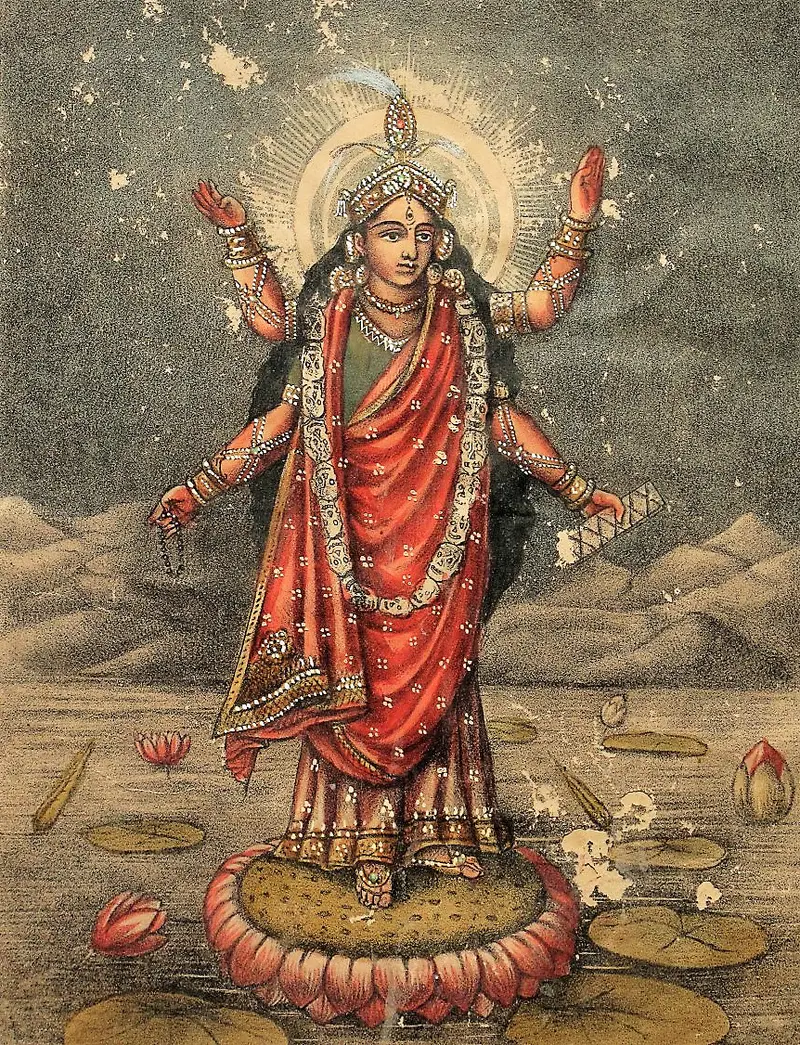
Her role in the Navratri journey is to:
Remove laziness and complacency
Purify the mind
Strengthen the resolve of the seeker
This stage represents the forge in which the seeker is refined.
On the fifth day of Navratri, the Navadurga worshipped is Devi Skandamata, the mother of Lord Skanda (Kartikeya).
She represents:
Maternal protection
Nurturing strength
Guidance toward victory
Together, both forms symbolise:
Protective maternal power
Discipline that prepares the seeker for spiritual challenges
Just as a mother prepares her child for life’s struggles, Ma Bhairavi prepares the seeker for deeper spiritual transformation.
Ma’s Bhairavi Bij Mantra
The primary Bij mantra of Ma Bhairavi is:
ह्रीं (Hrīng)
The Tantraraj Tantra states:
ह्रीं बीजं भैरव्याः शक्तेः परं तेजः प्रकीर्तितम् ।
Meaning:
Hrīng is the seed of Bhairavī, the supreme radiant power.
The sound Hreeng is associated with the transformative power of Shakti and appears in several Mahavidya traditions.
Worship Ma Bhairavi This Chaitra Navratri
Ma Bhairavi’s presence marks a stage where spiritual growth requires focused effort and sustained practice.
Tantric teachings preserved in the Kularnava Tantra emphasise that:
Spiritual attainment (siddhi) does not arise from emotion alone
It requires consistent discipline and austerity
Ma Bhairavi represents the inner fire that burns impurities and distractions.
Therefore, the fifth day of Chaitra Navratri represents the awakening of disciplined spiritual effort.
After experiencing purification, guidance, harmony, and expansion, the seeker encounters the transformative fire of Ma Bhairavi.
She represents the stage where Grace must be supported by effort, and where spiritual progress depends on sustained discipline.
This Chaitra Navratri, the Tantra Sadhana App by Himalayan monk, Om Swami, offers Shakti Sadhaks access to its Secret Shrine.
Each day of Navratri, the Shrine allows seekers to recite the Dhyan Shlok and Mool Bij Mantra of a Mahavidya. The Shloks and mantras, awakened and consecrated by Om Swami, make the worship potent, safe and in accordance with the scriptures.
Once your Chaitra Navratri Sadhana is done on 15 April 2027, you can also begin your worship of the Das Mahavidyas, awakening each Mahavidya with their Tantric Bij mantra and esoteric Sadhana, one at a time - starting from Ma Kali to Ma Kamalatmika.
The app is free and ad-free, with an entirely optional Dakshina.
The Chaitra Navratri of the Das Mahavidyas begins on Amavasya, 6 April 2027.
Enter the Secret Shrine to worship Ma Bhairavi with Her Dhyan Shlok and Mool Bij Mantra.
May the blessings of the Das Mahavidyas make this Chaitra Navratri a transformative period in your life.