In this article, you will read about:
Why Perform Navratri Worship At All?
The Core Principles of Tantra
The Symbolism of Ma Chinnamasta
Ma Chinnamasta’s Connection with Navadurga, Devi Katyayani
Worship Ma Chinnamasta This Chaitra Navratri
Chaitra Navratri represents a systematic awakening of Shakti through nine stages of inner transformation.
Each day corresponds to a particular form of the Divine Mother and reflects a shift in the seeker’s spiritual development.
Day 1 — Ma Kali: Dissolution of inertia and ego
Day 2 — Ma Tara: Guidance through transformation
Day 3 — Ma Tripura Sundari: Emergence of harmony and balance
Day 4 — Ma Bhuvaneshwari: Expansion of consciousness into cosmic space
Day 5 — Ma Bhairavi: Awakening of discipline and tapas
Day 6 — Ma Chinnamasta: Cutting through ego and awakening higher consciousness
By the sixth day, the spiritual process becomes deeply internal, focusing on transforming the ego and redirecting life energy.
Why Perform Navratri Worship At All?
Spiritual practices performed during Navratri are traditionally believed to bring deep inner transformation.
These practices aim to:
Purify the mind
Awaken dormant spiritual energy (Shakti)
Guide the seeker toward self-realisation
In Sanatan Dharm, self-realisation is considered the highest goal of human life, leading ultimately to Moksh, freedom from the cycle of birth and death.
The Core Principles of Tantra
Tantra is a spiritual tradition with many branches and approaches. Despite these variations, several principles are common to most Tantric teachings.
1. Tantra accepts all aspects of reality
Tantra emphasises non-rejection.
According to Tantric philosophy:
Everything in existence is an expression of Shakti.
Nothing lies outside Divine reality.
This includes both the pleasant and difficult aspects of life.
Tantric texts such as the Kularnava Tantra stress that genuine practice must be grounded in strong ethical discipline.
2. The Universe is a manifestation of Shakti
Tantra views the world as a tapestry of divine energy.
The word Tantra itself has several meanings:
Tan — expansion
Tra — liberation
Tantra — weaving or interconnected structure
Thus, Tantra describes the universe as an interconnected web of energies, all of which are expressions of the Divine Mother.
3. Spiritual energy is awakened within the human being
According to Tantric teachings:
Shiv represents consciousness
Shakti represents energy
Both principles exist within every human being.
When Creation occurs, Shakti emerges from Shiv through an outward movement called Unmesha, producing the Universe.
And by worshipping the Divine Mother on Navratri, the seeker aims to reunite Shiv-Shakti within themselves.
The power that drives both cosmic creation and human creativity is Shakti.
In Tantric understanding:
thought
emotion
action
inspiration
are all expressions of Shakti.
The masculine principle (Shiv) provides awareness and direction, while the feminine principle (Shakti) provides energy and movement.
True creative power arises when consciousness and energy function together.
The Symbolism of Ma Chinnamasta
Among the Das Mahavidyas, Ma Chinnamasta is one of the most striking forms.
She is depicted as a goddess who cuts off Her own head and drinks Her own blood while feeding Her attendants.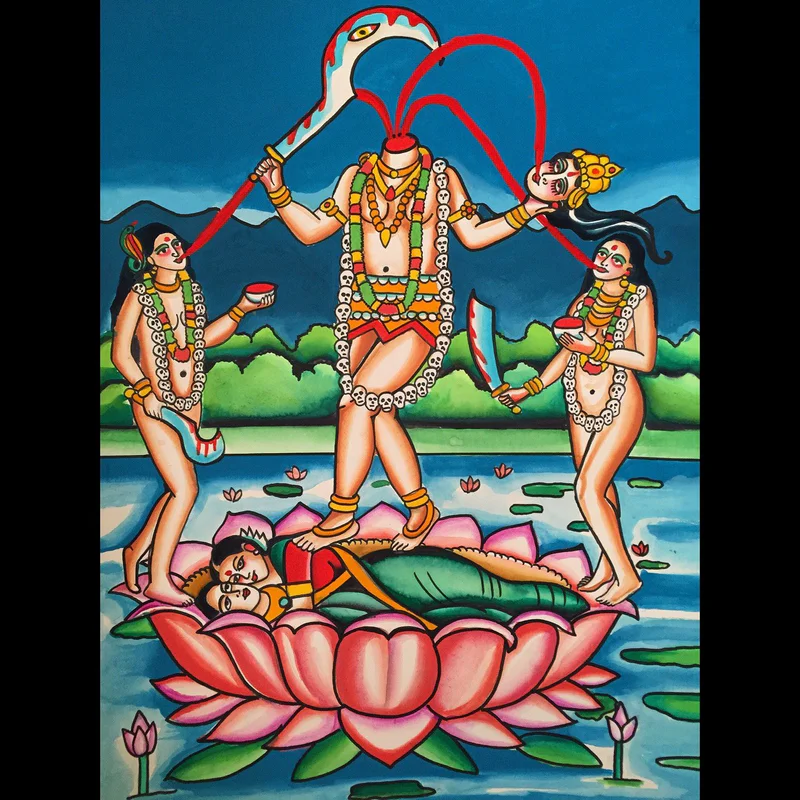
This imagery is symbolic rather than literal.
It represents:
Transcendence of the ego
Transformation of life energy
Awakening of higher consciousness
Commentaries on the Rudra Yamala Tantra interpret Ma Chinnamasta as the stage where the seeker turns completely inward.
She represents:
Self-sacrifice of the ego
Control of life force (prana)
Transcendence of duality
Her symbolism also expresses the insight that:
Prana or life energy
Sexuality
Death
Spiritual awakening
are interconnected aspects of the same cosmic force.
Ma Chinnamasta’s Connection with Navadurga, Devi Katyayani
On the sixth day of Navratri, the Navadurga worshipped is Devi Katyayani.
She is the fierce warrior Goddess invoked by the Gods to defeat the demon Mahishasur.
Mahishasur symbolically represents:
Ego
Uncontrolled desire
Ignorance
Devi Katyayani represents:
Divine courage
Righteous action
Destruction of negative forces
Tantric traditions connect this stage with Ma Chinnamasta, who symbolises the radical cutting of the ego.
Both forms emphasise that true transformation requires the fearless confrontation of ignorance.
Ma Chinnamasta’s Bij Mantra
The primary Bij mantra associated with Ma Chinnamasta is:
ह्रीं (Hrīng)
A verse from the Mantra Mahodadhi states:
ह्रीं बीजं छिन्नमस्तायाः सर्वसिद्धिप्रदायकम् ।
Meaning
Hrīng is the seed mantra of Chinnamasta that grants all Siddhis.
Hrīng represents the transformative power of Shakti.
Worship Ma Chinnamasta This Chaitra Navratri
The sixth day of Chaitra Navratri represents the cutting away of ego and the redirection of spiritual energy.
After purification, guidance, harmony, expansion, and disciplined effort, the seeker encounters the radical transformation represented by Ma Chinnamasta.
Her symbolism teaches that true spiritual awakening requires the transcendence of ego and the mastery of life energy, leading the seeker closer to the realisation of Shiv-Shakti.
This Chaitra Navratri, the Tantra Sadhana App by Himalayan monk, Om Swami, offers Shakti Sadhaks access to its Secret Shrine.
Each day of Navratri, the Shrine allows seekers to recite the Dhyan Shlok and Mool Bij Mantra of a Mahavidya. The Shloks and mantras, awakened and consecrated by Om Swami, make the worship potent, safe and in accordance with the scriptures.
Once your Chaitra Navratri Sadhana is done on 15 April 2027, you can also begin your worship of the Das Mahavidyas, awakening each Mahavidya with their Tantric Bij mantra and esoteric Sadhana, one at a time - starting from Ma Kali to Ma Kamalatmika.
The app is free and ad-free, with an entirely optional Dakshina.
The Chaitra Navratri of the Das Mahavidyas begins on Amavasya, 6 April 2027.
Enter the Secret Shrine to worship Ma Chinnamasta with Her Dhyan Shlok and Mool Bij Mantra.
May the blessings of the Das Mahavidyas make this Chaitra Navratri a transformative period in your life.