In this article, you will read about:
The Das Mahavidyas and Their Role in Spiritual Transformation
The Three Kalpas of Navratri Worship
Ma Dhumavati: The Wisdom of the Void
Ma Dhumavati’s Connection With Navadurga, Devi Kalaratri
Worship Ma Dhumavati This Chaitra Navratri
Chaitra Navratri represents a structured journey of Shakti awakening through nine stages of inner transformation. Each day corresponds to a specific expression of the Divine Mother and reflects a shift in the seeker’s spiritual awareness.
Day 1 — Ma Kali: Dissolution of inertia and ego
Day 2 — Ma Tara: Guidance during transformation
Day 3 — Ma Tripura Sundari: Emergence of harmony and balance
Day 4 — Ma Bhuvaneshwari: Expansion of consciousness into cosmic space
Day 5 — Ma Bhairavi: Awakening of discipline and tapas
Day 6 — Ma Chinnamasta: Cutting through ego and redirecting life energy
Day 7 — Ma Dhumavati: Realisation of impermanence and the wisdom of detachment
By the seventh day, the seeker encounters a deeper philosophical stage — recognising the temporary nature of worldly experience and turning inward toward spiritual truth.
The Das Mahavidyas and Their Role in Spiritual Transformation
Each form of the Das Mahavidyas, the 10 Wisdom Goddesses, represents a specific dimension of spiritual knowledge and transformation.
They guide the seeker through different stages of inner evolution, ultimately leading toward liberation.
The Das Mahavidyas
1. Ma Kali
Represents time, dissolution, and destruction of negativity. She is worshipped for protection, spiritual strength, and removal of obstacles.
2. Ma Tara
Represents guidance and rescue from difficulty. She grants strength to overcome crises and inner turmoil.
3. Ma Tripura Sundari (Shodashi/Lalita)
Represents beauty, harmony, and balance. She is associated with prosperity, relationships, and spiritual refinement.
4. Ma Bhuvaneshwari
Represents cosmic space and the creative matrix of the universe. Her worship is associated with prosperity and removal of planetary obstacles.
5. Ma Bhairavi
Represents discipline, austerity, and destruction of ignorance
6. Ma Chinnamasta
Represents self-sacrifice and transformation of life energy
7. Ma Dhumavati
Represents the cosmic void, detachment, and the understanding of impermanence
8. Ma Bagalamukhi
Represents victory over enemies and protection from negative forces
9. Ma Matangi
Represents knowledge, speech, music, creativity, and hidden wisdom
10. Ma Kamala
Represents wealth, prosperity, and spiritual abundance
The worship of the Mahavidyas is believed to grant both:
Bhog — fulfillment of worldly needs
Moksh — spiritual liberation
The Mahavidyas originate from Adya Shakti, the primordial Divine Mother. Together, they represent a complete journey of spiritual transformation — from the primal force of Kali to the fully manifested prosperity of Kamalatmika.
The Three Kalpas of Navratri Worship
Traditional texts describe different ritual frameworks to celebrate Navratri.
The Navratra Pradeep outlines three principal Kalpas (methodological systems) for the worship of Ma Durga.
1. Ugra Kalpa
Begins during Pitru Paksha Navami
Includes specific mantra invocations
Continues through nine days beginning on Shukla Pratipad
2. Bhadrakali Kalpa
Begins on Ashwin Krishna Chaturdashi
Invokes the sixteen-armed form of Bhadrakali
Ritual worship is performed from Saptami to Navami
Immersion occurs on Dashami
3. Katyayani Kalpa
Begins on Shukla Shashthi
Includes regional immersion traditions
Followed widely in several regional practices
Tantric practices in these Kalpas may include:
Mantra Jap
Yagna
Worship of the Das Mahavidyas
Internal meditation practices
Among all practices, Mantra Jap remains the central discipline of Navratri worship.
Ma Dhumavati: The Wisdom of the Void
On the seventh day of Navratri (Shukla Shashthi), the Divine Mother appears as Ma Dhumavati.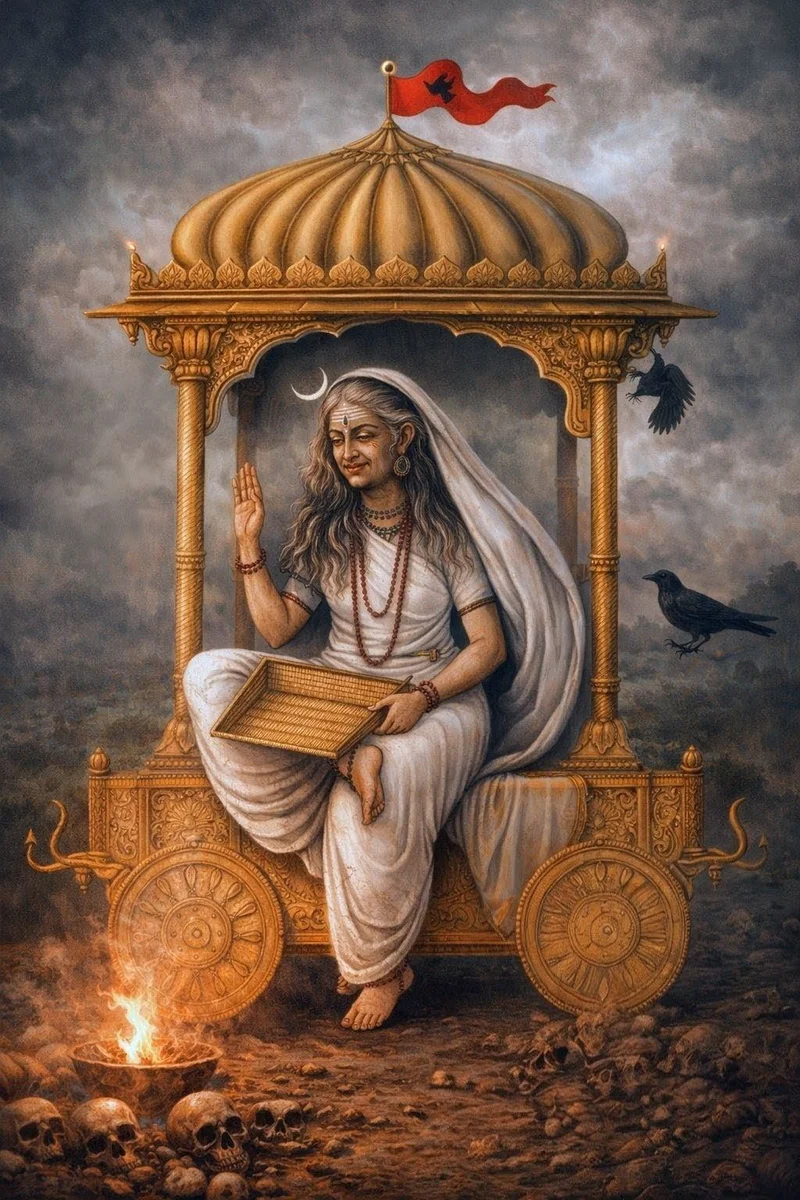
She represents:
The cosmic void
Detachment from illusion
The recognition of impermanence
Ma Dhumavati is often misunderstood due to Her austere symbolism. However, in Kaula traditions, She is revered as the teacher of Vairagya (detachment).
Her teachings emphasise a fundamental spiritual truth:
All worldly experiences are temporary
The seeker must ultimately walk the spiritual path alone
True stability lies only in the Divine
The Todala Tantra speaks of Ma Dhumavati as the Mahavidya who reveals the reality many seekers avoid — the transient nature of the world.
Ma Dhumavati’s Connection With Navadurga, Devi Kalaratri
On the seventh day of Navratri, the Navadurga worshipped is Devi Kalaratri.
She represents:
Destruction of darkness and fear
Dissolution of illusion
Protection from negative forces
Her fierce form represents the night of spiritual transformation, where ignorance collapses.
This stage closely resonates with Ma Dhumavati, whose symbolism represents:
Emptiness
Detachment
The collapse of worldly illusions
Although their imagery appears intense, both forms reveal an important spiritual insight:
Wisdom often arises through experiences of loss, dissolution, and the recognition that worldly attachments are temporary.
Ma Dhumavati’s Bij Mantra
The primary Bij Mantra associated with Ma Dhumavati is:
धूं (Dhūṃ)
A verse from Mantra Mahodadhi states:
धूं बीजं धूमवत्यास्तु सर्वविघ्नविनाशनम् ।
Meaning:
“Dhūṃ is the seed mantra of Dhumavati, the destroyer of all obstacles.”
The sound Dhūṃ represents the dissolving force that removes obstacles and clears the path for deeper spiritual understanding.
Worship Ma Dhumavati This Chaitra Navratri
The seventh day of Chaitra Navratri represents a profound stage in the spiritual journey.
After experiencing purification, guidance, harmony, expansion, discipline, and ego-transformation, the seeker encounters the deeper wisdom represented by Ma Dhumavati.
Her teachings emphasise:
Detachment from illusion
Recognition of impermanence
Turning inward toward the eternal truth
Through Her grace, the seeker begins to understand that true freedom arises not from worldly gain but from inner realisation.
This Chaitra Navratri, the Tantra Sadhana App by Himalayan monk, Om Swami, offers Shakti Sadhaks access to its Secret Shrine.
Each day of Navratri, the Shrine allows seekers to recite the Dhyan Shlok and Mool Bij Mantra of a Mahavidya. The Shloks and mantras, awakened and consecrated by Om Swami, make the worship potent, safe and in accordance with the scriptures.
Once your Chaitra Navratri Sadhana is done on 15 April 2027, you can also begin your worship of the Das Mahavidyas, awakening each Mahavidya with their Tantric Bij mantra and esoteric Sadhana, one at a time - starting from Ma Kali to Ma Kamalatmika.
The app is free and ad-free, with an entirely optional Dakshina.
The Chaitra Navratri of the Das Mahavidyas begins on Amavasya, 6 April 2027.
Enter the Secret Shrine to worship Ma Dhumavati with Her Dhyan Shlok and Mool Bij Mantra.
May the blessings of the Das Mahavidyas make this Chaitra Navratri a transformative period in your life.