In this article, you will read about:
Kanya Pujan and Living Worship of the Divine Mother
Advanced Observances During Navratri
Sages Who Practised Navratri Sadhana: Both Tantric and Vedic Traditions
Ma Bagalamukhi: The Power to Still All Forces
Worship Ma Bagalamukhi This Chaitra Navratri
Chaitra Navratri represents a structured journey of Shakti awakening through nine stages of inner transformation. Each day corresponds to a specific form of the Divine Mother and reflects a shift in the seeker’s spiritual awareness.
Day 1 — Ma Kali: Dissolution of inertia and ego
Day 2 — Ma Tara: Guidance during transformation
Day 3 — Ma Tripura Sundari: Emergence of harmony and balance
Day 4 — Ma Bhuvaneshwari: Expansion of consciousness into cosmic space
Day 5 — Ma Bhairavi: Awakening of discipline and tapas
Day 6 — Ma Chinnamasta: Cutting through ego and redirecting life energy
Day 7 — Ma Dhumavati: Realisation of impermanence and detachment
Day 8 — Ma Bagalamukhi: Mastery over speech, thought, and action
By the eighth day, the seeker reaches a stage where awakened energy must be stabilised and directed with awareness.
Kanya Pujan and Living Worship of the Divine Mother
One of the important observances during Navratri is Kanya Pujan, which honours the Goddess in the form of young girls.
In Śākta Tantric traditions, the Kumari (young girl) is regarded as a living embodiment of Chaitanya Shakti — the conscious power of the Divine Mother.
Traditional Practice
Girls aged 1 to 11 years are worshipped as different manifestations of Devi.
Each age represents a particular aspect of Shakti.
Offerings are made to the girls in the form of:
Food
Clothes
Dakshina (monetary offerings)
During the ceremony, a young boy is also worshipped as Batuk Bhairav, representing the protective Masculine Principle accompanying the Goddess.
The core principle behind this practice is the worship of Bāla-rūpā Devi — the Divine Mother in child form.
The Scriptural Basis of Kumari Worship
The Devi Bhagavata Purana (Skandha 7) explicitly prescribes Kumari Pujan during Navratri.
Verse:
कुमार्यः पूजयेद् भक्त्या नवमीदिने विशेषतः ।
ब्राह्मणांश्च विशेषेण तुष्टिं यान्ति सुरेश्वरि ॥Meaning:
One should worship the virgin girls with devotion, especially on Navami. By this worship, O Goddess, the Devas become pleased.
Another passage states:
अथ नवरात्र व्रते कुमार्यः पूजयेद् भक्त्या नवम्याम्।
Meaning:
During the Navratri vow, one should worship the Kanyas with devotion, particularly on Navami.
The Durga Saptashati also emphasises the Divinity of feminine forms:
स्त्रियः समस्ताः सकला जगत्सु ॥
Meaning:
All women in the world are manifestations of the Divine Mother.
Advanced Observances During Navratri
In traditional Shakta and Tantric practice, several advanced observances are performed.
Ritual Practices
Kumari Nyasa (sometimes involving 18 Kumaris)
Worship of Nava Devis
Invocation of attendant energies of the Goddess
Advanced Sadhana Practices
Prahar-based worship across eight daily segments
Night-focused Mantra Jap
Extended Navratri Vrat observed across 60 cycles
In Tantric tradition, Mahavidya worship begins with Ma Kali on Amavasya and continues through the nine nights of Navratri, culminating with Ma Kamalatmika on Navami.
Sages Who Practised Navratri Sadhana: Both Tantric and Vedic Traditions
Lord Ram
Performed Devi worship before the battle with King Ravan, according to the Devi Bhagavat Puran.
According to the text, Sage Narad instructed Lord Ram in the methods of Devi worship and Lord Ram observed a nine-day Sadhana of fasting, Mantra Jap and Yagna.
On the eighth night, the Goddess appeared to bless Him, declaring that He had been born to restore Dharm.
A verse from Lalita Trishati includes the phrase:
Lakshmanagraja Poojita |
Meaning:
One who is worshipped by the elder brother of Lakshman
The Brahmand Puran further mentions that the presiding deity of Ayodhya was Maha Tripura Sundari.
Rishi Vishwamitra
Performed intense Mahavidya Sadhana during Navratri and attained immense spiritual power.Rishi Vashisht
Associated with the first Tantric worship of Ma Tara, and is particularly linked to the Tarapith tradition.Rishi Bharadvaj
Whose lineage contributed significantly to ritual traditions involving Yagna, Mantra Jap, and seasonal rites that later influenced Navratri worship.Shukracharya
Advised Meghnad (son of King Ravan) to perform powerful Tantric rituals and gain invincibilityKingRavan and Meghnad
Advanced practitioners of esoteric Shakti rituals who sought mastery over the energies of the Das Mahavidyas
Ma Bagalamukhi: The Power to Still All Forces
On the eighth night of Navratri, the Divine Mother manifests as Ma Bagalamukhi.
She represents the power known in Tantra as Stambhan Shakti — the ability to paralyse or neutralise hostile forces.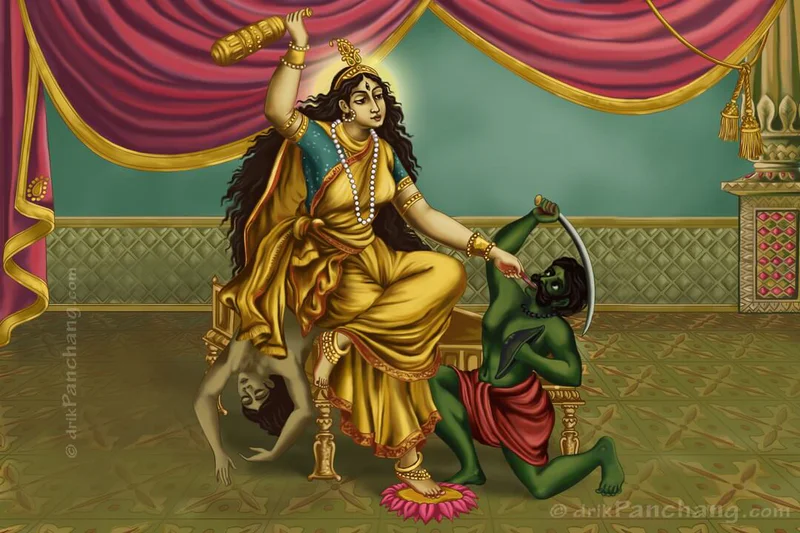
Her symbolism represents:
Control over speech
Control over thoughts
Control over actions
Many traditions consider this one of the most powerful nights of Navratri Sadhana.
At this stage, the seeker’s awakened consciousness gains the ability to stabilise and direct inner energies.
Ma Bagalamukhi’s Connection With Navadurga, Devi Mahagauri
On the eighth day of Navratri, the Navadurga worshipped is Devi Mahagauri.
She represents:
Purity
Removal of karmic impurities
Spiritual clarity

Her white complexion symbolises purified consciousness.
This stage corresponds to Ma Bagalamukhi, who grants control over the forces of mind and speech once purification has occurred.
Both forms represent the stabilisation of awakened spiritual power.
Ma Bagalamukhi’s Bij Mantra
The primary Bij Mantra associated with Ma Bagalamukhi is:
ह्लीं (Hlīng)
A Bagalamukhi Tantra verse states:
ह्लीं बीजं बगलामुख्याः स्तम्भनस्य परं स्मृतम् ।
Meaning:
Hlīng is the seed mantra of Bagalamukhi, representing the supreme power of stambhana — the ability to arrest or neutralise negativity.
The sound Hleeng represents the power that stills harmful forces and stabilises awakened energy.
Worship Ma Bagalamukhi This Chaitra Navratri
The eighth day of Chaitra Navratri marks a stage where spiritual energy becomes steady and controlled.
After purification, guidance, harmony, expansion, discipline, ego-transformation, and detachment, the seeker reaches the stabilising power of Ma Bagalamukhi.
Her teachings emphasise:
Mastery over speech
Control over thoughts
The ability to neutralise negativity
Through Her Grace, the seeker begins to stabilise awakened consciousness and prepare for the final stages of the Navratri journey.
This Chaitra Navratri, the Tantra Sadhana App by Himalayan monk, Om Swami, offers Shakti Sadhaks access to its Secret Shrine.
Each day of Navratri, the Shrine allows seekers to recite the Dhyan Shlok and Mool Bij Mantra of a Mahavidya. The Shloks and mantras, awakened and consecrated by Om Swami, make the worship potent, safe and in accordance with the scriptures.
Once your Chaitra Navratri Sadhana is done on 15 April 2027, you can also begin your worship of the Das Mahavidyas, awakening each Mahavidya with their Tantric Bij mantra and esoteric Sadhana, one at a time - starting from Ma Kali to Ma Kamalatmika.
The app is free and ad-free, with an entirely optional Dakshina.
The Chaitra Navratri of the Das Mahavidyas begins on Amavasya, 6 April 2027.
Enter the Secret Shrine to worship Ma Bagalamukhi with Her Dhyan Shlok and Mool Bij Mantra.
May the blessings of the Das Mahavidyas make this Chaitra Navratri a transformative period in your life.