In this article, you will read about:
The Lineage of Navratri Worship in Tantric Tradition
Navratri in the Kaula and Nath Traditions
Ma Matangi: The Refinement of Divine Expression
Ma Matangi’s Connection With Navadurga, Devi Siddhidatri
Worship Ma Matangi This Chaitra Navratri
Chaitra Navratri represents a structured journey of Shakti awakening through nine stages of inner transformation. Each day corresponds to a specific form of the Divine Mother and reflects a shift in the seeker’s spiritual awareness.
Day 1 — Ma Kali: Dissolution of inertia and ego
Day 2 — Ma Tara: Guidance during transformation
Day 3 — Ma Tripura Sundari: Emergence of harmony and balance
Day 4 — Ma Bhuvaneshwari: Expansion of consciousness into cosmic space
Day 5 — Ma Bhairavi: Awakening of discipline and tapas
Day 6 — Ma Chinnamasta: Cutting through ego and redirecting life energy
Day 7 — Ma Dhumavati: Realisation of impermanence and detachment
Day 8 — Ma Bagalamukhi: Mastery over speech, thought, and action
Day 9 — Ma Matangi: Refinement of wisdom, speech, and sacred knowledge
By the ninth day, the seeker reaches a stage where the awakened energy becomes refined and expressed through clarity of knowledge, speech, and inner awareness.
The Lineage of Navratri Worship in Tantric Tradition
Navratri worship has deep roots in both Tantric and Puranic traditions. Several sages and traditions preserved and transmitted structured forms of Devi worship.
Sage Durvasa and the Sri Vidya Tradition
Sage Durvasa is considered one of the earliest transmitters of Sri Vidya, the Tantric worship of Lalita Tripura Sundari.
Traditional accounts state that he:
Received the knowledge of Lalita Upasana
Propagated Sri Chakra worship
Taught structured cycles of Devi sadhana
Many Sri Vidya Tantric Paddhatis prescribe intensified Devi worship during Navratri following the Durvasa Krama, making him one of the strongest traditional links to Tantric Navratri practice.
Sage Agastya and the Lalitopakhyana Tradition
The Brahmand Puran, in the Lalitopakhyana dialogue, describes Sage Agastya receiving the secret teachings of Lalita worship.
In this dialogue:
Lord Hayagriva instructs Agastya in the glory of Sri Vidya
The methods of Devi Upasana and mantra practices are explained
Many Navratri ritual traditions symbolically trace their lineage to this Agastya–Hayagriva transmission.
Agastya is therefore regarded as a key figure in:
Mantra Shastra traditions
Devi worship methodologies
Southern streams of Sri Vidya Tantra
Sage Matanga and the Origin of Matangi Worship
According to Purashcharya Arnava and Tantrasara, Sage Matanga Rishi performed intense tapas dedicated to the Divine Mother and obtained the grace of Devi Matangi.
While texts do not explicitly state that he performed Navratri rituals, his worship included:
Devi Sadhana
Mantra Purashcharan cycles
Mahavidya worship
Navratri in the Kaula and Nath Traditions
The Kaula Tantric tradition and the Nath Sampradaya also emphasise Navratri night practices.
One of the earliest masters associated with these traditions is Matsyendranath.
These traditions highlight:
Night-focused Shakti worship
Cycles of Mahavidya Sadhana
Internal spiritual practices performed during Navratri
Navratri is therefore regarded as a particularly powerful period for Tantric spiritual practice.
The Kalika Puran also describes the concept of Akal Bodhana, the untimely awakening of the Goddess.
A verse states:
ऐं रावणस्य वधार्थाय रामस्यानुग्रहाय च ।
अकाले ब्रह्मणा बोधो देव्यास्त्वयि कृतः पुरा ॥Meaning:
O Goddess, you were awakened by Brahma at an untimely hour to grant grace to Rama for the destruction of Ravana.
This narrative forms an important basis for many Navratri traditions observed today.
Ma Matangi: The Refinement of Divine Expression
On the ninth day of Navratri, the Divine Mother manifests as Ma Matangi.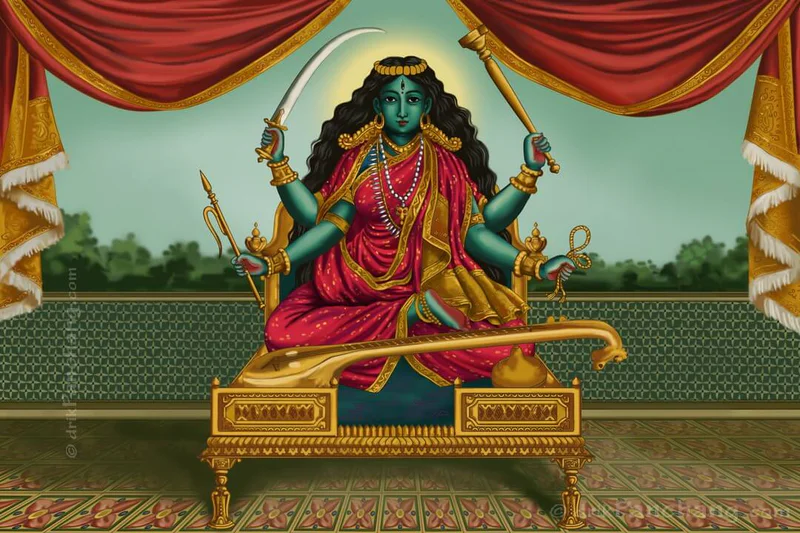
She represents:
Inner speech
Sacred knowledge
Perfection of mantra and sound
Tantric texts often describe her as the Tantric Ma Sarasvati.
At this stage of the spiritual journey:
The seeker is no longer struggling with purification
The mind becomes refined and stable
Spiritual practice becomes inward and effortless
Ma Matangi governs the subtle power of vibration and expression, which arises once the mind has been purified.
Ma Matangi’s Connection With Navadurga, Devi Siddhidatri
The final Navadurga worshipped on Navratri is Devi Siddhidatri.
She represents:
Spiritual accomplishment (Siddhi)
Fulfilment of the spiritual journey
Realisation of Divine wisdom
Her energy aligns with Ma Matangi, who governs refined knowledge and sacred speech.
Together they represent:
The flowering of divine knowledge
Mastery of mantra
Completion of the spiritual journey
Ma Matangi’s Bij Mantra
The primary Bij Mantra associated with Ma Matangi is:
ऐं (Aiṃ)
A verse from Mantra Mahodadhi states:
ऐं बीजं मातङ्ग्याः सर्वविद्याप्रदायकम् ।
Meaning:
Aiṃ is the seed mantra of Matangi, the bestower of all knowledge.
The sound Aing represents the awakening of higher intelligence, refined speech, and spiritual wisdom.
Worship Ma Matangi This Chaitra Navratri
The ninth day of Chaitra Navratri marks the stage where spiritual knowledge becomes fully refined.
After the stages of purification, guidance, harmony, expansion, discipline, ego-transformation, detachment, and stabilisation, the seeker reaches the refined wisdom of Ma Matangi.
Her teachings emphasise:
Mastery of speech and mantra
Refinement of knowledge
Expression of divine wisdom
Through Her Grace, the seeker approaches the culmination of the Navratri journey — the realisation of divine knowledge and spiritual accomplishment.
This Chaitra Navratri, the Tantra Sadhana App by Himalayan monk, Om Swami, offers Shakti Sadhaks access to its Secret Shrine.
Each day of Navratri, the Shrine allows seekers to recite the Dhyan Shlok and Mool Bij Mantra of a Mahavidya. The Shloks and mantras, awakened and consecrated by Om Swami, make the worship potent, safe and in accordance with the scriptures.
Once your Chaitra Navratri Sadhana is done on 15 April 2027, you can also begin your worship of the Das Mahavidyas, awakening each Mahavidya with their Tantric Bij mantra and esoteric Sadhana, one at a time - starting from Ma Kali to Ma Kamalatmika.
The app is free and ad-free, with an entirely optional Dakshina.
The Chaitra Navratri of the Das Mahavidyas begins on Amavasya, 6 April 2027.
Enter the Secret Shrine to worship Ma Matangi with Her Dhyan Shlok and Mool Bij Mantra.
May the blessings of the Das Mahavidyas make this Chaitra Navratri a transformative period in your life.